Two LCA FOC Twin-Seaters and three HTT-40 trainers delivered to IAF; four Dhruv NG helicopters handed over to Pawan Hans as Rajnath Singh calls for stronger public-private partnership
Bengaluru, September 18, 2026:
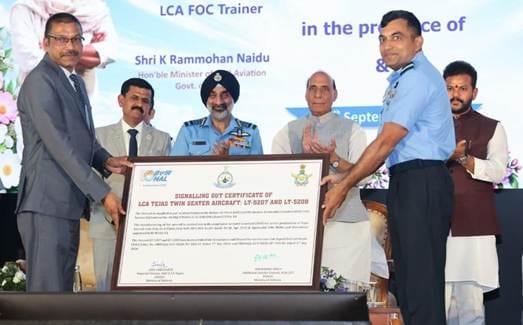
Hindustan Aeronautics Limited (HAL) handed over two LCA Tejas Final Operational Clearance (FOC) Twin-Seater Trainers and three HTT-40 Basic Trainer Aircraft to the Indian Air Force, along with four Dhruv Next Generation (NG) helicopters to Pawan Hans Limited (PHL), in Bengaluru on Friday.
The handover ceremony was attended by Defence Minister Rajnath Singh and Civil Aviation Minister K. Rammohan Naidu, along with senior officials from the Ministry of Defence, Ministry of Civil Aviation, Indian Air Force and HAL.
The Ministry of Defence described the event as an important milestone in the development of India’s indigenous aerospace ecosystem.
Tejas, HTT-40 and Dhruv NG Showcase Expanding Indigenous Capability
The three platforms handed over during the ceremony represent different segments of India’s aerospace requirements.
The LCA Tejas Twin-Seater Trainer is intended to support IAF pilot training while retaining the core systems and combat capabilities of the frontline aircraft. The two aircraft delivered on September 18 are the final two aircraft under the FOC Twin-Seater contract, according to the Ministry of Defence.
The HTT-40, meanwhile, is an indigenously designed and developed basic trainer aircraft intended for the primary training requirements of the armed forces.
The four Dhruv NG helicopters handed over to Pawan Hans represent HAL’s move into the civil and commercial rotary-wing segment. The civil configuration incorporates modern avionics and enhanced systems and is intended for roles including passenger transport, emergency medical services and offshore logistics support.
Rajnath Singh Calls for Integrated Aerospace Ecosystem
Addressing the gathering, Rajnath Singh said indigenous aerospace capability was essential for achieving self-reliance and global competitiveness.
He said India needed to build capabilities across the complete aerospace value chain rather than focus only on individual platforms.
According to Singh, capabilities in areas such as aircraft design, avionics, propulsion, composite materials, flight-control systems, manufacturing and certification can contribute to both civil and military aviation.
He also emphasised that aerospace development is a gradual process involving numerous technologies, components and industrial capabilities.
Singh called for continued efforts to strengthen the domestic ecosystem while recognising that technological development in aerospace involves complex and long-term programmes.
Defence and Civil Aviation Sectors Seen as Complementary
The ceremony also highlighted the increasing overlap between India’s military and civil aerospace capabilities.
Singh said that the development of aircraft, engines, avionics, materials and other aerospace technologies should create benefits across both sectors.
The presence of the Civil Aviation Minister alongside the Defence Minister reflected this broader approach, with HAL supplying platforms for both defence and civil applications.
Civil Aviation Minister K. Rammohan Naidu said the certification and induction of the Dhruv NG into civil operations represented an important development for India’s indigenous civil aviation ecosystem.
He linked the programme to the growing ability of Indian industry to develop and support advanced aerospace platforms for commercial applications.
Tejas Twin-Seater to Support Fighter Pilot Training
The LCA Twin-Seater Trainer is designed to provide an indigenous training pathway for pilots progressing towards frontline fighter operations.
According to the Ministry of Defence, the aircraft retains the core systems and combat capability of the Tejas platform, allowing pilots to train on an aircraft closely aligned with the type they will eventually operate in frontline service.
The latest handover completes the two remaining aircraft under the FOC Twin-Seater contract.
The Tejas programme has therefore expanded beyond the single-seat combat configuration to include a dedicated training variant that supports the IAF’s pilot-training requirements.
HTT-40 Strengthens Basic Training Capability
The Hindustan Turbo Trainer-40, or HTT-40, is designed to perform the basic training role for military pilots.
The aircraft features a modern cockpit and avionics suite and is designed for training activities including aerobatics, general handling, instrument flying, navigation, night flying and close formation flying.
The Defence Ministry has previously said that the HTT-40 programme is intended to reduce dependence on imported aircraft for basic training requirements.
In 2023, the Ministry of Defence signed a contract with HAL for 70 HTT-40 aircraft for the IAF, valued at ₹6,828.36 crore, with deliveries planned over six years. An earlier PIB release stated that the aircraft had approximately 56% indigenous content at that stage, with the share expected to rise through further indigenisation.
The platform is also part of HAL’s broader portfolio of indigenous aircraft programmes, alongside the LCA, helicopters and other aerospace systems. HAL identifies HTT-40 as one of its major ongoing indigenous development programmes.
Dhruv NG Expands Civil Helicopter Portfolio
The Dhruv NG handover marked another development in HAL’s civil aviation ambitions.
The helicopter is being positioned for civil applications, including passenger transport, emergency medical services and offshore logistics.
According to the Ministry of Defence, the civil version incorporates enhanced systems, modern avionics and a more powerful engine.
The programme gives HAL an opportunity to expand the use of an indigenous helicopter platform beyond traditional military customers and into commercial and government-operated civil services.
Rajnath Singh Seeks Greater Public-Private Partnership
A major theme of Singh’s address was the need for greater cooperation between the public and private sectors.
He argued that public-sector defence companies and private industry should be viewed as collaborators rather than competitors in building next-generation aerospace capabilities.
The Defence Minister called for cooperation in emerging areas such as Artificial Intelligence, autonomous systems, unmanned aerial systems, electronic warfare, cyber technologies and next-generation propulsion.
He also urged HAL to expand across the aerospace value chain, covering design, development, manufacturing, certification, lifecycle support and global marketing.
Focus on R&D and Future Technologies
Singh also stressed the importance of research and development, calling on scientists, engineers, designers, test pilots and technicians to work on technologies that could shape the next decade of aerospace development.
He specifically highlighted the need for India to develop advanced technologies domestically rather than remain dependent on external sources for critical capabilities.
The Defence Minister also called for realistic timelines for technical projects, pointing out that delays can create capability gaps, increase costs and raise the risk of technologies becoming obsolete before they enter service.
A Broader Aerospace Ecosystem
HAL’s latest handover brings together three platforms serving distinct roles: the Tejas Twin-Seater for advanced fighter training, the HTT-40 for basic pilot training and the Dhruv NG for civil helicopter operations.
Together, the programmes illustrate the breadth of India’s indigenous aerospace manufacturing effort, spanning military aviation, pilot training and civil rotary-wing operations.
The event also brought together the defence and civil aviation establishments, highlighting the potential for common technologies, industrial capabilities and supply chains to support both sectors.
Key Takeaways
- 2 LCA Tejas FOC Twin-Seater Trainers handed over to the IAF.
- 3 HTT-40 Basic Trainer Aircraft delivered to the IAF.
- 4 Dhruv NG helicopters handed over to Pawan Hans.
- Tejas twin-seaters are the final two aircraft under the FOC Twin-Seater contract.
- HTT-40 is designed for basic military pilot training.
- Dhruv NG is being positioned for civil and commercial helicopter operations.
- Rajnath Singh called for stronger public-private aerospace cooperation.
- Emerging priorities include AI, autonomous systems, unmanned aviation, electronic warfare, cyber technologies and next-generation propulsion.
- The government is seeking greater integration between India’s civil and military aerospace ecosystems.
The Bengaluru ceremony therefore marked more than the delivery of individual aircraft and helicopters. It brought together India’s fighter-training, basic-flight-training and civil-helicopter programmes while highlighting the broader effort to expand domestic design, manufacturing, certification and technological capabilities across the aerospace sector.