Defence Minister says India is a “First Responder” and “Preferred Security Partner” in the Indian Ocean; 18 warships planned for induction in 2026
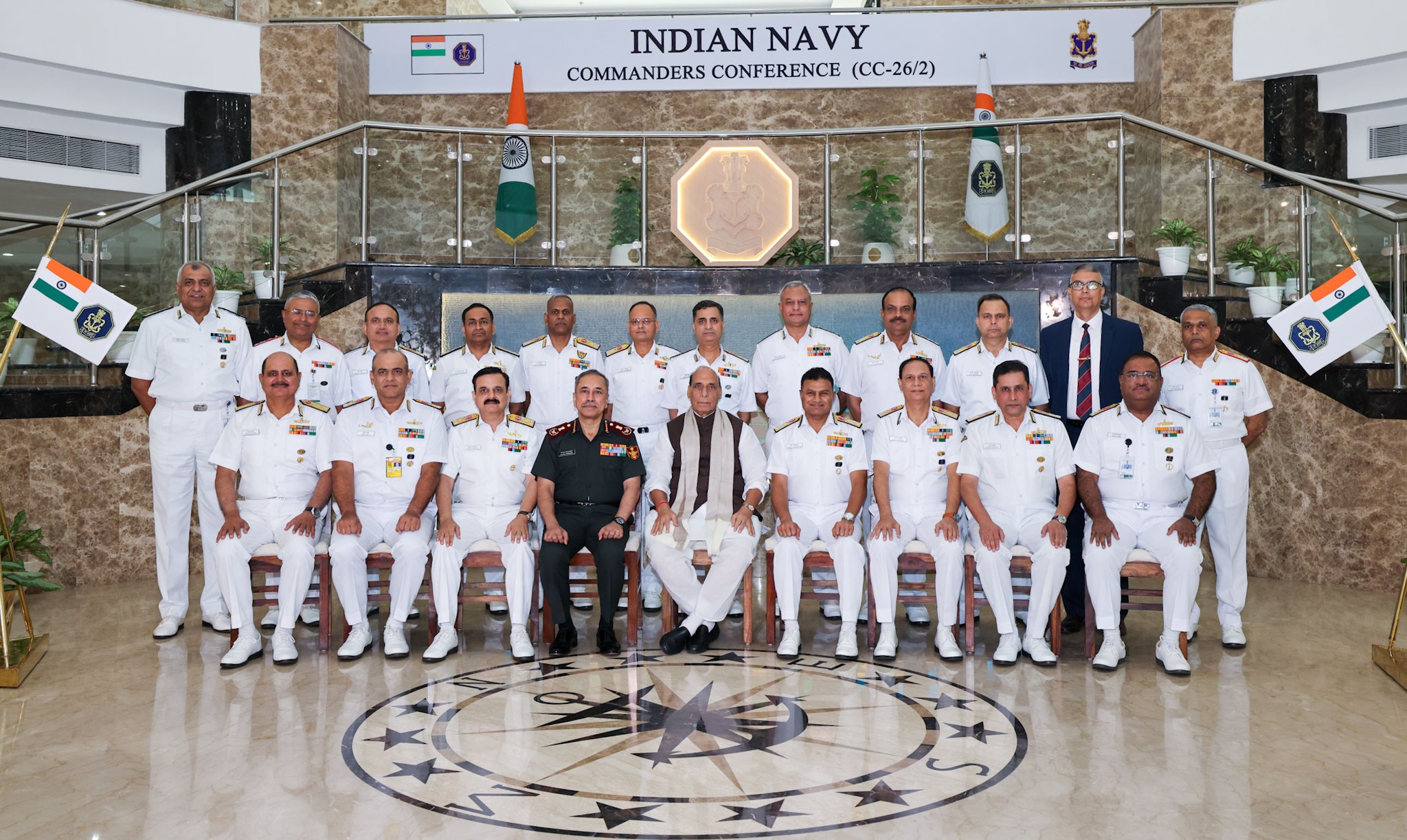
NEW DELHI, September 29: Defence Minister Rajnath Singh has underlined the expanding strategic role of the Indian Navy in the Indian Ocean Region and beyond, describing India as a “First Responder” and “Preferred Security Partner” while calling for stronger maritime surveillance, greater technological preparedness and continued expansion of indigenous naval capabilities.
Addressing the second edition of the Indian Navy’s biannual Commanders’ Conference 2026 at Nausena Bhawan in New Delhi on September 29, Singh said the changing maritime environment — marked by congestion, deception and “gray-zone” activities — required India to strengthen its monitoring and response mechanisms.
The three-day apex-level conference, being held from September 29 to October 1, brings together the Navy’s senior operational and area commanders to review operational preparedness, maritime security and future capability development.
Indian Warships Operating Far Beyond the Indian Ocean
Highlighting the Navy’s growing operational reach, Singh pointed to the presence of Indian warships in the South China Sea, Mediterranean and Atlantic Ocean as evidence of India’s blue-water naval capability.
He said the Indian Navy has an important role in providing strategic depth and supporting India’s wider regional presence.
The Defence Minister also stressed that the Navy’s role extends beyond the traditional protection of India’s maritime boundaries. According to Singh, the service contributes to economic protection, regional stability and power projection, making it a key component of the government’s broader vision of Viksit Bharat 2047.
The remarks come as the Navy continues to undertake deployments and maritime partnerships across the Indian Ocean and other strategically important regions.
Maritime Security Linked Directly to Energy Security
A major focus of Singh’s address was the relationship between maritime security and India’s economic and energy interests.
Referring to the ongoing security situation in West Asia, he highlighted the Indian Navy’s role in ensuring the safe movement of Indian-flagged merchant vessels, particularly LPG tankers, through the Strait of Hormuz under Operation Urja Suraksha.
Singh said India imports approximately 85–90% of its crude oil and around 50% of its natural gas through maritime routes, making the security of sea lanes directly connected with the country’s economy, energy supplies and defence preparedness.
The Navy’s role in protecting maritime commerce therefore extends beyond conventional military missions and increasingly encompasses the security of vital supply chains.
The Commanders’ Conference itself was scheduled to focus on the Navy’s contribution to safeguarding India’s maritime interests, including energy security amid ongoing conflicts in West Asia.
18 Warships Planned for Induction in 2026
Singh described 2026 as a historic year for the Indian Navy, saying that 18 warships are planned to be inducted or commissioned during the year.
According to the Defence Minister, this would represent the largest single-year force accretion in the history of the Indian Navy.
He linked the planned induction to the growing capabilities of India’s domestic naval shipbuilding ecosystem.
The development is part of India’s broader effort to increase the share of domestically designed and manufactured naval platforms.
Singh said recently commissioned warships contain more than 75% indigenous content, and called for the Indian shipbuilding ecosystem to move beyond meeting domestic requirements towards exporting warships to friendly foreign countries.
Push for Stronger Maritime Surveillance
The Defence Minister also called for a significant upgrade of India’s maritime surveillance architecture.
While recognising the importance of existing surveillance systems, Singh pointed to the rapidly increasing volume and complexity of maritime traffic and the need for stronger analytical capabilities.
Modern maritime security increasingly requires the ability to detect, identify and track a large number of vessels and activities across vast areas. This involves combining information from multiple sensors and sources and converting that information into actionable situational awareness.
The emphasis on surveillance also reflects the Navy’s expanding responsibilities across India’s maritime neighbourhood.
Gray-Zone Challenges and Changing Maritime Environment
Singh said the maritime domain has become more complicated due to congestion, deception and gray-zone activities.
Gray-zone activities generally refer to actions that remain below the threshold of conventional armed conflict but can nevertheless affect national security. At sea, such challenges can involve ambiguous activities, information manipulation, maritime coercion or the exploitation of complex commercial and security environments.
Against this backdrop, the Defence Minister called for India’s monitoring and response mechanisms to be elevated to a new level.
The conference provides the Navy’s senior leadership an opportunity to assess such emerging challenges and examine requirements for future operations, technology and force development.
Indigenous Warship Building Gains Momentum
Singh also highlighted the Navy’s role in India’s defence self-reliance drive.
According to the Defence Minister, the country’s naval warship production ecosystem is now meeting global benchmarks, while recently commissioned vessels have crossed the 75% indigenous-content mark.
He said the next stage should involve not only fulfilling India’s own requirements but also positioning Indian shipyards to export warships to friendly foreign nations.
The emphasis on domestic shipbuilding is significant because naval platforms require long-term industrial capabilities covering ship design, propulsion, sensors, weapons, electronics and specialised maritime systems.
Women Officers and “All Ranks, All Roles”
The Defence Minister also praised the Navy’s efforts towards women’s empowerment, recruitment and innovation under its “All Ranks, All Roles” approach.
He highlighted the deployment of women officers aboard frontline warships and aircraft, along with women’s participation in naval navigational expeditions.
The Navy’s women personnel have also taken part in major maritime expeditions, including the Navika Sagar Parikrama voyage, which Singh cited as an example of the expanding range of roles being undertaken by women officers.
India’s Role in Combined Maritime Security
Another major point highlighted by Singh was India’s increasing contribution to multinational maritime security mechanisms.
He congratulated the Navy on assuming command of Combined Task Force-154 (CTF-154) under the Combined Maritime Forces (CMF), describing it as an important contribution to regional cooperative security.
Singh also referred to Operation Southern Readiness, conducted in Kochi during India’s command tenure of CTF-154.
The operation involved 276 personnel from 27 countries, 76 facilitators and subject-matter experts, and four international organisations, according to the Defence Ministry’s account.
The initiative reflects India’s participation in multinational maritime-security efforts involving training, cooperation and coordinated responses to shared maritime challenges.
INS Sudarshini and Maritime Diplomacy
Singh further highlighted the deployment of INS Sudarshini for Lokayan-26.
The deployment was described as contributing to India’s maritime diplomacy and engagement with the Indian diaspora across the United States, Atlantic and Mediterranean regions.
Beyond its operational role, the deployment also showcased India’s maritime heritage and the Navy’s role as an instrument of international engagement.
Such deployments allow the Navy to combine operational presence with diplomatic outreach and cultural engagement.
Navy’s Role in the Viksit Bharat Vision
Singh positioned the Indian Navy as a strategic component of the Viksit Bharat 2047 vision.
His argument was that maritime security is closely connected to India’s economic development because the country depends heavily on the sea for energy supplies, international trade and access to global markets.
The Defence Minister therefore linked naval preparedness with broader national resilience.
His concluding message was framed around this connection: secure seas contribute to a secure India, while national security provides a stronger foundation for India’s development goals.
Top Military Leadership Reviews Naval Preparedness
The Commanders’ Conference brings together the Navy’s senior leadership to assess the country’s maritime security environment and operational preparedness.
The conference is also being used to discuss future capability development and technology absorption. The subsequent Defence Ministry update noted that Chief of Defence Staff Gen Anil Chauhan described the Navy as a strategic force multiplier and stressed technology transformation, data sharing, resilience and greater jointness among the three services.
The discussions therefore extend beyond immediate operational issues to the longer-term transformation of India’s maritime military capabilities.
Key Takeaways
- Defence Minister Rajnath Singh addressed the Indian Navy’s second Commanders’ Conference of 2026 in New Delhi.
- He described India as a First Responder and Preferred Security Partner in the Indian Ocean Region.
- Indian warship deployments in the South China Sea, Mediterranean and Atlantic were cited as evidence of blue-water capability.
- Singh called for stronger maritime surveillance and analytical capabilities.
- The Navy’s role in Operation Urja Suraksha and the safe movement of Indian merchant vessels through the Strait of Hormuz was highlighted.
- India imports around 85–90% of its crude oil and about 50% of its natural gas through maritime routes, according to Singh.
- 18 warships are planned for induction or commissioning in 2026, which Singh described as the Navy’s largest single-year force accretion.
- Recently commissioned Indian warships have more than 75% indigenous content, according to the Defence Minister.
- Singh highlighted the Navy’s “All Ranks, All Roles” approach and the expanding role of women officers.
- India’s leadership of CTF-154 and Operation Southern Readiness were highlighted as examples of multinational maritime cooperation.
- INS Sudarshini’s Lokayan-26 deployment was cited as an example of maritime diplomacy.
Conclusion
The second Naval Commanders’ Conference of 2026 has placed operational readiness, maritime surveillance, energy security, indigenous shipbuilding and multinational cooperation at the centre of India’s naval priorities.
Rajnath Singh’s address reflects the government’s view that India’s maritime security requirements are expanding alongside the country’s economic and strategic interests. With Indian warships operating well beyond the Indian Ocean, a planned induction of 18 warships in 2026 and continued emphasis on indigenous shipbuilding, the Navy is being positioned for a broader role in India’s maritime security architecture.
The conference, which runs through October 1, provides the Navy’s senior leadership with a forum to review current challenges and shape future capability development.