
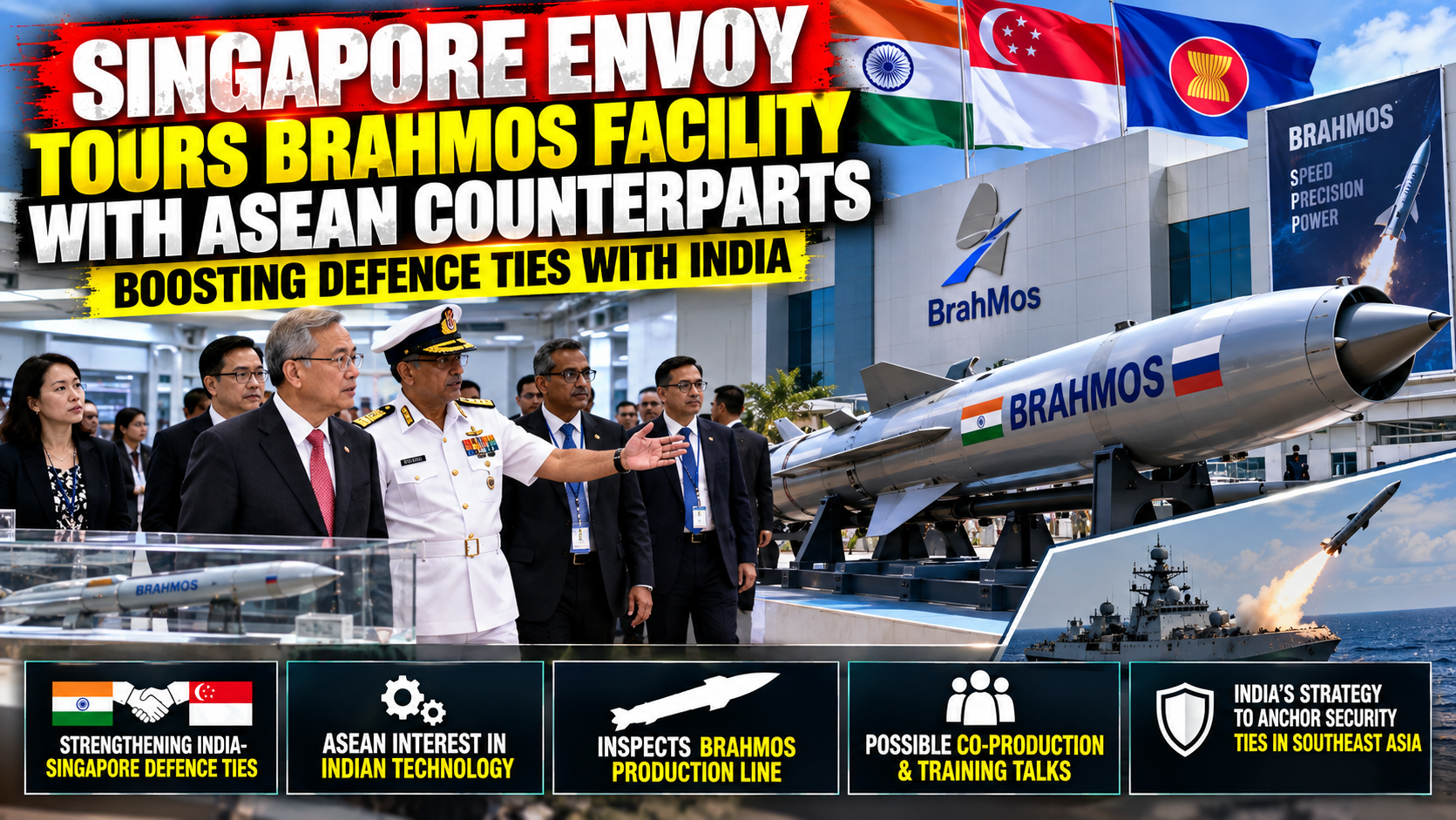
Singapore High Commissioner Simon Wong calls visit an “eyeopener” into India’s defence industry; Philippines-organised delegation gains insight into BrahMos engineering and missile programme
NEW DELHI, October 1: India’s BrahMos supersonic cruise missile programme has emerged as a focal point of growing defence-industrial engagement with Southeast Asia after Singapore’s High Commissioner to India Simon Wong, along with diplomats from other ASEAN countries, visited the BrahMos Aerospace headquarters in New Delhi.
The visit, organised by the Philippine Embassy in India, provided the visiting diplomats an opportunity to learn about India’s defence industry and the engineering behind the BrahMos missile system. Wong described the visit as an “eyeopener” in a post on social media, thanking BrahMos and the Philippine Embassy for hosting and organising the engagement.
The visit comes at a time when India is expanding defence exports and strengthening security and industrial relationships with countries across Southeast Asia, with BrahMos increasingly becoming one of the most visible examples of India’s defence-export push.
ASEAN Diplomats Get First-Hand Look at BrahMos
The delegation’s visit to the BrahMos Aerospace headquarters offered the ASEAN representatives an opportunity to understand the industrial ecosystem supporting one of India’s flagship missile programmes.
Wong said the delegation was able to learn more about India’s defence industry and the engineering behind BrahMos. The visit was arranged with the involvement of the Philippine Embassy, which currently has a significant role in ASEAN’s engagement with India.
The publicly available accounts of the visit do not indicate that any new missile procurement agreement was concluded during the tour.
Instead, the engagement appears to have been focused on exposure to India’s defence-industrial capabilities and understanding of the BrahMos programme.
This distinction is important because the growing interest in BrahMos across Southeast Asia does not mean every ASEAN country visiting the facility is necessarily considering an immediate purchase.
Singapore Leads a Wider ASEAN Engagement
The participation of Singapore’s High Commissioner gives the visit additional significance.
Singapore has long maintained extensive defence cooperation with India, including military exercises, training and strategic dialogue. The two countries have also worked closely on maritime security and defence technology-related issues.
Singapore’s Ministry of Defence has recently highlighted the importance of international partnerships for strengthening defence supply chains and building resilience in defence-industrial ecosystems. Singapore has also said it is interested in expanding defence-technology cooperation with international partners.
The BrahMos visit therefore fits within a broader pattern of Southeast Asian countries examining opportunities for defence-industrial cooperation and diversification of their defence supply chains.
Philippines Already a BrahMos Customer
For the Philippines, the BrahMos programme has a more direct operational relevance.
Manila became the first foreign customer for BrahMos after signing a contract in 2022 for the shore-based anti-ship missile system.
The Philippines subsequently began receiving the system, making BrahMos India’s most prominent defence export success in Southeast Asia.
The Philippine Embassy’s role in organising the latest ASEAN diplomatic visit is therefore significant because Manila already has experience with the missile system and has a direct stake in India’s growing defence-industrial capabilities.
The Philippines has also been exploring further cooperation with India in defence and maritime security.
BrahMos Expands Across Southeast Asia
The ASEAN interest in BrahMos comes as India’s missile exports to Southeast Asia continue to expand.
India has already supplied BrahMos to the Philippines, while deals involving Vietnam and Indonesia have also advanced.
In May 2026, India’s Defence Secretary Rajesh Kumar Singh publicly confirmed that a BrahMos deal with Vietnam had been signed, while saying an agreement with Indonesia was in the final stages.
In July, India and Indonesia announced a defence agreement involving BrahMos missiles and Astra air-to-air missiles. Reuters reported the BrahMos-Astra package at around $630 million, although detailed contractual terms were not publicly disclosed.
With the Philippines, Vietnam and Indonesia all linked to BrahMos procurement, Southeast Asia has become an increasingly important market for India’s defence exports.
A Joint India-Russia Missile Programme
BrahMos Aerospace is a joint venture between India’s Defence Research and Development Organisation (DRDO) and Russia’s NPO Mashinostroyenia.
The company describes its objective as designing, developing, manufacturing and marketing the BrahMos supersonic cruise missile system.
The missile family has evolved into variants that can be launched from different platforms, including land, naval and air-based systems.
Indian armed forces operate multiple versions of BrahMos, while the Philippines became the first foreign operator of the system.
The programme has consequently developed from a bilateral India-Russia technology partnership into an important component of India’s defence-export portfolio.
Why BrahMos Matters to Southeast Asian Countries
Several Southeast Asian nations face maritime-security challenges involving extensive coastlines, busy sea lanes and disputed or strategically sensitive waters.
A land-based anti-ship missile such as the Philippine BrahMos system can provide a country with a long-range coastal defence capability.
The missile’s combination of supersonic speed, precision and multiple launch options has contributed to its appeal as India seeks to expand defence exports.
For countries looking to strengthen maritime deterrence while diversifying their defence suppliers, BrahMos provides an Indian-origin option that is already in operational service with the Indian Armed Forces and the Philippines.
This does not mean that every ASEAN country is seeking the same capability. Defence requirements differ considerably between Singapore, Indonesia, Vietnam, the Philippines and other Southeast Asian states.
India’s Defence-Export Push
The ASEAN visit comes amid a broader transformation in India’s defence-industrial sector.
India has increasingly sought to move from being primarily a defence importer towards becoming a defence equipment producer and exporter.
BrahMos has become one of the flagship examples of this strategy.
The missile programme combines Indian manufacturing capabilities with a jointly developed technology base and has helped establish an Indian defence product in overseas markets.
The expansion into Southeast Asia also aligns with India’s broader Act East and Indo-Pacific engagement, where defence cooperation forms one component of wider economic, maritime and strategic relations.
Indonesia Deal Adds Momentum
The recent Indonesia agreement has further strengthened BrahMos’ position in Southeast Asia.
According to Reuters, the July 2026 agreement covers the supply of BrahMos cruise missiles alongside Astra air-to-air missiles. The package also involves supporting infrastructure, training, maintenance and long-term technical support.
Indonesia’s geographical position gives the deal particular maritime significance.
The country sits astride some of the world’s most important sea lanes and has extensive maritime territory. India and Indonesia have simultaneously been strengthening cooperation on maritime security and broader Indo-Pacific issues.
Vietnam Deal Signals Wider Regional Interest
Vietnam is another important development in India’s BrahMos export story.
India’s Defence Secretary publicly confirmed in May that a deal with Vietnam had been signed, although details of the agreement were not made public at that time.
Vietnam’s interest in BrahMos has been closely watched because of its maritime-security requirements and its location along the South China Sea.
However, the significance of the deal should be assessed separately from broader geopolitical interpretations. The publicly confirmed facts establish defence cooperation and missile procurement; they do not by themselves establish a collective ASEAN military arrangement.
Possible Future Areas of Cooperation
The latest ASEAN visit could provide a platform for further conversations between India and Southeast Asian countries about defence technology and industrial cooperation.
Potential areas could include training, maintenance, logistics, defence manufacturing, technology partnerships and further procurement discussions.
However, no new co-production or training agreement involving Singapore or other ASEAN diplomats was announced as part of this particular BrahMos visit.
The immediate outcome was an opportunity for the visiting representatives to understand India’s defence-industrial ecosystem and the engineering behind the missile programme.
BrahMos as a Showcase of Indian Defence Manufacturing
The BrahMos programme also demonstrates how India’s defence industry is increasingly being positioned as an export-oriented ecosystem.
BrahMos Aerospace says its programme involves more than 200 public and private industrial partners and institutions, illustrating the wider industrial network supporting the missile system.
Such an ecosystem is important for sustaining exports because overseas customers require not only missiles but also infrastructure, training, maintenance, logistics and long-term technical support.
The ASEAN delegation’s visit therefore provided exposure not simply to the missile itself but to the broader industrial capabilities behind it.
Growing Defence Engagement With ASEAN
The BrahMos visit comes against the background of increasingly structured defence engagement between India and ASEAN countries.
Military exercises, defence dialogues, maritime cooperation and defence exports are all becoming part of India’s broader relationship with Southeast Asia.
At the regional level, ASEAN countries are also expanding practical defence cooperation through mechanisms such as the ASEAN Defence Ministers’ Meeting-Plus (ADMM-Plus). A major multinational exercise in Indonesia in September 2026 brought together personnel from all 19 ADMM-Plus countries, including India.
This wider defence environment provides additional context for the ASEAN diplomats’ interest in India’s defence manufacturing capabilities.
Key Takeaways
- Singapore High Commissioner Simon Wong led ASEAN diplomats on a visit to BrahMos Aerospace headquarters in New Delhi.
- Wong described the visit as an “eyeopener” into India’s defence industry and BrahMos engineering.
- The visit was organised by the Philippine Embassy in India.
- The delegation received an overview of the BrahMos missile programme and India’s defence-industrial capabilities.
- The Philippines is already a BrahMos customer and was the missile’s first export customer.
- India has also moved ahead with BrahMos-related deals involving Vietnam and Indonesia.
- BrahMos Aerospace is a joint venture between DRDO and Russia’s NPO Mashinostroyenia.
- No new procurement or co-production agreement involving Singapore was publicly announced during the visit.
- The engagement highlights the growing role of defence manufacturing and exports in India’s ASEAN outreach.
Conclusion
The visit by Singapore’s High Commissioner and other ASEAN diplomats to BrahMos Aerospace marks another visible step in India’s expanding defence-industrial engagement with Southeast Asia.
While the visit itself did not result in a publicly announced new missile contract, it provided ASEAN representatives with direct exposure to the engineering, manufacturing and industrial ecosystem behind BrahMos.
With the Philippines already operating the system and India moving ahead with BrahMos agreements involving Vietnam and Indonesia, the missile has become an increasingly important element of India’s defence-export relationship with Southeast Asia. The latest diplomatic engagement indicates that interest in India’s defence industry is extending beyond individual procurement deals towards broader conversations about technology, capability development and long-term defence partnerships.