
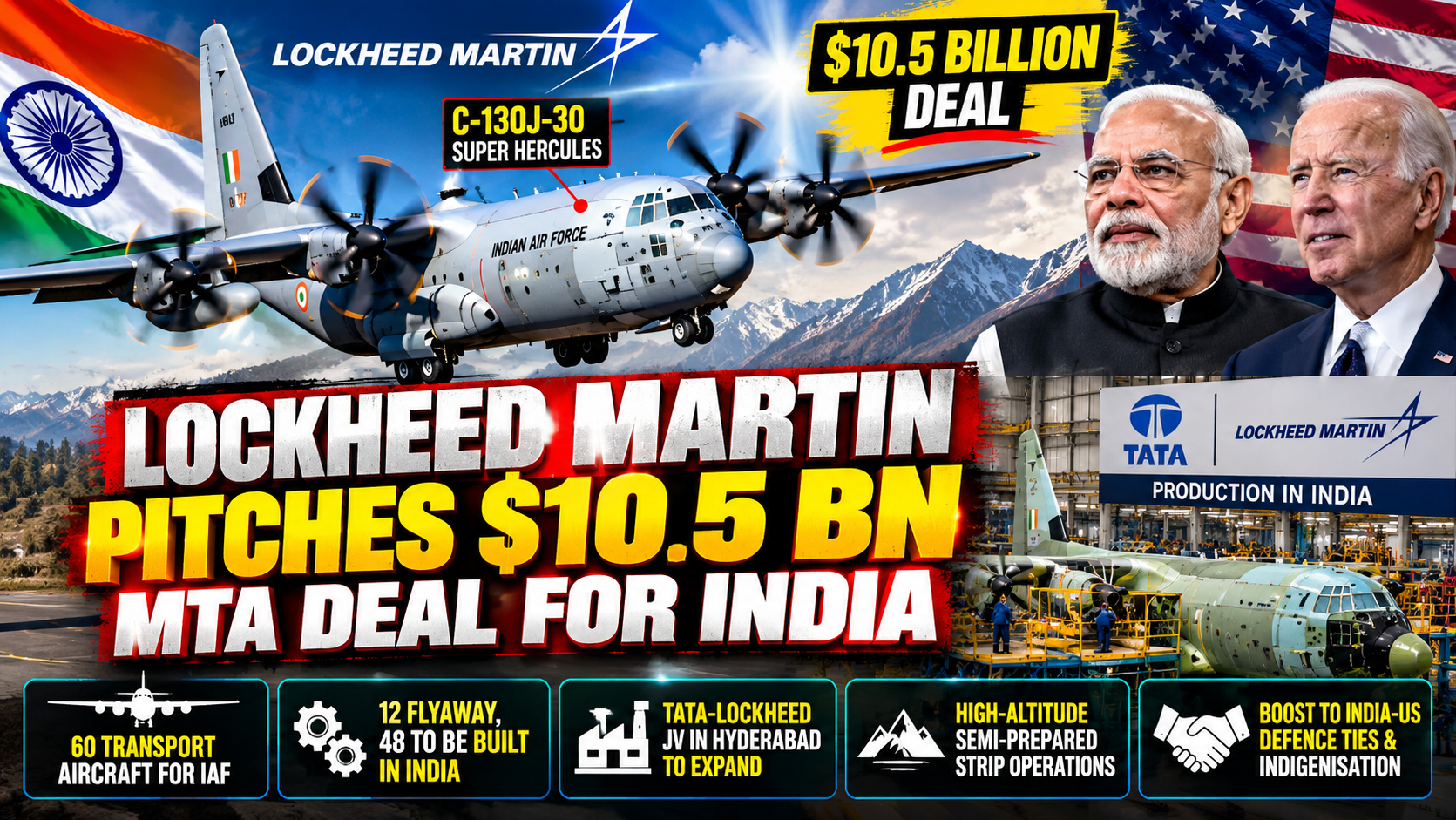
US aerospace major proposes 12 C-130J-30 aircraft in flyaway condition and 48 to be manufactured in India with Tata; Embraer-Mahindra’s C-390 emerges as the principal rival
NEW DELHI, October 4: US aerospace major Lockheed Martin has stepped up its bid for the Indian Air Force’s proposed 60-aircraft Medium Transport Aircraft (MTA) programme, offering to expand its manufacturing footprint in India if the C-130J-30 Super Hercules is selected for the estimated $10.5 billion contract.
The proposal would see 12 aircraft delivered in flyaway condition and 48 manufactured in India, while also expanding Lockheed Martin’s existing industrial partnership with Tata Advanced Systems Limited (TASL). The competition is emerging primarily between Lockheed Martin’s C-130J-30 and Brazil’s Embraer C-390 Millennium, with Mahindra Defence partnering Embraer.
The programme is aimed at modernising the IAF’s ageing tactical transport fleet, particularly the Soviet-origin An-32, while creating a new domestic manufacturing and maintenance ecosystem for medium transport aircraft.
$10.5 Billion Programme to Replace Ageing Transport Fleet
India issued the MTA tender in August 2026 for 60 medium transport aircraft, in a programme estimated at around $10.5 billion or nearly ₹1 lakh crore. The requirement was framed around replacing ageing transport aircraft and strengthening the IAF’s tactical airlift capabilities.
The procurement is structured around a significant domestic manufacturing component.
Under the tender, 12 aircraft are to be supplied in flyaway condition, while the remaining 48 are to be manufactured in India through an Indian industry–foreign OEM partnership. The selected Indian partner is also expected to establish supporting infrastructure, including manufacturing and maintenance capabilities.
The programme therefore goes beyond simply purchasing transport aircraft. It is designed to create a long-term industrial ecosystem covering production, supply chains, maintenance and technological collaboration.
Lockheed Martin Offers Expanded C-130J Production
Lockheed Martin is pitching the C-130J-30 Super Hercules, a stretched version of the C-130J already operated by the Indian Air Force.
India currently operates 12 C-130J aircraft, giving the IAF existing operational experience with the platform. Lockheed Martin says its C-130J programme already has a substantial industrial footprint in India through its partnership with Tata.
Under the latest proposal, Lockheed Martin would expand this footprint if selected for the MTA programme.
The company has said that its proposal includes manufacturing 48 of the 60 aircraft in India, alongside the initial 12 flyaway aircraft. It has also proposed upgrading India’s existing C-130J fleet to a common advanced configuration, potentially creating a much larger standardised Super Hercules fleet.
That commonality could offer the IAF advantages in training, maintenance, logistics and spares management.
Tata-Lockheed Partnership Gives C-130J an Existing Industrial Base
A major advantage being highlighted by the American company is its existing relationship with Tata Advanced Systems.
Tata and Lockheed Martin have been associated with C-130J manufacturing for several years. Their joint venture, Tata Lockheed Martin Aerostructures Limited (TLMAL) in Hyderabad, produces C-130J empennage assemblies and is the global source for these components for new Super Hercules aircraft.
The partnership has also expanded into maintenance.
Lockheed Martin and Tata Advanced Systems announced a new C-130J MRO facility in Bengaluru in 2025 to support India’s existing fleet and potentially other Super Hercules aircraft.
The MTA bid would therefore build upon infrastructure and industrial relationships that already exist rather than starting an entirely new production ecosystem from scratch.
Technology Transfer Also Part of the Offer
Lockheed Martin has indicated that its MTA proposal could provide India with access to technology associated with the Super Hercules programme.
A senior Lockheed Martin executive has said the company is prepared to transfer technology for certain components of the C-130J if it wins the Indian contract.
The company and Tata had already signed a 2024 teaming agreement that specifically included potential expansion of C-130J manufacturing and assembly in India for the IAF’s MTA programme, subject to the necessary government approvals.
For India, such arrangements are important because the MTA programme is being evaluated not only on aircraft capability but also on the depth of domestic manufacturing and technology participation.
C-130J-30: Familiar Platform With Tactical Airlift Credentials
The C-130J-30 is the stretched version of Lockheed Martin’s C-130J Super Hercules.
According to Lockheed Martin, the C-130J-30 adds 15 feet to the fuselage compared with the standard C-130J, providing additional usable cargo space. The aircraft has a maximum allowable payload of approximately 19.96 tonnes, while the manufacturer lists a maximum normal payload of about 20.23 tonnes under specified conditions.
The aircraft is designed for tactical airlift missions and can carry combinations of troops, pallets, vehicles and other equipment.
Its established service with the IAF is another factor in Lockheed Martin’s pitch.
India has operated its C-130Js for more than a decade, including missions requiring operations from challenging airfields and support to special operations.
Embraer-Mahindra Brings a Larger Competitor
The principal competing platform is the Embraer C-390 Millennium, being offered in India through a partnership between Brazilian aerospace company Embraer and Mahindra Group.
The C-390 offers a higher payload capacity than the C-130J-30, with Embraer listing a payload of up to 26 tonnes. The company also highlights its ability to perform troop and cargo transport, airdrops, medical evacuation, search and rescue, firefighting and humanitarian missions.
The C-390 is also designed to operate from temporary or unpaved runways, a feature relevant to India’s tactical airlift requirements.
The aircraft has already been selected by several international operators, giving Embraer an established export customer base for the platform.
Embraer-Mahindra Selects Nagpur for Potential Assembly Line
The competition gained another dimension earlier this month when Embraer and Mahindra identified Nagpur, Maharashtra, as the proposed location for a C-390 final assembly line in India, if the aircraft is selected for the MTA programme.
Embraer said the companies are working with the Maharashtra government on preparations for the potential facility, including local manufacturing, assembly, supply-chain development, services, training and lifecycle support.
This means both leading contenders are now putting forward significant Indian manufacturing propositions.
Lockheed Martin has an established C-130J industrial relationship with Tata in Hyderabad, while Embraer and Mahindra are proposing a new C-390 production ecosystem centred on Nagpur.
Airbus A400M Seen as an Outsider
Airbus had earlier been associated with the MTA competition with its A400M Atlas, but reporting around the tender indicates that it is not actively competing in the current contest.
The A400M is significantly larger than the aircraft class sought by the IAF. ThePrint reported that Airbus was likely to sit out because the A400M’s approximately 37-tonne payload capacity exceeds the requirement.
As a result, the competition has increasingly narrowed to the C-130J-30 and C-390.
The two aircraft, however, represent somewhat different approaches: the C-130J offers the advantage of an established IAF fleet and existing Indian production ecosystem, while the C-390 offers greater payload capacity and a newer platform.
Five Indian Companies in the Race
The MTA tender has also created a significant contest among Indian defence companies.
Five Indian firms are in the programme:
- Tata Advanced Systems Limited
- Mahindra Group/Mahindra Defence
- Adani Defence & Aerospace
- Hindustan Aeronautics Limited
- Reliance Defence
The tender requires Indian companies to partner with global aircraft manufacturers and establish production and maintenance capabilities in India.
The contest is therefore not simply between two aircraft manufacturers. It is also a competition between different Indian industrial ecosystems and their proposed partnerships with global aerospace companies.
Why the MTA Is Important for the IAF
The IAF’s transport fleet remains heavily dependent on ageing Soviet-origin platforms, particularly the An-32.
The MTA programme is intended to provide a modern tactical airlift capability capable of supporting troop movement, logistics, humanitarian assistance and operations in difficult geographical conditions.
The aircraft are expected to operate from high-altitude and semi-prepared airstrips, making performance in India’s mountainous and remote regions an important consideration.
For the IAF, the new fleet will therefore have to balance payload, range, tactical mobility, reliability and the ability to operate from austere locations.
Beyond Aircraft: Industrial Capability at Stake
The MTA competition has become an important test of India’s defence-manufacturing ambitions.
Both major contenders are offering substantial localisation.
Lockheed Martin can point to an existing Indian C-130J industrial ecosystem involving Tata, while Embraer and Mahindra are proposing a new C-390 manufacturing and support hub.
The eventual winner will consequently influence not only the IAF’s transport capability but also the development of India’s military aerospace supply chain.
The programme could generate work for Indian manufacturers involved in aerostructures, avionics, components, maintenance, repair and overhaul, engineering and lifecycle support.
The Decision Will Go Beyond Price
The final selection is expected to involve a range of technical and commercial considerations.
These could include aircraft performance, tactical operating capability, lifecycle costs, indigenous manufacturing, technology transfer, production timelines, maintenance infrastructure and the ability of the Indian partner to build a sustainable supply chain.
The aircraft’s ability to meet the IAF’s specific requirements for operations from high-altitude and semi-prepared airfields will also be critical.
The MTA programme has already moved beyond the conceptual stage, with the formal RFP issued in August after the acquisition proposal progressed through the defence procurement process.
Key Takeaways
- Lockheed Martin has offered the C-130J-30 Super Hercules for India’s MTA programme.
- The contract is estimated at approximately $10.5 billion.
- The IAF is seeking 60 medium transport aircraft.
- The proposed structure includes 12 flyaway aircraft and 48 to be manufactured in India.
- Lockheed Martin plans to expand its existing Tata partnership and Indian manufacturing footprint if selected.
- Tata-Lockheed’s Hyderabad joint venture already produces C-130J empennage assemblies.
- Lockheed Martin has also proposed expanding C-130J-related production and potentially upgrading India’s existing 12-aircraft fleet.
- Embraer and Mahindra are offering the C-390 Millennium, which can carry up to 26 tonnes.
- Embraer and Mahindra have identified Nagpur as a potential C-390 final assembly location if they win the programme.
- Five Indian companies — Tata, Mahindra, Adani, HAL and Reliance Defence — are involved in the tender process.
- The programme is intended to replace ageing transport aircraft and strengthen the IAF’s tactical airlift capability.
Conclusion
India’s $10.5-billion Medium Transport Aircraft programme is shaping up to be one of the country’s most significant military aviation competitions, with the outcome likely to influence both the IAF’s future tactical airlift capability and India’s emerging aerospace-manufacturing ecosystem.
Lockheed Martin enters the contest with a major advantage in the form of an existing C-130J fleet, established Tata manufacturing links and an operational support ecosystem in India. Embraer and Mahindra, meanwhile, are offering the newer and larger C-390 Millennium, backed by a proposed indigenous assembly line in Nagpur.
With 48 of the 60 aircraft expected to be built in India, the final decision will be about more than selecting a transport aircraft. It will also determine which industrial model can best combine operational capability, domestic manufacturing, technology access, lifecycle support and India’s long-term ambition to become a global aerospace production hub.