
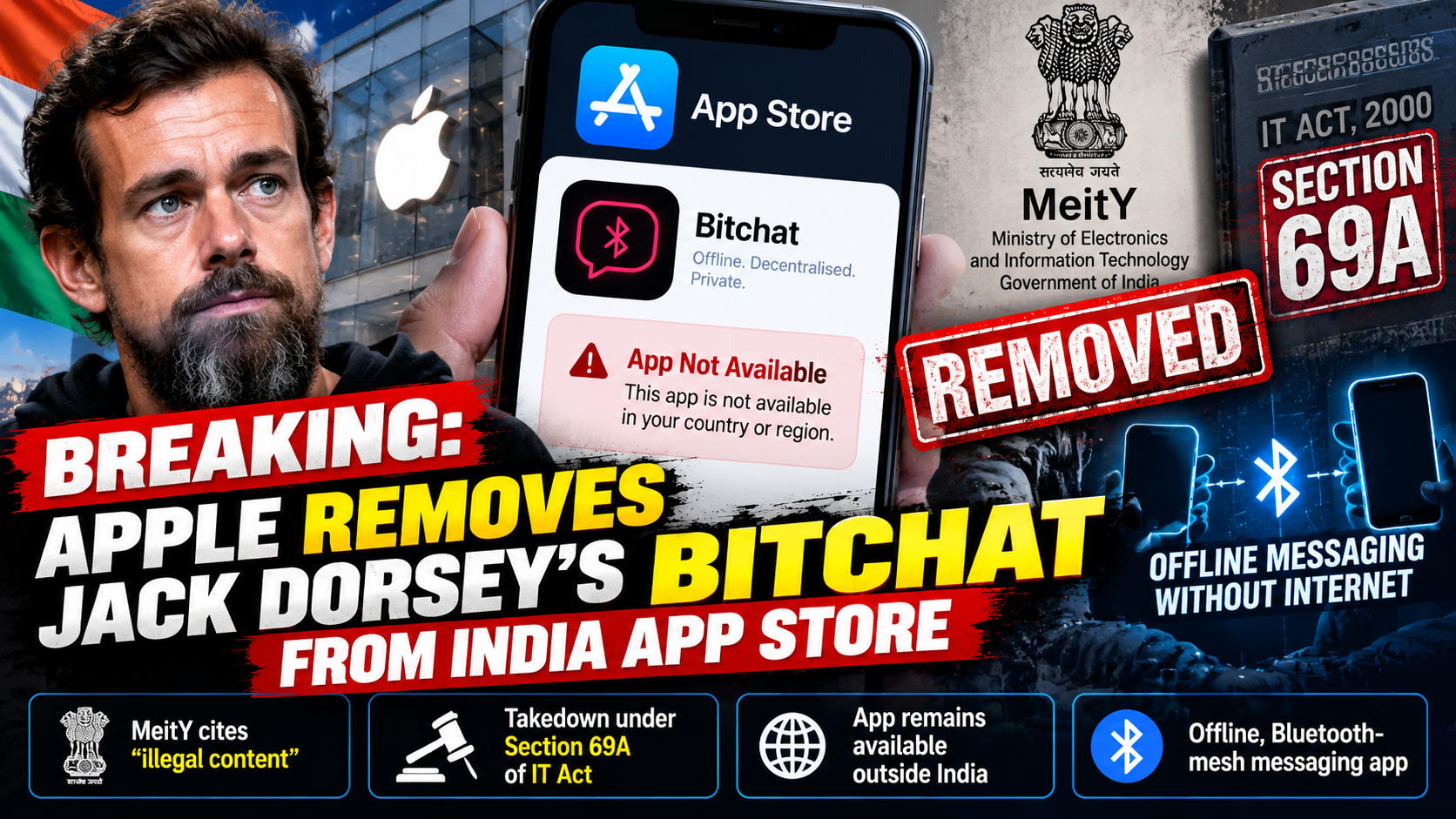
Offline Bluetooth-mesh messaging app removed from Indian App Store; Apple says the action followed a MeitY demand citing content “illegal in India”
NEW DELHI, October 4: Apple has removed Bitchat, the decentralised offline messaging application associated with Twitter co-founder Jack Dorsey, from its India App Store following a government takedown demand issued under Section 69A of the Information Technology Act, 2000.
Dorsey disclosed the development on October 3 by posting what appeared to be an Apple App Review notice on X. In the post, he wrote that the “Government of India officially removes bitchat from the App Store.”
Apple’s notice, as shared by Dorsey, said the application would be removed from the India App Store “per demand from the Ministry of Electronics and Information Technology (MeitY)” because it included content that was considered illegal in India and therefore did not comply with Apple’s App Review Guidelines.
The move is significant because Bitchat is designed specifically to enable communication without conventional internet or cellular connectivity, using Bluetooth-based mesh networking between nearby devices.
What Apple’s Notice Says
According to the notice shared publicly by Dorsey, Apple said MeitY had issued the demand under Section 69A of the Information Technology Act.
The notice said Bitchat would be removed from the India-specific App Store, while remaining available in other territories selected by the developer through Apple’s App Store Connect system.
Apple also informed the developer that the application’s TestFlight version would no longer be available for internal or external testing in India, and public TestFlight links would stop functioning in the country.
However, the notice does not publicly identify the specific content that MeitY considered illegal. It also does not explain which particular ground under Section 69A was cited in the government direction.
That leaves an important distinction: the removal is confirmed through Apple’s notice, but the precise government reasoning behind the order has not been publicly detailed in the material available so far.
Dorsey Shares Apple Communication
Dorsey, who is associated with the development of Bitchat, brought the matter into the public domain through his X account.
Alongside the screenshot of Apple’s communication, he wrote:
“Government of India officially removes bitchat from the App Store.”
The post triggered renewed discussion around encrypted and decentralised communication technologies, particularly applications that can continue to function when conventional internet or mobile networks are unavailable.
Apple’s notice directs the developer to contact MeitY for further information regarding the removal and the applicable Indian legal requirements.
As of the latest reports, Apple, Google and India’s IT ministry had not publicly provided additional details on the specific content or technical feature that prompted the latest action.
How Bitchat Works
Bitchat differs from conventional messaging applications such as WhatsApp or Signal because it was designed to function without relying on a central messaging server or conventional internet connectivity.
The application uses Bluetooth Low Energy mesh networking to allow nearby devices to communicate directly. Messages can be relayed across participating devices, extending communication beyond the immediate range of a single Bluetooth connection.
The system does not require:
- A conventional internet connection
- Cellular data
- Wi-Fi
- A phone number
- A central messaging server
This architecture allows nearby users to exchange encrypted messages even when conventional telecommunications infrastructure is unavailable.
It is this offline capability that has made Bitchat notable in discussions around communications resilience and internet shutdowns.
Earlier Government Action Against Bitchat
The latest App Store removal follows an earlier episode involving Bitchat in India.
According to TechCrunch, Indian authorities had previously sought to restrict access to Bitchat-related repositories on GitHub in July 2026. The government direction cited concerns about the architecture of the application and its ability to make communications difficult for authorities to intercept or trace.
NDTV Profit reported that the earlier action involved an order directing GitHub to disable access to three Bitchat repositories, with authorities citing concerns about possible misuse by anti-national elements, terrorist organisations, organised criminal groups and cybercriminals.
The latest Apple notice, however, does not explicitly state whether the concerns raised during the earlier GitHub action were the basis for the new Section 69A demand.
That distinction is important because the current Apple communication simply says that MeitY demanded removal because the application included content considered illegal in India.
Section 69A and Government Blocking Orders
Section 69A of the Information Technology Act, 2000 provides the legal framework through which the Indian government can direct blocking of public access to information in specified circumstances.
The provision has been used by the government in a variety of cases involving online content and digital platforms.
In the Bitchat case, Apple’s notice specifically identifies Section 69A as the legal basis cited by MeitY for its demand.
However, the actual blocking order has not been publicly reproduced in the reports currently available, and the precise material or legal ground relied upon by the government has not been disclosed.
India-Only Removal From Apple
The action is geographically limited on Apple’s platform.
Apple’s communication says Bitchat will remain available in other territories selected by the developer, meaning the company has not removed the application globally from its App Store ecosystem.
The restriction also extends to TestFlight in India.
This creates a situation in which the application may continue to be accessible through Apple’s ecosystem in other countries while being unavailable through the official Indian App Store.
Reports also indicate that Bitchat was no longer available through Google Play in India, while its website was inaccessible through various Indian internet service providers when checked by TechCrunch and Moneycontrol. However, it was not immediately clear whether Google and internet service providers had received separate government directions or whether those restrictions resulted from another mechanism.
Why Offline Messaging Has Become Significant
The controversy surrounding Bitchat is closely linked to the changing communications environment.
Most popular messaging platforms depend on internet connectivity and centralised infrastructure to deliver messages. Bitchat’s mesh-based architecture attempts to bypass that dependency by allowing nearby devices to communicate directly.
Such technology can have legitimate applications, including communication during:
- Natural disasters
- Network outages
- Infrastructure failures
- Remote-area operations
- Emergency situations
At the same time, authorities can view communication systems that operate outside conventional networks as presenting additional challenges for lawful interception, monitoring and attribution.
This tension between communications resilience, privacy and law-enforcement requirements is at the centre of the debate surrounding Bitchat.
Government Concerns and Digital Rights Debate
The latest action has already prompted discussion among digital-rights advocates and technology experts.
Critics of the action have questioned the absence of publicly available details explaining what specific content was considered illegal and why Section 69A was used to restrict the application.
The Internet Freedom Foundation, in a statement shared on Reddit, argued that Section 69A permits blocking of unlawful information rather than necessarily banning an entire messaging application because of its ability to function during internet shutdowns. The organisation also called for publication of the underlying blocking order.
These are criticisms of the government’s action, rather than an established finding that the order is unlawful.
The government’s stated legal basis and the precise material cited in the order would be necessary to fully assess the competing arguments.
A Broader Tech-Security Question
The Bitchat episode highlights a broader issue facing governments and technology companies: how should regulators approach applications whose architecture itself can make conventional forms of communication monitoring more difficult?
For technology companies, applications distributed through global platforms must comply with local laws in the jurisdictions where they are offered.
For governments, meanwhile, emerging technologies can create new challenges for public safety, cybercrime investigations and national security.
The Bitchat case brings those competing considerations into sharp focus because the application’s defining feature — communication without conventional internet connectivity — is also what makes it different from mainstream messaging platforms.
Key Takeaways
- Apple has removed Bitchat from India’s App Store.
- The action followed a MeitY demand under Section 69A of the IT Act, 2000.
- Apple said the application included content considered “illegal in India.”
- The Apple notice does not specify what content was considered illegal.
- Bitchat remains available in other App Store territories selected by its developer.
- TestFlight access has also been blocked in India.
- Jack Dorsey publicly shared Apple’s notice and said the Indian government had officially removed the app.
- Bitchat uses Bluetooth mesh networking and is designed to work without cellular networks, Wi-Fi or central servers.
- Indian authorities had previously taken action involving Bitchat-related GitHub repositories in July.
- Reports indicate Bitchat was also unavailable through Google Play in India, although it was not immediately clear whether Google received a separate government order.
Conclusion
Apple’s removal of Bitchat from the Indian App Store marks a significant development in the regulatory scrutiny of decentralised and offline communication technologies.
The immediate facts are clear: Apple says it acted following a MeitY demand under Section 69A, and its notice says the application contained content considered illegal in India. At the same time, the publicly available notice does not identify that content or provide the detailed reasoning behind the government’s order.
The episode follows earlier government action involving Bitchat’s GitHub repositories and raises broader questions about the balance between national security, lawful access, privacy, communications resilience and technological innovation.
For now, the restriction is limited to India on Apple’s platform, while Bitchat remains available in other territories. The significance of the case will depend largely on whether the government publishes further details about the underlying order and the specific legal concerns that led to the application’s removal.