Raksha Mantri inaugurates first ASEAN-India Defence Think Tank Forum in New Delhi; stresses maritime security, defence technology, joint production and regional stability
NEW DELHI, OCTOBER 14: Defence Minister Rajnath Singh on Wednesday called for a free, open and inclusive Indo-Pacific region where all countries, irrespective of their size, can make independent choices, safeguard their national interests and pursue development in peace.
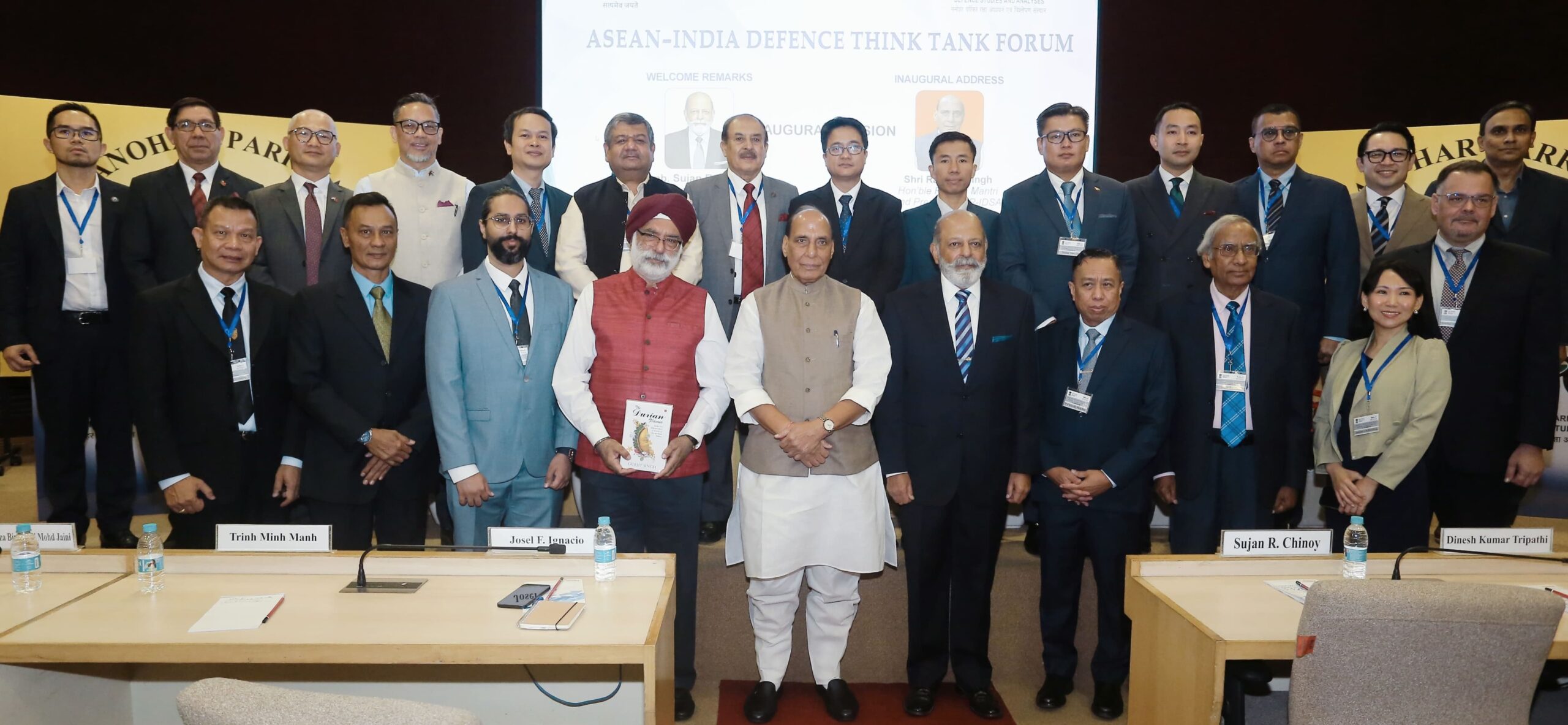
Addressing the inaugural ASEAN-India Defence Think Tank Forum at the Manohar Parrikar Institute for Defence Studies and Analyses (MP-IDSA) in New Delhi, Singh emphasised the need to build mutual trust, respect national sovereignty, uphold international law and maintain open channels of dialogue to address emerging security challenges.
He said India and the Association of Southeast Asian Nations (ASEAN) share common interests in maintaining peace, stability, prosperity and an inclusive regional order amid growing strategic competition and evolving security threats.
India-ASEAN Partnership Key to Indo-Pacific Stability
Rajnath Singh highlighted India’s Act East Policy and its regional vision under SAGAR (Security and Growth for All in the Region) and MAHASAGAR (Mutual and Holistic Advancement for Security and Growth Across Regions), stating that these initiatives support deeper engagement and cooperation across the Indo-Pacific.
He underlined the importance of ASEAN-led mechanisms in India’s regional approach and called for greater cooperation rather than competition between regional forums.
The Defence Minister also pointed to the longstanding historical, cultural and commercial connections between India and Southeast Asia, describing the Act East Policy as a sustained commitment to working with regional partners as equals.
He stressed that countries should resolve differences peacefully before they escalate into disputes and work together without being compelled to choose sides.
Maritime Security Emerges as a Shared Priority
Emphasising the strategic importance of the Indian Ocean and Southeast Asian waters, Singh said the connected maritime region is vital for international trade, energy supplies, movement of people and the transportation of essential goods.
He identified maritime domain awareness, interoperability between forces and underwater cooperation as key pillars of a stable, rules-based maritime order.
With 2026 designated as the ASEAN-India Year of Maritime Cooperation, Singh called for translating shared interests into concrete initiatives, including improved maritime information-sharing, closer coordination between navies and coast guards, and enhanced capabilities to respond jointly to emergencies.
He also stressed the need to counter piracy, trafficking, illegal fishing and other maritime threats in accordance with international law.
AI, Drones and Cybersecurity in Focus
Highlighting the growing role of emerging technologies in modern warfare, Singh said artificial intelligence, unmanned aerial systems, cyber capabilities and space-based technologies are increasingly shaping defence preparedness.
Referring to lessons from recent conflicts, he noted that relatively inexpensive drones can pose challenges to costly defence systems, making practical, affordable and adaptable technological solutions essential.
The Defence Minister called for greater participation by startups, universities, research institutions and smaller companies in defence innovation.
He cited India’s Innovations for Defence Excellence (iDEX) and Technology Development Fund (TDF) initiatives as platforms that encourage innovation to meet the country’s defence requirements.
Singh proposed joint research projects, shared testing facilities, exchanges among young researchers and innovation challenges focused on areas such as counter-drone systems, cyber defence, maritime surveillance and disaster response.
He emphasised that such partnerships must safeguard sensitive information, respect intellectual property rights and ensure responsible technology sharing.
Push for Joint Defence Production and Technology Partnerships
The Defence Minister said India is willing to explore defence industrial cooperation with ASEAN partners in areas including patrol vessels, radars, air-defence systems, helicopters, drones and other defence technologies, according to individual countries’ requirements.
He clarified that the Aatmanirbhar Bharat initiative does not mean India intends to work in isolation. Instead, self-reliance can create opportunities for trusted partners to jointly design, manufacture, maintain and upgrade defence equipment.
Singh highlighted co-development, co-production, maintenance, repair and overhaul (MRO), training and long-term technical support as important areas for deeper collaboration.
According to him, these arrangements can strengthen local capabilities, develop skilled manpower, support industries and improve the resilience of defence supply chains.
He called for partnerships based on clearly defined requirements, reliable after-sales support, appropriate technology safeguards and a fair distribution of responsibilities and benefits.
The objective, he stressed, should be to establish enduring partnerships rather than limit cooperation to one-time transactions.
Disaster Response and Humanitarian Cooperation
Rajnath Singh also called for making Humanitarian Assistance and Disaster Relief (HADR) a regular component of India-ASEAN defence dialogue.
He noted that cyclones, floods, rising sea levels and extreme weather events can damage ports, disrupt trade and threaten lives and livelihoods across the region.
He encouraged both sides to exchange best practices, share expertise and strengthen coordination before disasters occur, enabling a faster and more effective response during emergencies.
Think Tanks Urged to Deliver Practical Outcomes
Highlighting the role of strategic research institutions, Singh said governments require sound analysis as well as actionable ideas that can translate into tangible cooperation.
He proposed a joint India-ASEAN research agenda covering maritime security, cyber threats, emerging technologies, disaster response and defence industrial collaboration.
Other suggestions included fellowships and exchange programmes for researchers, joint publications, pilot projects on maritime disaster response and counter-drone solutions, and secure maritime information-sharing initiatives.
He also called for sustained Track 1.5 and Track 2 dialogues involving researchers, practitioners and policymakers, along with a framework to identify responsible institutions and review progress at future meetings.
Two-Day Forum to Strengthen Strategic Engagement
The inaugural ASEAN-India Defence Think Tank Forum is being held on October 14 and 15, 2026, in New Delhi. It aims to deepen strategic dialogue, encourage joint analysis and identify practical opportunities for defence and security cooperation between India and ASEAN.
The initiative follows an announcement made by Rajnath Singh at the second ASEAN-India Defence Ministers’ Informal Meeting in Kuala Lumpur on October 31, 2025, on the sidelines of the 12th ASEAN Defence Ministers’ Meeting-Plus (ADMM-Plus).
The two-day programme covers strategic stability, regional geopolitics, maritime security, grey-zone challenges, HADR, emerging defence technologies, artificial intelligence, cybersecurity, space, unmanned systems, defence industry cooperation and resilient supply chains.
In his welcome address, MP-IDSA Director General Ambassador Sujan R. Chinoy welcomed participants from India and all 11 ASEAN member states, describing the forum as an important milestone in the evolution of India-ASEAN defence engagement.
The forum is expected to help institutionalise dialogue between the two sides’ strategic communities and identify practical measures for a stronger, more forward-looking defence partnership.
With maritime cooperation, emerging technologies and joint defence production at the centre of discussions, India is seeking to deepen its engagement with ASEAN while advancing its vision of a peaceful, inclusive and rules-based Indo-Pacific.