
Raksha Mantri Releases Land Warfare Doctrine to Strengthen Army’s Future Preparedness; Highlights Lessons from Operation Sindoor, Multi-Domain Warfare and Defence Self-Reliance
NEW DELHI, OCTOBER 23: Defence Minister Rajnath Singh has called upon the senior leadership of the Indian Army to adopt a long-term strategic vision for the next 20 to 30 years while maintaining the capability to respond swiftly and effectively to immediate and emerging security challenges.
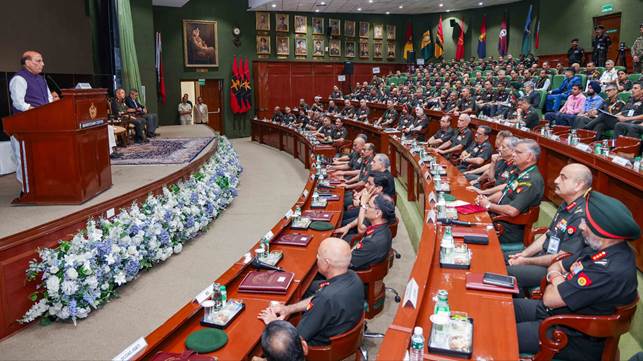
Addressing the Army Commanders’ Conference in New Delhi on October 23, the Raksha Mantri emphasised the need for continuous assessment of geopolitical and regional developments, flexible military strategies and sustained modernisation to prepare the Army for the rapidly changing character of warfare.
He stressed that the Indian Army must remain future-ready by anticipating emerging threats, adapting to technological advancements and strengthening its operational capabilities in line with evolving national security requirements.
On the occasion, Rajnath Singh released the Land Warfare Doctrine, an overarching framework aimed at preparing the Indian Army to meet the challenges of evolving warfare and future conflicts. The conference also provided a platform for senior military leadership to review ongoing initiatives, identify future priorities and formulate policy directions for building a technologically advanced, adaptive and progressive force.
Operation Sindoor Demonstrated Synergy, Innovation and Advanced Military Capabilities
Highlighting the operational lessons from Operation Sindoor, Rajnath Singh commended the Defence Forces for their ability to adapt to changing operational circumstances through innovative thinking, enhanced synergy and superior coordination, supported by advanced weaponry.
He said the operation demonstrated the importance of combining technological capabilities with effective coordination and operational preparedness.
According to the Defence Minister, Operation Sindoor sent a clear message that India would not hesitate to take necessary measures to safeguard its national interests.
The operation, he noted, underscored the importance of innovation, coordinated action and the effective employment of modern military capabilities in addressing contemporary security challenges.
The experience also reinforced the need for the Armed Forces to continuously evaluate their operational performance, identify areas requiring improvement and incorporate lessons from military engagements into future planning and preparedness.
20–30-Year Strategic Vision Alongside Immediate Operational Readiness
Emphasising the importance of long-term defence planning, the Raksha Mantri called upon Army Commanders to look beyond immediate operational requirements and prepare for the security environment that India may face over the next two to three decades.
He stressed that military planning must account for geopolitical shifts, regional security developments, emerging technologies and changes in the nature of future conflicts.
At the same time, he cautioned against losing sight of immediate and emerging challenges, underlining that long-term strategic planning must go hand in hand with operational readiness.
Rajnath Singh also emphasised that military strategies should remain dynamic and flexible rather than rigid. This would enable the Army to make timely adjustments in response to changing circumstances and emerging threats.
The Defence Minister’s message highlighted the need to balance long-term capability development with the ability to respond decisively to unforeseen security situations.
Multi-Domain Warfare Requires Integrated Military Planning
The Raksha Mantri highlighted that although the significance of challenges across the air, maritime, space and cyber domains is increasing, land warfare and ground forces will continue to play an indispensable role in national security.
He called for an integrated approach to modern warfare, stressing that operational success would increasingly depend on multi-domain capabilities and seamless coordination during joint operations.
The evolving battlefield requires the Armed Forces to operate in a coordinated manner, bringing together capabilities across different operational domains to achieve common objectives.
The emphasis on integration reflects the growing importance of synchronising military operations, intelligence, communications, surveillance and technological resources rather than relying on capabilities operating in isolation.
Rajnath Singh’s remarks underscored that the Indian Army must continue to strengthen its traditional land-warfare capabilities while adapting to the expanding role of advanced technologies and cross-domain military coordination.
Artificial Intelligence, Drones and Autonomous Systems to Shape Future Warfare
Underscoring the importance of technological transformation, Rajnath Singh appreciated the restructuring efforts undertaken by the military, particularly those focused on the use of drones and modern technologies.
He called for accelerated efforts to strengthen capabilities in emerging fields, including artificial intelligence, autonomous systems, data analytics, cybersecurity and secure communication networks.
These technologies are becoming increasingly significant in modern military operations, where information superiority, rapid decision-making, surveillance and secure connectivity can influence operational effectiveness.
The Defence Minister emphasised the need for the Armed Forces to continuously assess their performance and introduce improvements in accordance with changing operational requirements.
The focus on drones and autonomous systems also highlights the need to adapt military structures, operational procedures and training to technological developments that are reshaping the contemporary battlefield.
Alongside acquiring advanced equipment, the Army must ensure that technological innovations are effectively integrated into operational planning and decision-making processes.
Defence Production Touches Record Rs 1.78 Lakh Crore in FY 2025–26
Highlighting India’s progress towards self-reliance in defence manufacturing, Rajnath Singh said the growing capabilities of the domestic defence industry were the result of concerted efforts by multiple stakeholders.
He reiterated that the government, under the leadership of Prime Minister Narendra Modi, was prioritising Aatmanirbharta in defence amid the changing global security landscape.
According to the figures cited by the Defence Minister, India’s defence production reached a record Rs 1.78 lakh crore in the financial year 2025–26, while defence exports touched an all-time high of approximately Rs 38,000 crore.
The figures reflect the government’s emphasis on strengthening domestic manufacturing capabilities, expanding the defence industrial base and increasing India’s participation in the global defence market.
Self-reliance in defence is also a strategic priority, as stronger domestic production capabilities can support the availability of military equipment, reduce dependence on external suppliers and contribute to the development of indigenous technologies.
Rajnath Singh urged the Defence Forces to sustain these efforts and continue supporting the broader objective of building a stronger, technologically capable and self-reliant defence ecosystem.
‘Year of Reforms – 2025’: Focus on Effective Implementation
Referring to the Year of Reforms – 2025, the Raksha Mantri stressed that reform should be treated as a continuous process rather than a one-time exercise.
He emphasised that the success of reforms depended on effective implementation and their ability to deliver tangible improvements in operational capabilities.
Rajnath Singh urged Army Commanders to drive reforms within their respective commands and organisational levels, ensuring that policy decisions translate into measurable improvements on the ground.
The emphasis on implementation reflects the importance of converting institutional changes into practical outcomes, including improved operational effectiveness, more efficient resource utilisation and enhanced military preparedness.
He also called for continued attention to manpower management and organisational efficiency as the Army adapts to the demands of future warfare.
Greater Participation of Women and Improved Manpower Management
The Defence Minister identified improved manpower management and greater participation of women among the important priorities for strengthening the Defence Forces.
He urged the military leadership to continue working towards organisational reforms that enhance the effectiveness of the force while supporting its evolving operational and institutional requirements.
Effective manpower management remains essential for maintaining combat readiness, ensuring the appropriate deployment of personnel and aligning training and skills with emerging technological and operational needs.
Greater participation of women was also highlighted as an important area of focus as the Armed Forces continue to evolve in response to changing organisational requirements.
The broader emphasis was on ensuring that reforms contribute directly to the development of a more capable, adaptive and future-ready military.
Land Warfare Doctrine Released to Guide the Army’s Future Preparedness
A major highlight of the Army Commanders’ Conference was the release of the Land Warfare Doctrine, which provides an overarching framework for preparing the Indian Army to address the evolving character of warfare and future conflicts.
The doctrine is intended to guide the Army’s approach to the changing operational environment and support its efforts to remain prepared for emerging military challenges.
Its release comes amid growing emphasis on technological modernisation, integrated operations, operational flexibility and the need to prepare for increasingly complex security scenarios.
By providing a framework for future readiness, the doctrine represents an important element of the Army’s ongoing efforts to assess its requirements and adapt its capabilities to the changing nature of warfare.
The conference also served as a forum for the Army’s senior leadership to deliberate on ongoing initiatives, future priorities and policy directions aimed at strengthening the force.
Rajnath Singh Credits Armed Forces for Strengthening India’s Global Standing
Rajnath Singh credited the valour, discipline, preparedness and restraint demonstrated by the Defence Forces, along with the dynamic leadership and diplomatic efforts of Prime Minister Narendra Modi, for strengthening India’s position on the global stage.
He urged the Armed Forces to maintain their focus on self-reliance, effective implementation of reforms, improved manpower management, greater participation of women and an integrated approach to national security.
The Defence Minister’s remarks highlighted the relationship between military preparedness, institutional reforms, indigenous defence capabilities and India’s broader strategic interests.
He emphasised the need for the Defence Forces to continue developing capabilities that can address both conventional security challenges and emerging threats associated with technological and geopolitical changes.
Indian Army Personnel Felicitated for Contributions to UN Peacekeeping
In another significant event during the conference, Rajnath Singh unveiled the annual United Nations Journal and felicitated Indian Army personnel who had made notable contributions while serving as United Nations peacekeepers.
The personnel were recognised for their exemplary service, professionalism and contribution to international peace and security.
India has long contributed military personnel to United Nations peacekeeping missions, reflecting the role of its Armed Forces in supporting international peacekeeping efforts.
The recognition acknowledged the commitment and professionalism of Indian Army personnel serving in demanding operational environments beyond the country’s borders.
Senior Defence Leadership Attends Army Commanders’ Conference
The conference was attended by Raksha Rajya Mantri Sanjay Seth, Chief of Defence Staff General NS Raja Subramani, Chief of the Army Staff General Dhiraj Seth, Defence Secretary Rajesh Kumar Singh and other senior officials.
The Army Commanders’ Conference serves as an important forum for the Army’s senior leadership to review ongoing initiatives, assess operational and organisational requirements and determine future policy priorities.
With a comprehensive agenda focused on modernisation, reforms, technological advancement and operational preparedness, the conference aims to support the development of a progressive, adaptive and technologically enabled Indian Army.
Focus on a Future-Ready Indian Army
The Defence Minister’s address brought together several key priorities for the Army’s future: a long-term strategic vision, immediate operational readiness, lessons from Operation Sindoor, multi-domain integration, technological innovation and greater self-reliance.
His emphasis on preparing for the next 20–30 years while remaining alert to immediate threats reflects the need for a military that can anticipate future challenges without compromising its present capabilities.
The release of the Land Warfare Doctrine, alongside discussions on reforms, emerging technologies and defence manufacturing, further underlined the importance of aligning India’s military preparedness with the changing character of warfare.
As geopolitical conditions evolve and technological advancements reshape military operations, the Indian Army is being encouraged to strengthen its capabilities, improve coordination across domains and ensure that reforms deliver concrete operational benefits.
The overarching objective, as emphasised by Rajnath Singh, is to build a force that is strategically prepared, technologically advanced, operationally agile and capable of responding effectively to both present-day threats and future security challenges.