
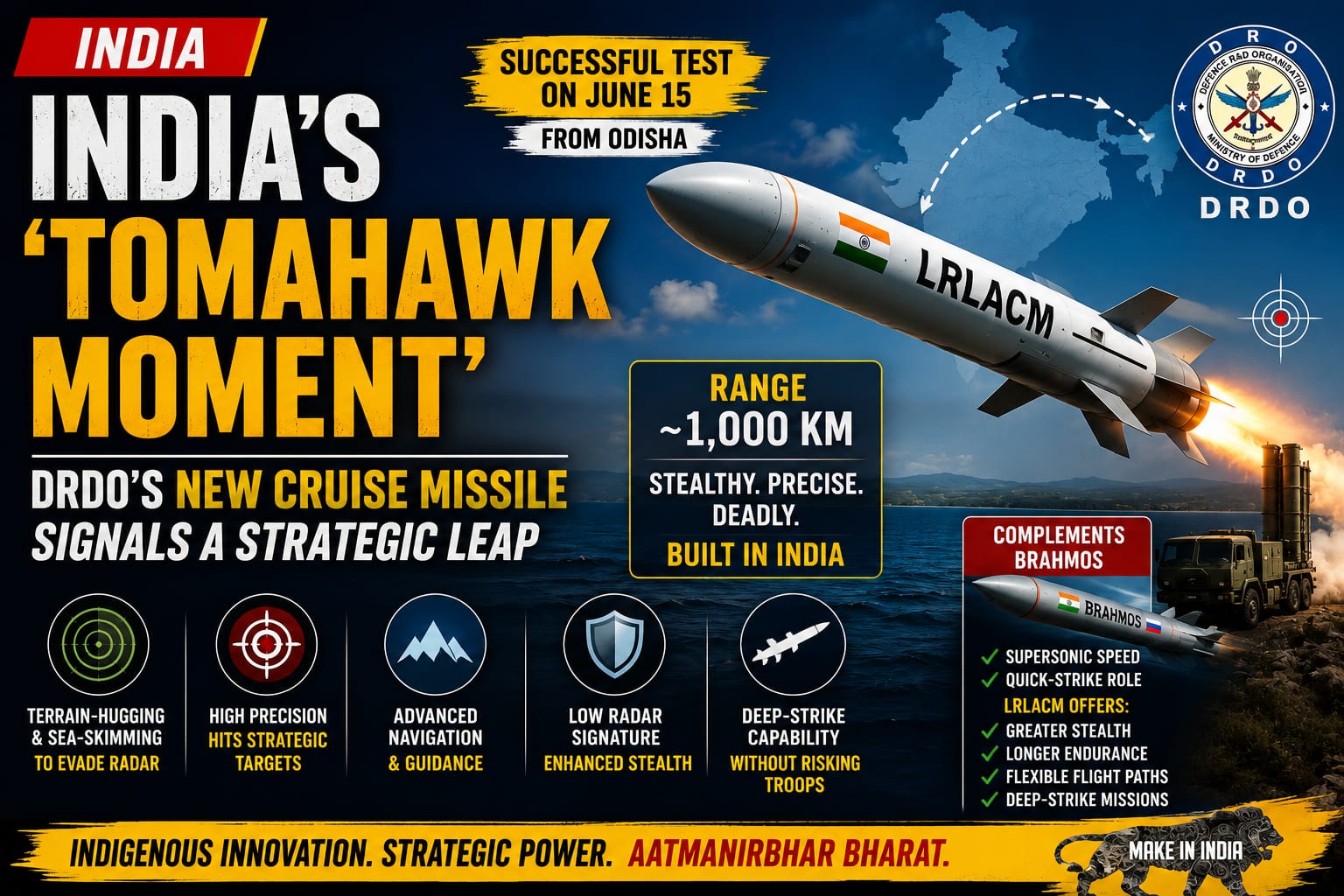
Stealthy, long-range and precision-guided, the LRLACM is set to redefine India’s conventional strike capability
New Delhi, June 18: India has taken a significant leap in strengthening its long-range strike capability with the successful flight-test of the indigenously developed Long Range Land Attack Cruise Missile (LRLACM)—a stealthy and precision-guided weapon being hailed as India’s answer to the iconic Tomahawk cruise missile.
Developed by the Defence Research and Development Organisation (DRDO), the missile was successfully tested from Dr APJ Abdul Kalam Island off the coast of Odisha on June 15. According to the Ministry of Defence, the missile met all mission objectives, with tracking systems validating its performance throughout the flight.
A New Weapon in India’s Arsenal
The LRLACM is designed to strike targets at distances of around 1,000 kilometres, enabling the Indian Armed Forces to engage strategic targets deep inside enemy territory without risking troops or combat aircraft.
The missile is expected to provide India with a potent conventional strike option capable of neutralising high-value targets such as command centres, radar installations, ammunition depots and critical infrastructure.
What Makes LRLACM Special?
The standout feature of the LRLACM is its ability to fly at extremely low altitudes in a terrain-hugging mode and skim over the sea surface.
This flight profile allows the missile to evade enemy radar systems and sophisticated air defence networks, making interception extremely difficult.
The missile is also equipped with:
- Advanced navigation and guidance systems.
- High-precision targeting capability.
- Ability to manoeuvre around obstacles and terrain features.
- Low radar cross-section for enhanced stealth.
- Capability to strike land-based strategic targets with pinpoint accuracy.
The combination of stealth, precision and long range places the LRLACM among the most advanced cruise missiles developed by India.
Successor to the Nirbhay Programme
The LRLACM is widely regarded as the successor to the Nirbhay cruise missile programme, which laid the foundation for India’s indigenous long-range cruise missile capability.
Over the years, DRDO incorporated lessons from multiple developmental trials, resulting in a more mature and technologically advanced system.
The latest successful test is being seen as a culmination of years of research and development aimed at reducing India’s dependence on imported strategic weapon systems.
How Does it Compare With BrahMos?
Defence experts believe the LRLACM will complement rather than replace the BrahMos missile.
While BrahMos is a supersonic cruise missile known for its speed and quick-strike capability, the LRLACM offers:
- Greater operational stealth.
- Longer endurance.
- Deep-strike capability.
- Flexible flight paths to evade enemy defences.
Together, the two missile systems are expected to provide India with a versatile and layered conventional strike capability.
A Boost to ‘Aatmanirbhar Bharat’
The missile has been developed largely using indigenous technologies with significant participation from Indian industry.
The successful test is being viewed as another milestone in the government’s ‘Aatmanirbhar Bharat‘ initiative aimed at boosting self-reliance in defence manufacturing and reducing dependence on foreign military hardware.
India has already emerged as a major defence exporter, and advanced indigenous systems such as the LRLACM are expected to further strengthen the country’s technological and strategic standing.
Strategic Implications
With the successful flight-test of the LRLACM, India joins a select group of nations possessing advanced long-range land attack cruise missiles capable of precision strikes while evading sophisticated air defence systems.
At a time of evolving regional security dynamics and rapid military modernisation across Asia, the induction of the LRLACM could prove to be a game-changer for India’s conventional deterrence posture.
The missile represents more than just a new weapon—it symbolises India’s growing prowess in indigenous defence technology and its ambition to emerge as a leading military power in the 21st century.