
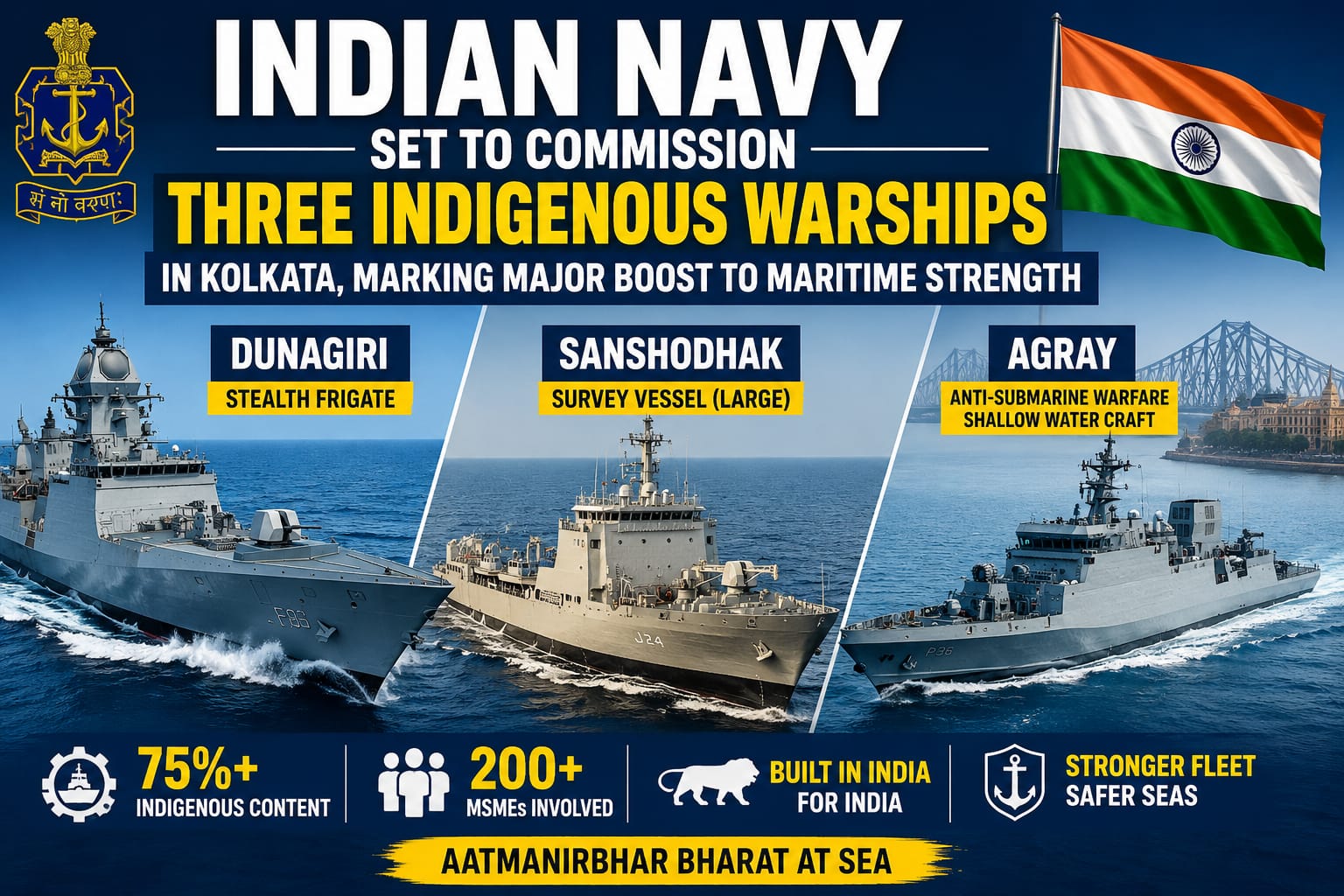
New Delhi, June 19: In a significant milestone for India’s maritime ambitions and indigenous defence manufacturing capabilities, the Indian Navy is set to commission three frontline naval platforms — Dunagiri, Sanshodhak and Agray — at a grand ceremony in Kolkata on June 21, 2026. The historic event will be presided over by Prime Minister Narendra Modi and is expected to showcase the growing strength of India’s indigenous shipbuilding ecosystem and the country’s resolve to emerge as a major maritime power.
Made in India, Built for Multiple Missions
All three vessels have been designed and built in India, underscoring the country’s growing self-reliance in defence production and the success of the Aatmanirbhar Bharat initiative. Developed by the Indian Navy’s Warship Design Bureau and constructed by Garden Reach Shipbuilders & Engineers (GRSE), Kolkata, these platforms are tailored to perform diverse operational roles ranging from maritime combat and hydrographic surveying to anti-submarine warfare. The commissioning of the three platforms reflects the Indian Navy’s balanced approach towards force development, aimed at enhancing blue-water capabilities, strengthening maritime domain awareness and safeguarding coastal waters against emerging security challenges.
Dunagiri: Stealth, Speed and Firepower
The most formidable among the trio is Dunagiri, the fifth stealth frigate under Project 17A. Equipped with state-of-the-art weapons and sensors, the warship boasts the formidable BrahMos supersonic cruise missile system along with the Medium Range Surface-to-Air Missile (MRSAM) system. Designed with advanced stealth features, Dunagiri is capable of undertaking a wide range of maritime operations, including anti-surface, anti-air and anti-submarine warfare. Its induction is expected to significantly enhance the Navy’s combat capabilities and operational reach in the strategically important Indian Ocean Region.
Sanshodhak: Expanding India’s Maritime Knowledge
Joining the fleet is Sanshodhak, the fourth Survey Vessel (Large), designed to conduct coastal and deep-water hydrographic surveys while collecting critical oceanographic and geophysical data. The vessel will serve both defence and civilian requirements and is fitted with advanced survey technologies, including Autonomous Underwater Vehicles (AUVs) and Remotely Operated Vehicles (ROVs), enabling precise underwater mapping and exploration. The data generated by Sanshodhak will play an important role in navigation safety, maritime infrastructure development and strategic planning, while also contributing to scientific research and disaster management efforts.
Agray: Strengthening Coastal Defence
The third platform, Agray, is the fourth vessel in the Arnala-class Anti-Submarine Warfare Shallow Water Craft series. Specially designed to operate in littoral and shallow waters, Agray is armed with lightweight torpedoes, indigenous rocket launchers and advanced sonar systems capable of detecting and neutralising underwater threats close to India’s coastline. With increasing strategic competition in the Indian Ocean and growing concerns over underwater surveillance and submarine activity, vessels like Agray will provide a critical layer of security to India’s coastal and near-shore waters.
Aatmanirbhar Bharat at Sea
Beyond their operational significance, the three platforms stand as a testament to the rapid growth of India’s indigenous shipbuilding ecosystem. With indigenous content exceeding 75 per cent, their construction witnessed the participation of more than 200 Micro, Small and Medium Enterprises (MSMEs), generating substantial employment opportunities and strengthening the domestic defence industrial base. The commissioning ceremony is expected to showcase the collaborative efforts of the Government of India, the Indian Navy, public sector shipyards, private industry and MSMEs in advancing indigenous defence manufacturing.
A New Chapter in India’s Maritime Journey
As the Indian Navy inducts these three advanced platforms into service, the event marks not only the addition of new warships to its fleet but also another important chapter in India’s journey towards strategic autonomy and maritime excellence. The commissioning of Dunagiri, Sanshodhak and Agray reinforces India’s vision of becoming a self-reliant naval power capable of protecting its interests across the vast expanse of the Indo-Pacific region while contributing to peace, stability and security at sea.