
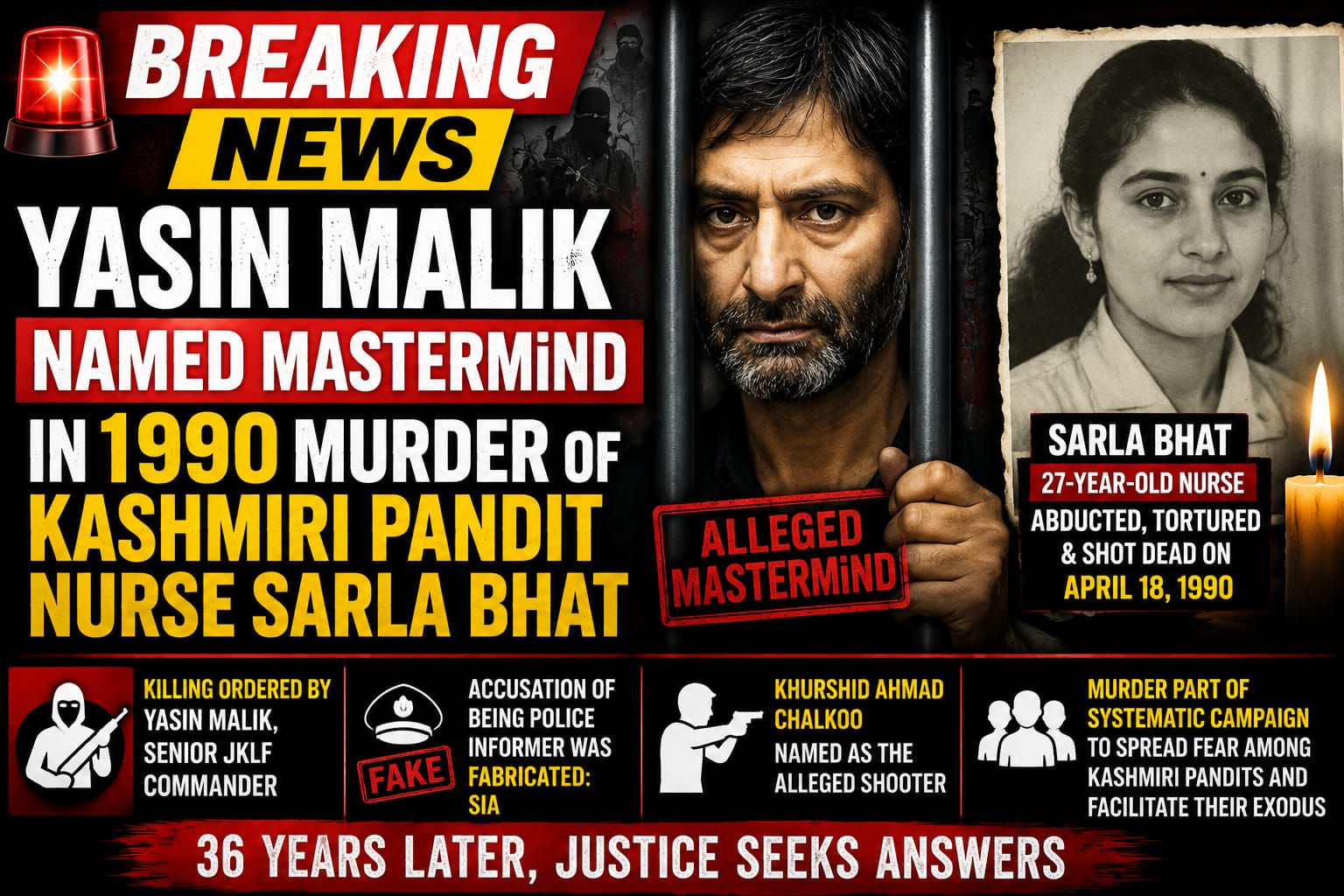
Srinagar, June 29: In a significant development more than three decades after the killing of Kashmiri Pandit nurse Sarla Bhat, the Jammu and Kashmir State Investigation Agency (SIA) has filed a 737-page chargesheet naming jailed Jammu and Kashmir Liberation Front (JKLF) chief Yasin Malik as the alleged mastermind behind her abduction, torture and murder in April 1990. The chargesheet describes the killing as part of a broader campaign of targeted terror aimed at creating fear among the Kashmiri Pandit community during the early years of militancy in the Valley.
The case is being seen as one of the most significant investigations into the targeted killings that took place during the insurgency in Jammu and Kashmir, with investigators claiming to have reconstructed the conspiracy through witness statements, documentary evidence and fresh findings gathered during the probe.
Sarla Bhat Abducted and Killed in 1990
According to the SIA, Sarla Bhat, a 27-year-old nurse employed at Sher-i-Kashmir Institute of Medical Sciences (SKIMS), was abducted from her residence on April 18, 1990. Investigators allege that she was illegally detained, subjected to torture and later shot dead.
The agency states that her killing sent shockwaves across the Valley at a time when targeted attacks against members of the Kashmiri Pandit community were increasing, contributing to widespread fear and insecurity.
Yasin Malik Named as Alleged Mastermind
The chargesheet alleges that Yasin Malik, who was then a senior commander of the JKLF, orchestrated the conspiracy leading to Sarla Bhat’s murder. Investigators claim the operation was carried out under his directions as part of the militant outfit’s activities during the early phase of the insurgency.
The SIA has accused Malik of playing a central role in planning and directing the crime, despite being lodged in prison in connection with other terrorism-related cases.
Allegation of Being Police Informer ‘Fabricated’: SIA
According to investigators, militants falsely accused Sarla Bhat of being a police informer to justify her abduction and killing. The SIA contends that its investigation found no credible evidence supporting the allegation and has described it as a fabricated accusation allegedly used as a pretext to eliminate her.
Officials say such false branding of civilians as informers was a common tactic employed by militant groups during that period to intimidate local populations and silence perceived opposition.
Shooter Identified, Other Conspirators Named
The chargesheet identifies Khurshid Ahmad Chalkoo as the alleged shooter who carried out the murder. Three other individuals have also been named as part of the alleged conspiracy; however, investigators noted that they are now deceased.
The agency stated that despite the passage of more than three decades, it has continued efforts to establish the sequence of events and identify those allegedly responsible for the crime.
Part of Wider Campaign Against Kashmiri Pandits
The SIA alleges that the murder of Sarla Bhat was not an isolated incident but formed part of a systematic campaign of targeted violence intended to terrorise the Kashmiri Pandit community and facilitate its mass exodus from the Valley during the early 1990s.
Investigators argue that targeted killings of civilians, government employees and community leaders created an atmosphere of fear that forced thousands of Kashmiri Pandit families to flee their homes, fundamentally altering the demographic and social fabric of Kashmir.
Investigation Revives One of Kashmir’s Most Sensitive Cases
The filing of the chargesheet marks a major milestone in one of Jammu and Kashmir’s oldest pending terror cases. Officials said the investigation reflects the government’s continued efforts to revisit unresolved cases related to terrorism and targeted killings, with the objective of ensuring accountability regardless of the time elapsed.
The matter will now proceed before the competent court, where the evidence presented by the SIA will be examined in accordance with the judicial process. The agency has maintained that its findings are based on extensive investigation and documentary evidence collected during the course of the probe.