
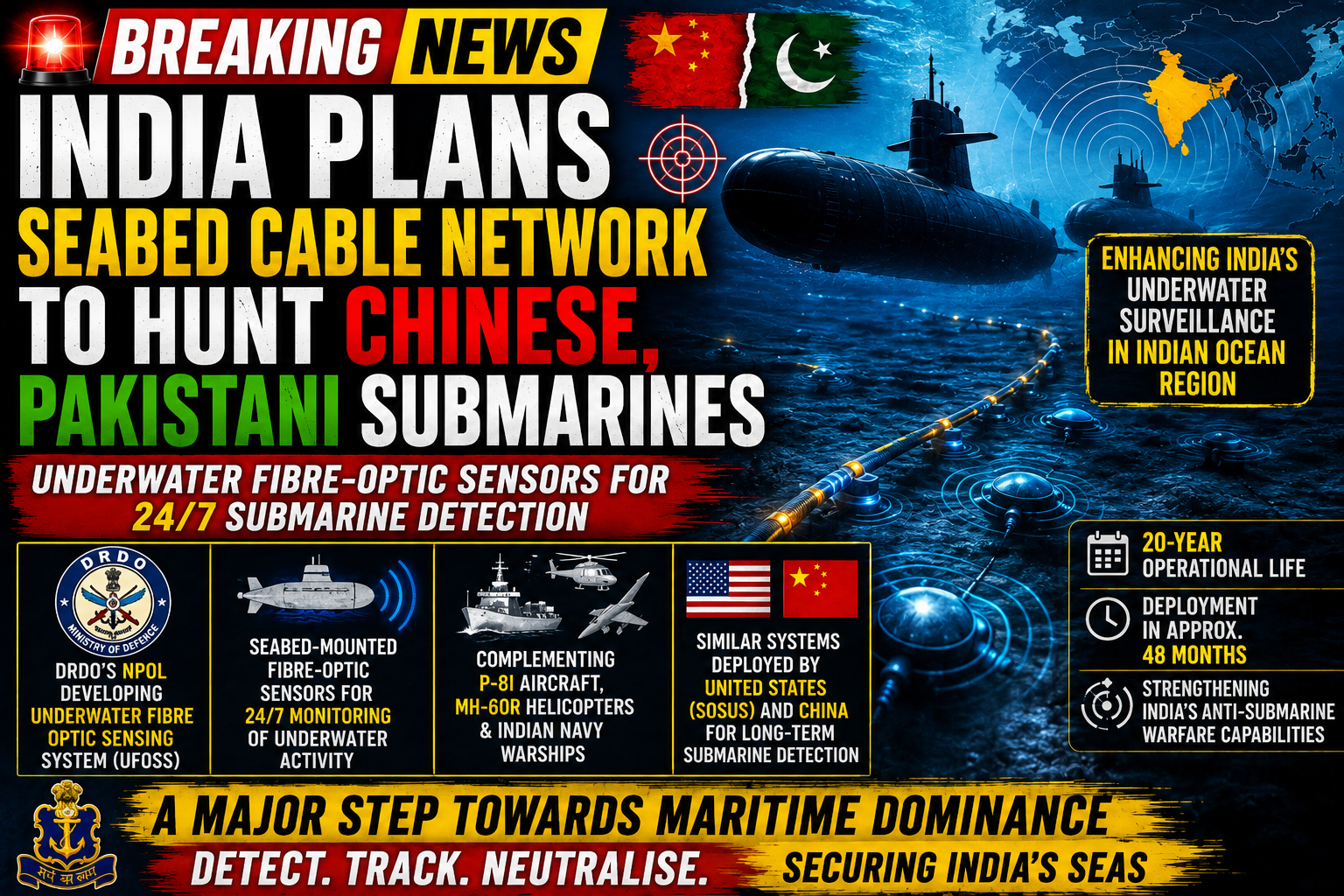
New Delhi, July 7: India is set to significantly strengthen its underwater surveillance capabilities with plans to develop a seabed-based fibre-optic sensor network designed to detect and track submarine movements in the Indian Ocean Region (IOR). The project is aimed at enhancing the Indian Navy’s anti-submarine warfare (ASW) capabilities amid the growing presence of Chinese and Pakistani submarines in the region.
The initiative is being spearheaded by the Defence Research and Development Organisation’s (DRDO) Naval Physical and Oceanographic Laboratory (NPOL), which has initiated the process for developing an Underwater Fiber Optic Sensing System (UFOSS).
24×7 Underwater Surveillance
The proposed UFOSS network will consist of fibre-optic sensors laid on the seabed, capable of continuously monitoring underwater activity. These sensors will detect acoustic signatures and vibrations generated by submarines and other underwater platforms, allowing security agencies to maintain round-the-clock surveillance of strategic maritime areas.
Unlike mobile surveillance platforms, the fixed sensor network will provide persistent monitoring without interruption.
Focus on Chinese and Pakistani Submarine Activity
The project comes at a time when the People’s Liberation Army Navy (PLAN) has steadily increased its deployments in the Indian Ocean, while Pakistan is modernising its submarine fleet, including the induction of Hangor-class air-independent propulsion (AIP) submarines being built with Chinese assistance.
The underwater surveillance network is expected to improve India’s ability to detect, classify and track hostile submarine movements at an early stage.
Complementing Existing Naval Assets
Officials say the seabed sensor network will complement the Indian Navy’s existing anti-submarine warfare capabilities, including:
- P-8I Poseidon long-range maritime patrol aircraft
- MH-60R Seahawk anti-submarine helicopters
- Indian Navy destroyers, frigates and corvettes equipped with advanced sonar systems
- Maritime surveillance drones and underwater sensors
Together, these platforms will create a multi-layered maritime surveillance architecture.
Similar to US SOSUS
The proposed system is comparable to the Sound Surveillance System (SOSUS) developed by the United States during the Cold War, which used seabed-mounted hydrophone arrays to track Soviet submarines.
China has also invested heavily in similar underwater sensor networks in strategically important maritime regions.
Long Operational Life
According to project documents, the proposed Underwater Fiber Optic Sensing System (UFOSS) is expected to have an operational life of approximately 20 years.
Following contract award, deployment of the complete network is expected to take around 48 months, after which it will provide continuous underwater surveillance across designated sectors.
Strategic Significance
Defence experts believe the project will significantly enhance India’s maritime domain awareness and strengthen its ability to monitor underwater threats in the Indian Ocean Region.
As submarine activity in the region continues to grow, the planned fibre-optic sensor network is expected to become a critical component of India’s future anti-submarine warfare and maritime security architecture.