
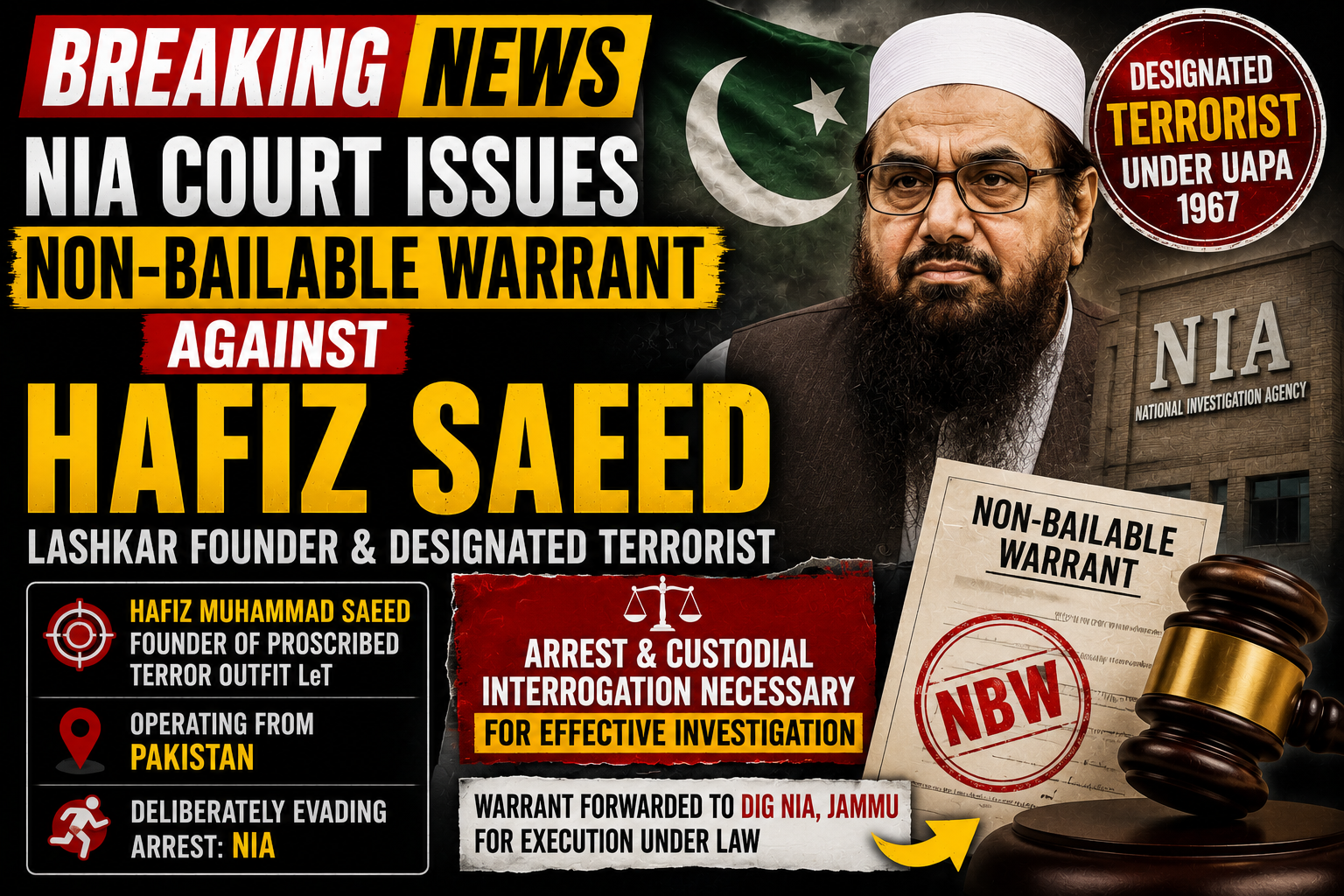
Jammu, July 13: In a significant development, a Special NIA Court in Jammu has issued an open-dated Non-Bailable Warrant (NBW) against Hafiz Muhammad Saeed, the founder of the banned terrorist organisation Lashkar-e-Taiba (LeT), in connection with an ongoing National Investigation Agency (NIA) probe.
According to court documents, the NIA informed the court that Hafiz Saeed, a designated terrorist under the Unlawful Activities (Prevention) Act (UAPA), 1967, is currently operating from Pakistan and has been deliberately evading arrest.
NIA Seeks Warrant
In its application, the NIA submitted that Saeed is required for arrest and custodial interrogation to ensure a fair, complete and effective investigation.
The agency stated that the accused has consistently remained outside the reach of Indian law enforcement agencies, necessitating the issuance of an open-dated non-bailable warrant to facilitate further legal proceedings.
Court’s Order
After hearing the NIA’s submissions and examining the application, the Special NIA Court observed that the arrest and custodial interrogation of Hafiz Saeed were necessary for the ongoing investigation.
The court subsequently issued an open-dated Non-Bailable Warrant (NBW) against Hafiz Saeed and directed that it be forwarded to the Deputy Inspector General (DIG), NIA Jammu, for execution in accordance with the prescribed legal procedure.
Who is Hafiz Saeed?
Hafiz Muhammad Saeed is the founder of Lashkar-e-Taiba (LeT), a Pakistan-based terrorist organisation banned under Indian law and designated as a terrorist organisation by several countries and international bodies.
He has also been designated as an individual terrorist under the UAPA and has been named in multiple terror investigations related to attacks in India.
Investigation Continues
The issuance of the warrant enables the NIA to continue legal proceedings against the accused and pursue further investigative steps under Indian law.
Officials said the warrant forms part of the agency’s continuing efforts to bring absconding and Pakistan-based terrorists to justice through available legal mechanisms.