
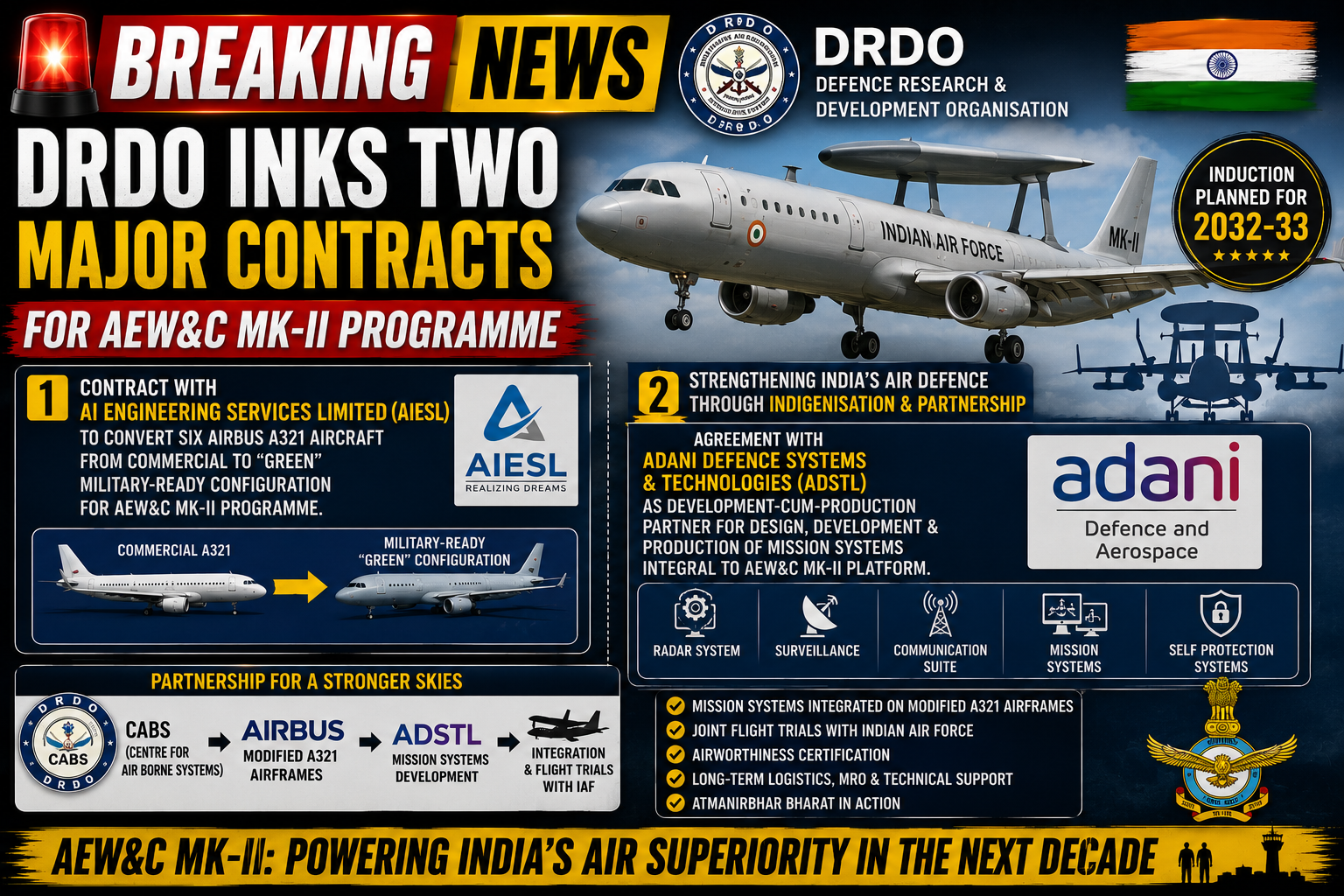
New Delhi: In a significant boost to India’s indigenous airborne surveillance capabilities, the Defence Research and Development Organisation (DRDO) has signed two major contracts with industry partners for the development of the Airborne Early Warning and Control (AEW&C) MK-II programme.
The agreements, signed through DRDO’s Centre for Air Borne Systems (CABS), mark a crucial step towards strengthening the Indian Air Force’s airborne surveillance, command and control capabilities under the Aatmanirbhar Bharat initiative.
AIESL to Convert Six Airbus A321 Aircraft
Under the first agreement, AI Engineering Services Limited (AIESL) will convert six Airbus A321 passenger aircraft into “green” military-ready platforms for the AEW&C MK-II programme.
The conversion process will involve stripping the commercial aircraft to their basic airframe configuration before integrating advanced military systems, making them suitable for airborne surveillance missions.
The modified A321 platforms will serve as the base aircraft for India’s next-generation airborne early warning system.
Adani Defence Named Development Partner
In a separate agreement, Adani Defence Systems and Technologies Limited (ADSTL) has been selected as the Development-cum-Production Partner (DcPP) for the programme.
ADSTL will be responsible for the design, development, production and integration of the sophisticated mission systems that form the core of the AEW&C MK-II aircraft.
These mission systems will include advanced surveillance sensors, communication suites, mission computers and electronic warfare capabilities.
Integration and Flight Trials
According to DRDO, the Centre for Air Borne Systems (CABS) will oversee the integration of the mission systems onto the modified Airbus A321 platforms.
Following integration, joint flight trials will be conducted with the Indian Air Force (IAF) to validate the aircraft’s performance and obtain airworthiness certification before induction into operational service.
Planned Induction by 2032–33
The AEW&C MK-II aircraft are expected to be inducted into the Indian Air Force between 2032 and 2033.
The programme also includes long-term provisions for:
- Maintenance, Repair and Overhaul (MRO)
- Logistics support
- Technical assistance
- Lifecycle sustainment
This is expected to ensure long-term operational availability of the fleet.
Major Boost for India’s Air Defence
The AEW&C MK-II will significantly enhance the Indian Air Force’s ability to:
- Detect enemy aircraft and missiles at long range.
- Monitor airspace in real time.
- Coordinate air combat operations.
- Provide battlefield command and control.
- Support network-centric warfare.
- Enhance situational awareness during military operations.
The aircraft will act as a force multiplier by extending the operational reach of fighter aircraft and air defence systems.
Strengthening Indigenous Defence Manufacturing
The contracts represent another major milestone in India’s push for indigenous defence production and public-private collaboration.
By combining the expertise of DRDO, AIESL, Adani Defence, Airbus, and the Indian Air Force, the programme aims to develop one of India’s most advanced airborne surveillance platforms using predominantly indigenous technologies.
Officials say the AEW&C MK-II programme will play a vital role in strengthening India’s air defence architecture and maintaining a technological edge in an increasingly complex regional security environment.