
Keel laying marks a key milestone in NGMV programme aimed at strengthening the Navy’s combat capability and indigenous warship-building capacity
Kochi, September 19, 2026:
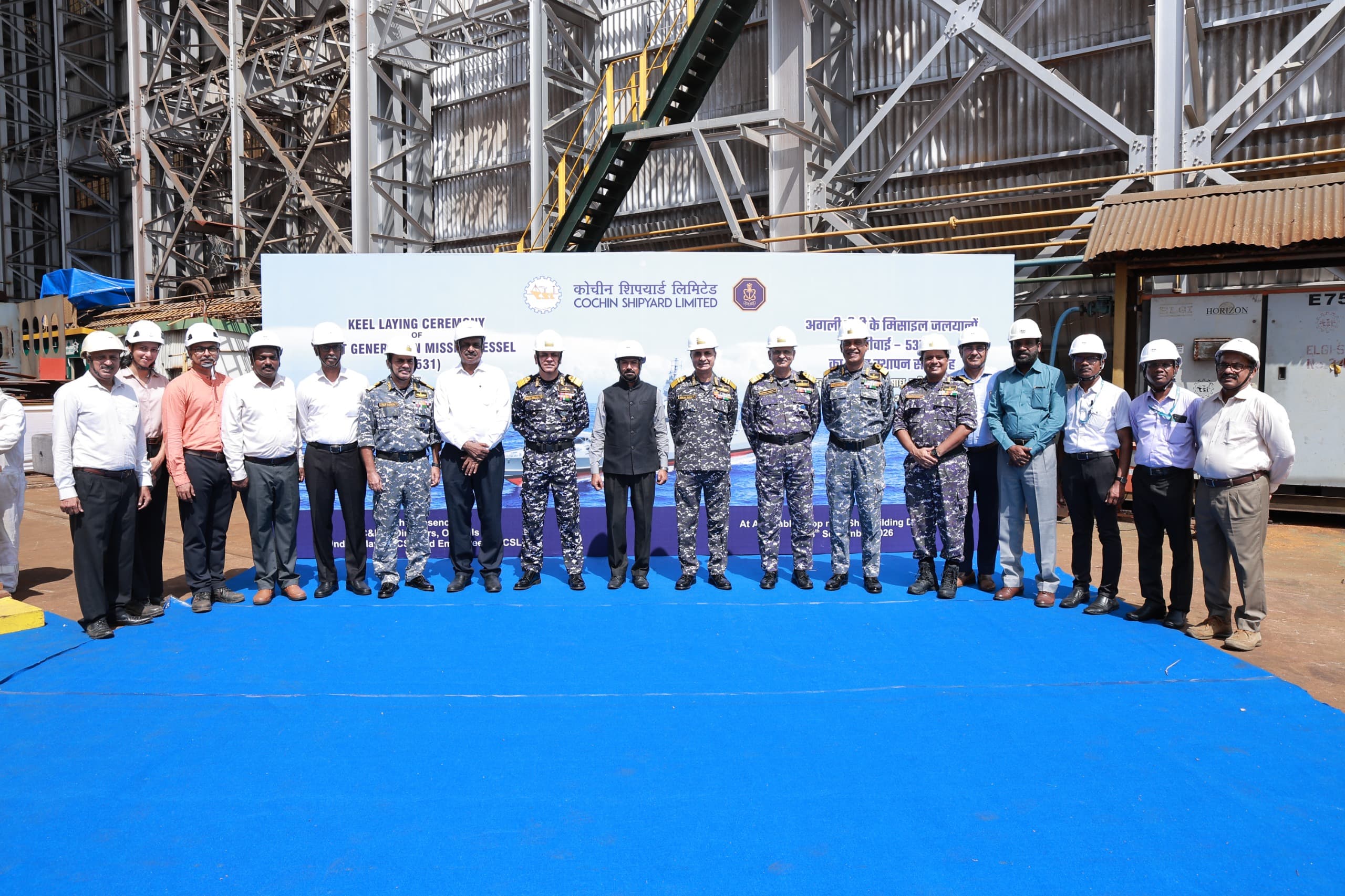
The keel of the first Next Generation Missile Vessel (NGMV) for the Indian Navy was laid at Cochin Shipyard Limited (CSL), Kochi) on September 18, marking a significant milestone in the construction of a new class of missile vessels for the force.
The keel-laying ceremony was attended by Vice Admiral Sanjay Sadhu, Controller of Warship Production & Acquisition, who was the Chief Guest. Senior officials from the Indian Navy and CSL were also present.
The construction programme is part of the Navy’s broader effort to strengthen its fleet with modern, indigenously built platforms capable of operating in an increasingly complex maritime environment.
NGMV Programme Contract Signed in 2023
The contract for construction of the Next Generation Missile Vessels was concluded with Cochin Shipyard Limited in March 2023.
The keel laying represents the formal commencement of a major stage in the construction of the first vessel under the programme.
According to the Ministry of Defence, the NGMVs will be equipped with state-of-the-art weapons and sensors, designed to significantly enhance the combat capabilities of the Indian Navy.
The vessels are being developed as part of the Navy’s objective of maintaining a future-ready and combat-ready force capable of responding to evolving maritime security requirements.
Designed for a Complex Maritime Environment
The Indian Ocean Region has witnessed increasing strategic and operational activity, placing greater emphasis on maritime surveillance, surface warfare, sea denial and rapid-response capabilities.
Against this backdrop, the NGMV programme is intended to add modern missile-vessel capabilities to the Navy’s fleet.
The vessels’ advanced weapons and sensor systems are expected to provide enhanced situational awareness and combat capability, although the Ministry of Defence release does not publicly specify the complete weapons and sensor configuration.
The platform will therefore form part of India’s broader effort to maintain a technologically capable naval force able to operate across the diverse maritime environment of the Indian Ocean Region.
Major Role-Defining Equipment to Be Indigenous
A key feature of the programme is its emphasis on indigenous development and manufacturing.
The Ministry of Defence stated that all major role-defining equipment for the NGMVs is being indigenously developed and manufactured.
This reflects the government’s broader Aatmanirbhar Bharat and Make in India objectives in defence production.
The move towards indigenous systems is particularly significant in warship construction, where modern vessels integrate multiple complex technologies, including weapons, sensors, communications, navigation and combat-management systems.
Greater domestic availability of such systems can also strengthen India’s defence industrial base and reduce dependence on foreign suppliers for critical naval capabilities.
Cochin Shipyard’s Role in Naval Shipbuilding
The NGMV programme further strengthens the role of Cochin Shipyard Limited in India’s naval shipbuilding ecosystem.
CSL has been involved in the construction of major vessels for the Indian Navy and Coast Guard and is among India’s key public-sector shipbuilding facilities.
The company’s participation in the NGMV programme contributes to the expansion of India’s indigenous warship-construction capacity and associated industrial supply chains.
The programme also supports the wider objective of developing domestic capabilities not only for building hulls, but also for integrating sophisticated combat and mission systems.
Strengthening a Future-Ready Indian Navy
The Navy has been pursuing a sustained modernisation programme focused on increasing the proportion of indigenously designed and built platforms in its fleet.
The NGMVs are expected to contribute to this effort by combining modern weapon and sensor technologies with an Indian-built platform.
The Ministry of Defence said the programme reinforces India’s commitment to building a strong and modern Navy capable of operating in the complex maritime environment of the Indian Ocean Region.
The keel laying is therefore an important programme milestone, although the vessel will undergo several further stages of construction, integration, testing and trials before eventual induction into the Navy.
Key Takeaways
- First NGMV keel laid at Cochin Shipyard Limited, Kochi.
- Ceremony held on September 18, 2026.
- Vice Admiral Sanjay Sadhu, Controller of Warship Production & Acquisition, was the Chief Guest.
- NGMV construction contract with CSL was concluded in March 2023.
- Vessels will feature advanced weapons and sensors.
- Programme is intended to strengthen the Navy as a future-ready and combat-ready force.
- Major role-defining equipment is being indigenously developed and manufactured, according to the Ministry of Defence.
- Programme supports Aatmanirbhar Bharat, Make in India and Make for the World objectives.
- Construction adds to India’s growing indigenous warship-building capability.
The keel laying of the first NGMV marks the transition of the programme into a significant construction phase and represents another step in the Indian Navy’s efforts to expand modern, indigenous maritime combat capabilities while strengthening India’s domestic defence-industrial ecosystem.