
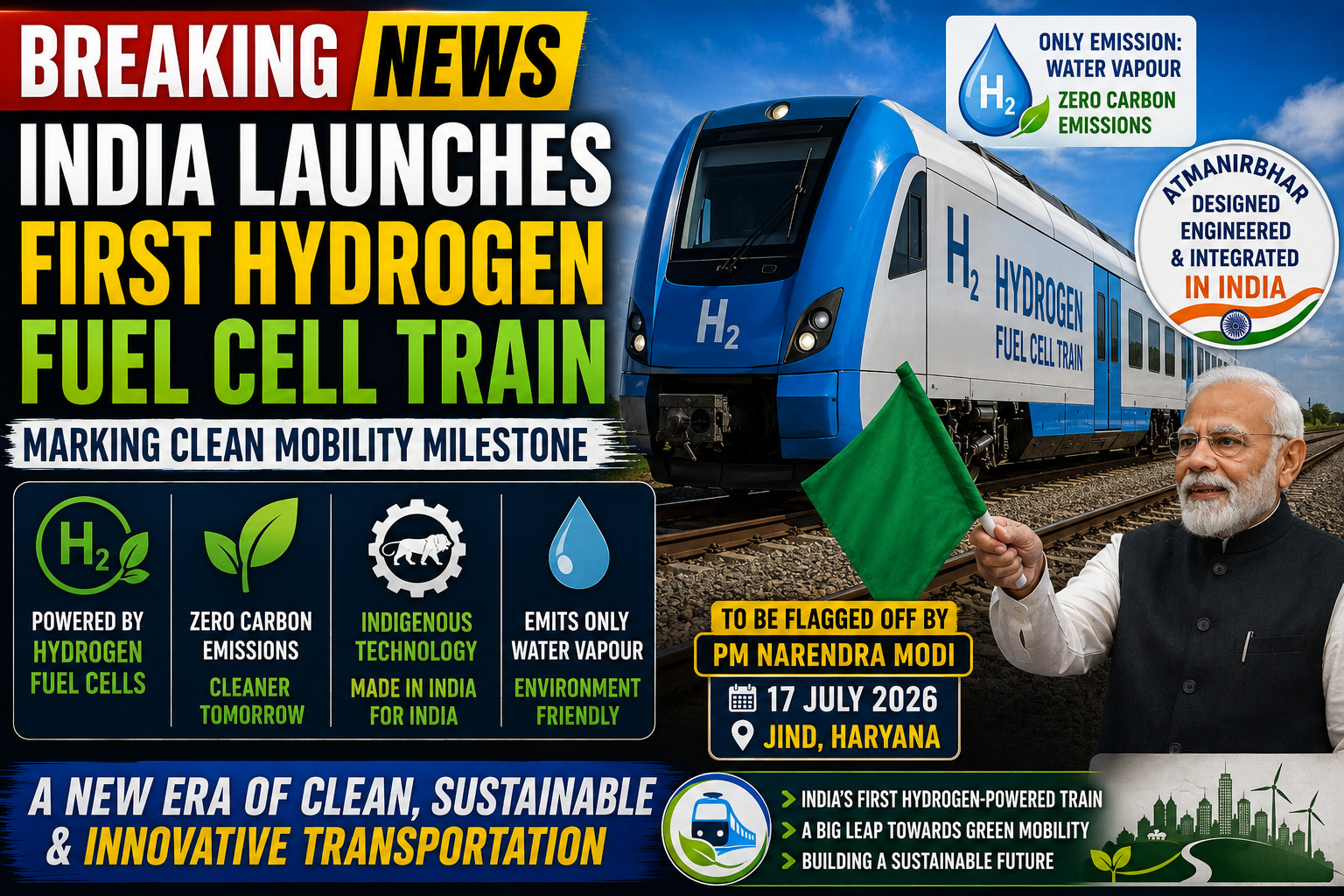
New Delhi/Jind: India is set to achieve a major milestone in sustainable transportation as Prime Minister Narendra Modi is scheduled to flag off the country’s first hydrogen fuel cell-powered train from Jind, Haryana, on July 17, 2026.
The launch marks a significant step in India’s transition towards clean, green and energy-efficient transportation, while reinforcing the government’s vision of Aatmanirbhar Bharat and sustainable infrastructure development.
First Hydrogen Train Built with Indigenous Technology
According to officials, the hydrogen-powered train has been designed, engineered and integrated entirely in India, using indigenous technology developed under Indian Railways’ green mobility programme.
Unlike conventional diesel-powered trains, the new train uses hydrogen fuel cells to generate electricity, making it one of the cleanest forms of rail transport.
Officials say the project showcases India’s growing capabilities in advanced railway engineering and clean energy technologies.
How Hydrogen Fuel Cell Technology Works
The train operates using hydrogen fuel cells, which generate electricity through a chemical reaction between hydrogen and oxygen.
Unlike diesel engines, the process does not involve combustion.
Instead, the only by-products are:
- Water vapour
- Heat
As a result, the train produces zero carbon dioxide emissions during operation, making it an environmentally friendly alternative to fossil fuel-powered locomotives.
A Big Push Towards Green Railways
The launch forms part of Indian Railways’ broader strategy to reduce its carbon footprint and move towards cleaner modes of transportation.
Hydrogen-powered trains offer several advantages, including:
- Zero carbon emissions.
- Reduced air pollution.
- Lower dependence on fossil fuels.
- Quieter operations compared to diesel locomotives.
- Improved energy efficiency.
The project is expected to contribute to India’s long-term climate commitments and support the country’s goal of achieving Net Zero emissions by 2070.
Supporting India’s Clean Energy Mission
The hydrogen fuel cell train is also aligned with the National Green Hydrogen Mission, under which India is investing heavily in hydrogen production, storage and transportation technologies.
Hydrogen is widely regarded as one of the fuels of the future because it can power industries and transport systems while significantly reducing greenhouse gas emissions.
Officials believe successful deployment of hydrogen-powered trains could pave the way for wider adoption of hydrogen technology across the country’s transport sector.
Indigenous Innovation
Railway officials have highlighted that the train has been developed using Made-in-India technology, reflecting the country’s growing expertise in advanced engineering and clean mobility solutions.
The project also supports the government’s focus on innovation, domestic manufacturing and technological self-reliance.
Significance of the Launch
The flagging-off ceremony at Jind, Haryana, is expected to mark the beginning of a new chapter in Indian Railways’ modernisation programme.
Industry experts believe hydrogen-powered trains could play an important role in reducing emissions on non-electrified railway routes while complementing India’s rapidly expanding electrified rail network.
The launch places India among a select group of countries investing in hydrogen-powered rail transport and demonstrates the country’s commitment to building a cleaner, more sustainable and technologically advanced transportation system.
With the introduction of its first hydrogen fuel cell train, India takes another significant step towards becoming a global leader in green mobility, clean energy and next-generation railway technology.