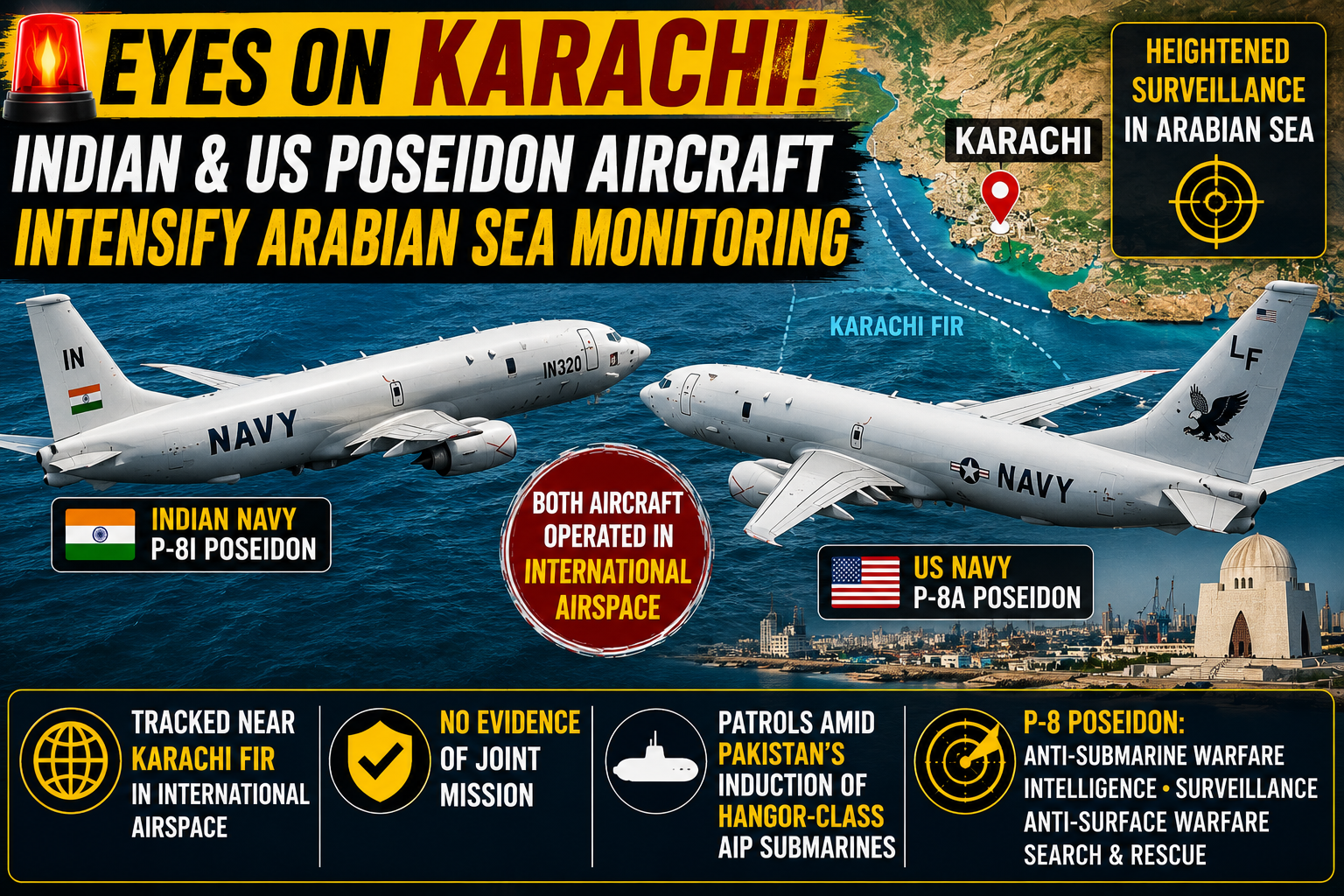
New Delhi, July 2: Maritime surveillance activity in the northern Arabian Sea has drawn fresh attention after publicly available flight-tracking data indicated that Indian Navy P-8I Poseidon and United States Navy P-8A Poseidon maritime patrol aircraft were operating in international airspace southwest of Karachi. While there is no evidence that the two aircraft were conducting a coordinated mission, their presence in the same broader maritime region underscores the increasing strategic importance of the Arabian Sea amid evolving regional security dynamics.
Aircraft Tracked Near Karachi FIR
Open-source flight tracking platforms showed the Indian Navy’s P-8I Poseidon and the US Navy’s P-8A Poseidon flying in areas close to the Karachi Flight Information Region (FIR). Both aircraft, however, remained within international airspace, and there is no indication that either aircraft violated Pakistani sovereign airspace.
Defence observers note that such patrols are routine for maritime reconnaissance aircraft operating in international waters, particularly in strategically important sea lanes.
No Evidence of Joint Operation
Although both aircraft were operating in the broader northern Arabian Sea around the same period, there is no official confirmation or evidence suggesting they were carrying out a joint surveillance mission.
The Indian Navy and the US Navy regularly conduct independent maritime patrols in the Indian Ocean Region to monitor shipping activity, submarine movements, and maritime security developments.
Increased Focus After Pakistan’s Naval Modernisation
The latest surveillance activity comes as regional attention remains focused on Pakistan’s efforts to modernise its submarine fleet, including the induction of Hangor-class Air Independent Propulsion (AIP) submarines, being developed with Chinese assistance.
The addition of AIP-equipped submarines is expected to enhance Pakistan Navy’s underwater endurance and stealth, prompting closer monitoring by regional naval forces.
The Arabian Sea has consequently witnessed increased maritime surveillance, anti-submarine warfare exercises, and naval deployments by several countries.
P-8 Poseidon: One of the World’s Most Advanced Maritime Patrol Aircraft
The Boeing P-8 Poseidon is regarded as one of the most capable long-range maritime patrol aircraft currently in service.
The Indian Navy’s P-8I variant is specifically customised for India’s operational requirements and plays a crucial role in safeguarding the country’s maritime interests across the Indian Ocean Region.
Its primary missions include:
- Anti-Submarine Warfare (ASW)
- Anti-Surface Warfare (ASuW)
- Intelligence, Surveillance and Reconnaissance (ISR)
- Long-range maritime patrol
- Search and Rescue (SAR)
- Maritime domain awareness
Equipped with advanced radar systems, electro-optical sensors, sonobuoys, electronic intelligence suites and anti-submarine weapons, the aircraft can detect, track and engage submarines and surface vessels over vast distances.
Strategic Importance of the Northern Arabian Sea
The northern Arabian Sea remains one of the world’s most strategically significant maritime regions. It serves as the primary approach to Pakistan’s ports, including Karachi and Gwadar, while also carrying a substantial portion of global energy shipments and commercial trade.
Given increasing naval competition in the Indian Ocean and the expanding presence of regional and extra-regional navies, surveillance missions by maritime patrol aircraft have become a regular feature of the security environment.
Routine Patrols, Heightened Attention
While the simultaneous presence of Indian and US Navy Poseidon aircraft has generated interest among defence observers, experts caution against interpreting such activity as evidence of coordinated military action without official confirmation.
At present, available flight-tracking data indicates that both aircraft were conducting operations in international airspace, consistent with routine maritime surveillance missions undertaken to maintain situational awareness in one of the world’s busiest and most strategically important maritime theatres.