
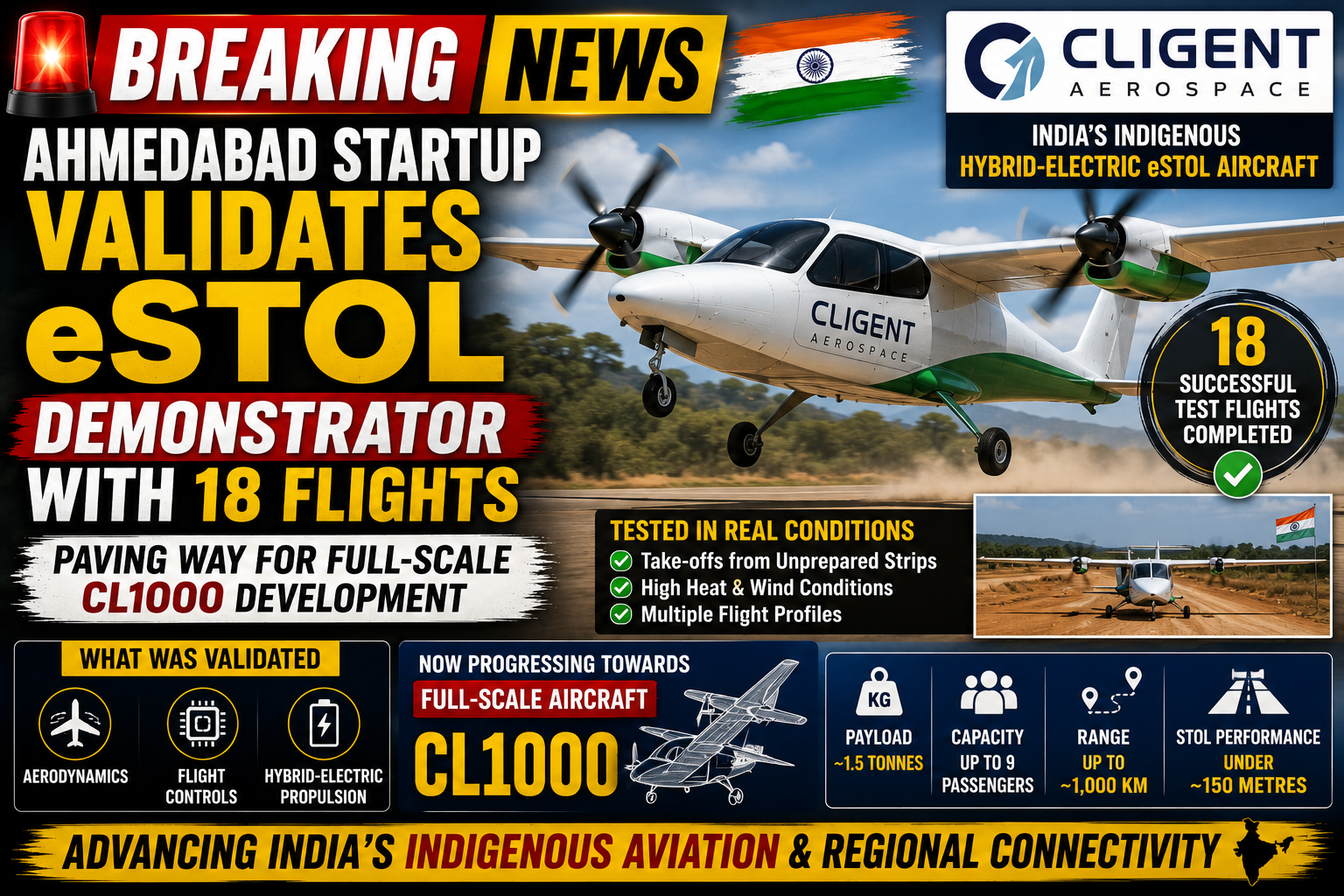
Ahmedabad, July 21: In a significant milestone for India’s indigenous aerospace sector, Ahmedabad-based Cligent Aerospace has successfully completed the flight-testing of its scaled hybrid-electric eSTOL (Electric Short Take-Off and Landing) demonstrator, bringing the company a step closer to developing its full-scale CL1000 aircraft.
The successful test campaign marks an important achievement in India’s efforts to develop next-generation sustainable aviation technologies capable of operating from short and unprepared airstrips.
18 Successful Test Flights
According to the company, the scaled fixed-wing demonstrator completed 18 successful test flights, validating several critical technologies, including:
- Aerodynamic performance.
- Flight control systems.
- Hybrid-electric propulsion.
- Aircraft stability and handling characteristics.
The trials were conducted under real operating conditions to assess the aircraft’s performance across different environments.
Tested in Challenging Conditions
The prototype was successfully operated under demanding conditions, including:
- Take-offs from unprepared and short airstrips.
- High-temperature environments.
- Strong wind conditions.
- Multiple flight profiles.
Officials said the tests confirmed the aircraft’s ability to operate reliably in diverse operational scenarios.
Development of Full-Scale CL1000
Following the successful demonstration, Cligent Aerospace is now moving toward the development of its full-scale aircraft, the CL1000.
The aircraft is expected to feature:
- Payload capacity of around 1.5 tonnes.
- Seating for up to nine passengers.
- Operational range of approximately 1,000 kilometres.
- Short Take-Off and Landing (STOL) capability requiring roughly 150 metres of runway.
These capabilities could enable operations in remote and underserved regions where conventional aircraft face operational limitations.
Boost for Regional Connectivity
Industry experts believe hybrid-electric STOL aircraft have the potential to transform regional air mobility by connecting:
- Remote villages.
- Border areas.
- Hilly terrain.
- Island territories.
- Disaster relief zones.
The technology could also reduce operating costs while significantly lowering emissions compared to conventional aircraft.
Supporting India’s Aerospace Ambitions
The achievement highlights the growing capabilities of India’s private aerospace ecosystem and aligns with the country’s focus on Aatmanirbhar Bharat, indigenous innovation and clean aviation technologies.
If successfully developed and certified, the CL1000 could become one of India’s first indigenous hybrid-electric STOL aircraft designed for commercial and utility operations, strengthening the country’s position in the emerging global market for sustainable aviation.