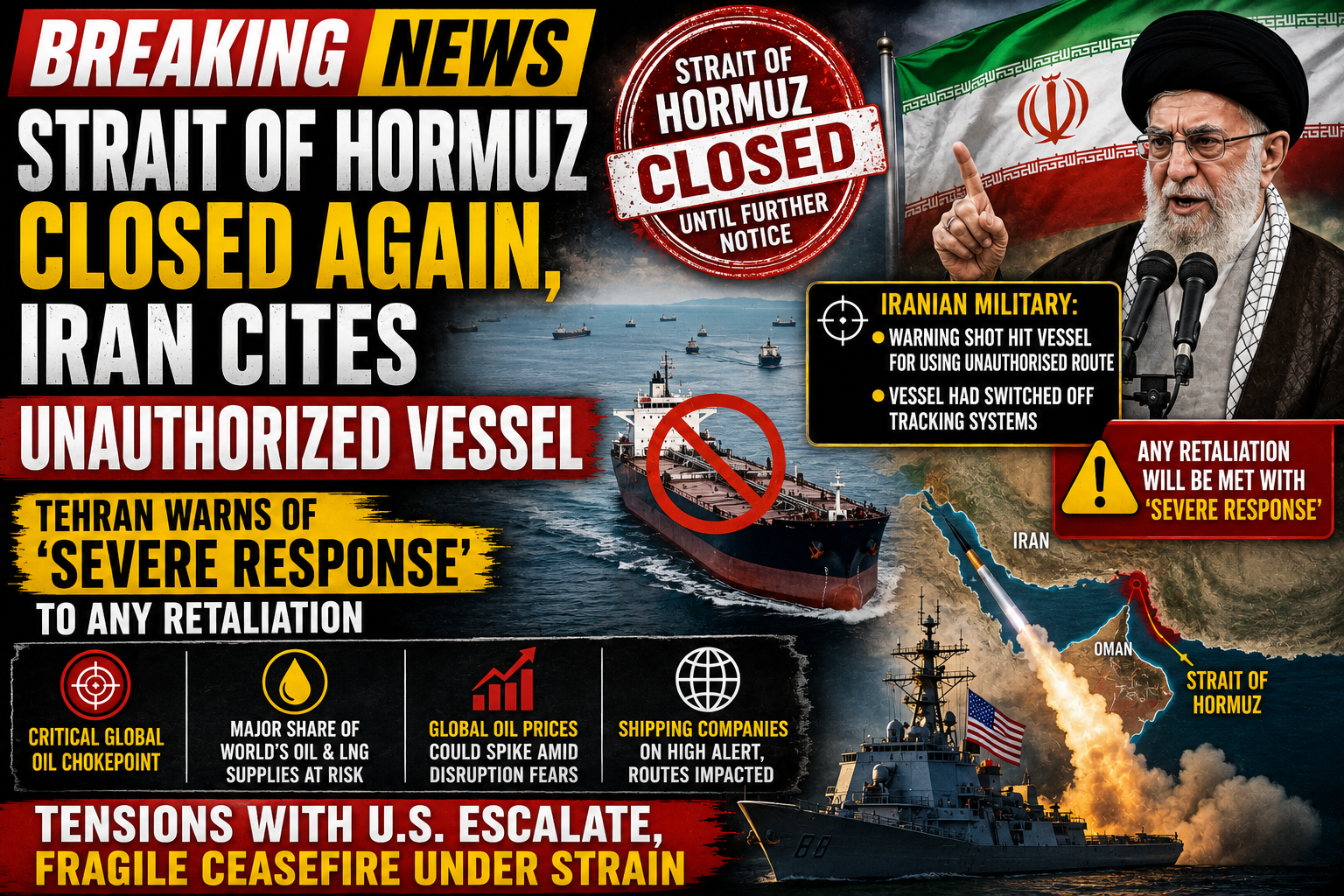
Dubai, July 12: Tensions in the Persian Gulf have escalated sharply after Iran announced the closure of the Strait of Hormuz “until further notice”, following an incident involving a vessel that Iranian authorities said travelled through an unauthorised shipping route while allegedly switching off its tracking systems. The latest development threatens to deepen the ongoing confrontation between Tehran and Washington and raises fresh concerns over global energy security.
According to a statement issued by the Islamic Revolutionary Guard Corps (IRGC) Navy, Iranian forces fired at a vessel after it allegedly ignored repeated warnings, deviated from an approved navigation route and disabled its Automatic Identification System (AIS) transponder, which is used to identify and track ships. The IRGC claimed the vessel posed a threat to maritime security and was brought to a halt. Iranian authorities have not publicly identified the vessel or disclosed its nationality.
Strait Closed “Until Further Notice”
Following the incident, the IRGC announced that the Strait of Hormuz would remain closed until further notice, stating that no vessels would be permitted to transit the waterway until what it described as the “end of U.S. interference” in the region. Tehran also warned that any military response or retaliation over the incident would be met with a “severe response,” signalling a further hardening of its position.
Renewed Pressure on Fragile Regional Stability
The announcement comes amid an already volatile security situation in the Gulf, where military exchanges between Iran and the United States have intensified in recent weeks. The latest maritime confrontation has further strained efforts to stabilise the region, with both sides accusing each other of escalating tensions.
Strategic Importance of the Strait
The Strait of Hormuz is regarded as one of the world’s most strategically important maritime chokepoints. Connecting the Persian Gulf with the Gulf of Oman and the Arabian Sea, it serves as a critical route for international energy trade. A substantial share of the world’s seaborne crude oil and liquefied natural gas exports passes through the narrow waterway every day.
Any disruption to shipping through the Strait has the potential to affect global energy markets, increase shipping insurance costs, disrupt supply chains and trigger volatility in international oil prices.
Global Shipping Under Watch
The latest closure announcement is expected to prompt shipping companies, insurers and naval forces operating in the region to reassess security measures for commercial vessels transiting the Gulf. Governments across the world are also closely monitoring the situation due to the Strait’s critical role in global trade and energy supplies.
Situation Remains Fluid
While Iran has declared the Strait closed, reports indicate that the United States maintains that commercial shipping continues to move through parts of the waterway despite Tehran’s announcement. The evolving situation remains highly dynamic, with diplomatic and military developments expected in the coming days.