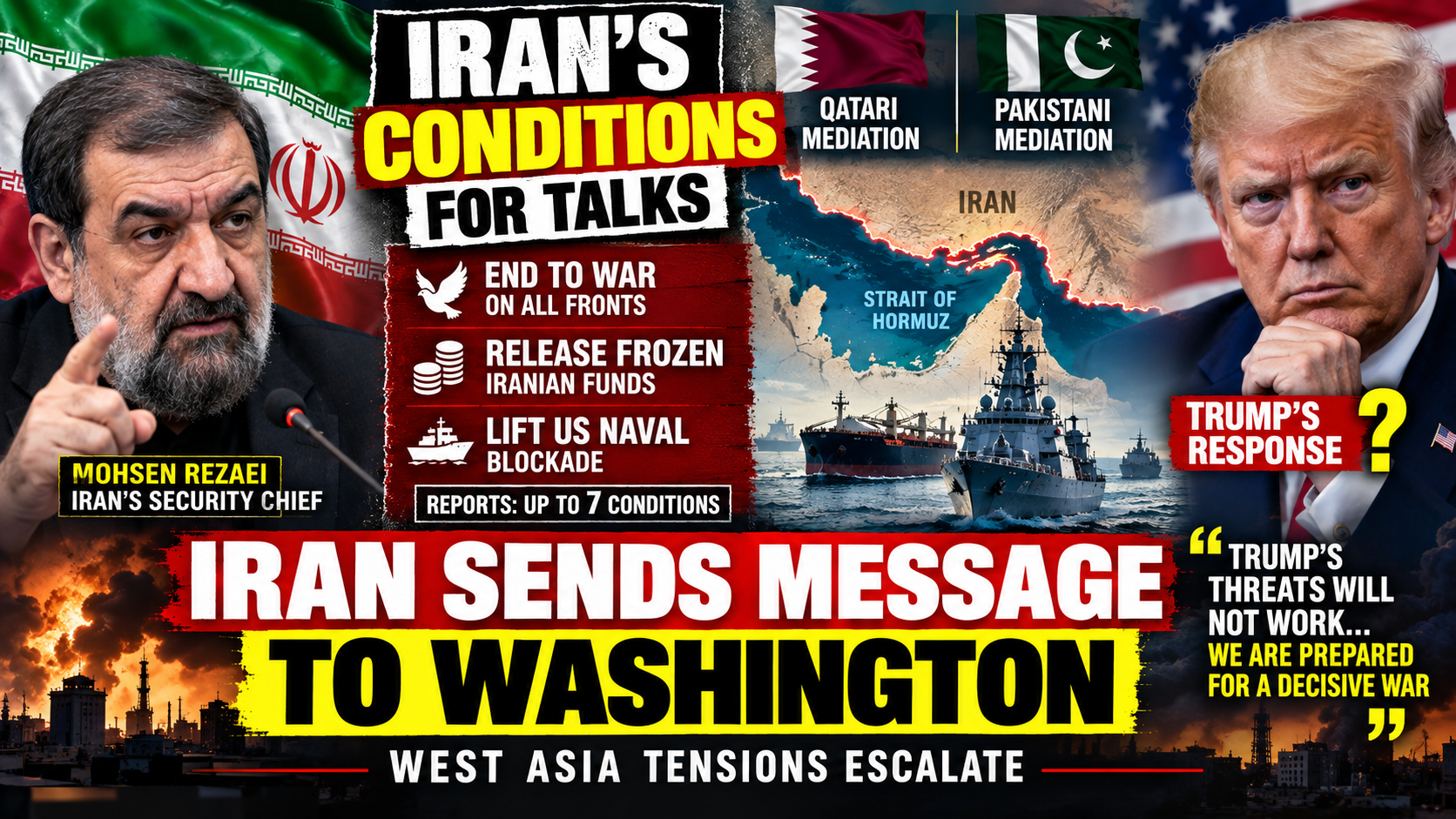
Mohsen Rezaei says Tehran has communicated terms through Qatar; demands include ending the war, releasing frozen Iranian assets and lifting the US naval blockade
Tehran/Washington, September 20, 2026:
Iran has communicated conditions to the United States for restarting negotiations aimed at ending the ongoing conflict, with Tehran saying the message has been conveyed through Qatari mediation as military tensions continue to escalate across West Asia.
Mohsen Rezaei, secretary of Iran’s Supreme National Security Council, said Tehran was awaiting a response from US President Donald Trump after Qatar conveyed Iran’s position to Washington. In separate comments, Rezaei said Iran had formally communicated seven conditions for reopening negotiations, although the full list has not been publicly disclosed.
Three Main Demands Publicly Identified
Rezaei publicly identified three central Iranian demands:
- An end to the war on all fronts
- Release of frozen Iranian funds/assets
- An end to the US naval blockade
Iranian officials have linked these conditions to the possibility of restarting diplomatic negotiations with Washington. Reports from Iranian and regional media indicate that the broader seven-point framework has not been fully made public.
Rezaei said Tehran was awaiting Trump’s response and argued that US threats would not force Iran to change its position.
In comments reported by Al Jazeera and other outlets, he also warned that Iran was prepared for what he described as a “decisive war” if its demands were rejected.
Qatar and Pakistan Remain Part of Diplomatic Efforts
Qatar has emerged as the principal intermediary in the latest communication between Tehran and Washington.
At the same time, Pakistan continues to play a diplomatic role. Pakistani Interior Minister Mohsin Naqvi was expected to travel to Tehran, with Iranian officials acknowledging Islamabad’s continuing efforts to facilitate dialogue.
Iranian Foreign Ministry spokesman Esmaeil Baghaei said Pakistan’s mediation efforts were natural but indicated that he was not aware of a specific US proposal that Naqvi was carrying.
The latest diplomatic channel follows the collapse of an earlier Pakistan-hosted memorandum of understanding between Iran and the United States. That arrangement had been intended to halt fighting and open a pathway towards broader negotiations, but it expired after the two sides accused each other of violations.
Strait of Hormuz at the Centre of the Crisis
The Strait of Hormuz remains a critical element of the confrontation.
Iran has made the lifting of the US naval blockade one of its publicly stated conditions. Rezaei has also said that Tehran and Oman had come close to an agreement concerning arrangements for the waterway, although that initiative was subsequently shelved.
The strategic importance of Hormuz extends far beyond the immediate Iran-US confrontation. The waterway is a major route for global energy shipments, and continued disruption has already affected maritime trade and shipping through the Gulf. The Financial Times reported that container traffic through the strait had fallen sharply amid the conflict, while shipping costs and transit times increased.
Recent developments have further heightened concerns. The Associated Press reported that Iran claimed its Revolutionary Guard had struck a Togo-flagged tanker in the Strait of Hormuz, while Tehran has threatened action against vessels it considers to be making unauthorised transit.
Iran Signals Diplomacy and Military Preparedness
Despite the diplomatic initiative, Rezaei has simultaneously adopted a hard-line military position.
He said Iran was preparing for the possibility of renewed US military action and claimed Tehran had adjusted its military planning following earlier rounds of fighting.
Rezaei also claimed that Iran had recently tested a multi-warhead anti-ship missile near a US naval asset and said Iranian forces were better prepared for possible future attacks. These military claims have not been independently verified.
The comments indicate that Tehran is maintaining two parallel tracks: keeping diplomatic channels open while preparing for the possibility that negotiations fail.
Regional Conflict Continues to Spread
The diplomatic developments come against a backdrop of continuing military activity across the region.
Saudi Arabia and Yemen’s Iran-backed Houthi movement have exchanged attacks, with Reuters reporting fresh cross-border strikes in September. The escalation has also created additional risks for shipping routes around the Red Sea and Gulf.
The simultaneous pressure around Hormuz and the Red Sea/Bab el-Mandeb corridor has increased concerns over energy supplies and international maritime trade.
For Washington and its regional partners, the challenge is therefore not limited to the Iran-US military confrontation but also involves the security of strategically important waterways.
Nuclear Issue Remains a Separate Flashpoint
Rezaei also addressed Iran’s nuclear policy, saying Tehran had not decided to withdraw from the Nuclear Non-Proliferation Treaty (NPT).
He maintained that Iran’s nuclear doctrine had not changed, while warning that future developments could influence Tehran’s position.
His remarks come amid continuing tensions over Iran’s nuclear programme and the possibility of additional international pressure.
What Happens Next?
The immediate focus is now on Washington’s response to the Iranian conditions.
Iran has publicly identified three demands while saying that a broader seven-condition framework has been communicated through Qatar. The United States has yet to accept those terms, and the situation remains fluid.
At the same time, continued fighting, pressure on maritime routes and threats of renewed military action mean that the diplomatic track is unfolding alongside significant military risks.
Key Takeaways
- Iran says it has conveyed seven conditions to Washington for restarting negotiations.
- Qatar has served as the principal intermediary in transmitting Tehran’s terms.
- Three publicly identified demands are an end to the war, release of frozen Iranian assets and lifting of the US naval blockade.
- Pakistan is also continuing diplomatic engagement with Tehran.
- The Strait of Hormuz remains a central issue in the confrontation.
- Iran’s security chief has warned of a “decisive war” if its conditions are rejected.
- Iranian claims regarding recent missile tests and military preparations remain unverified.
- Regional fighting involving Saudi Arabia and the Houthis continues to add pressure to already disrupted maritime routes.
The latest Iranian message leaves diplomacy open but sets out conditions that Washington would have to consider before negotiations can resume. With military activity continuing and the security of key maritime routes under pressure, the next response from Washington could significantly shape the direction of the conflict.