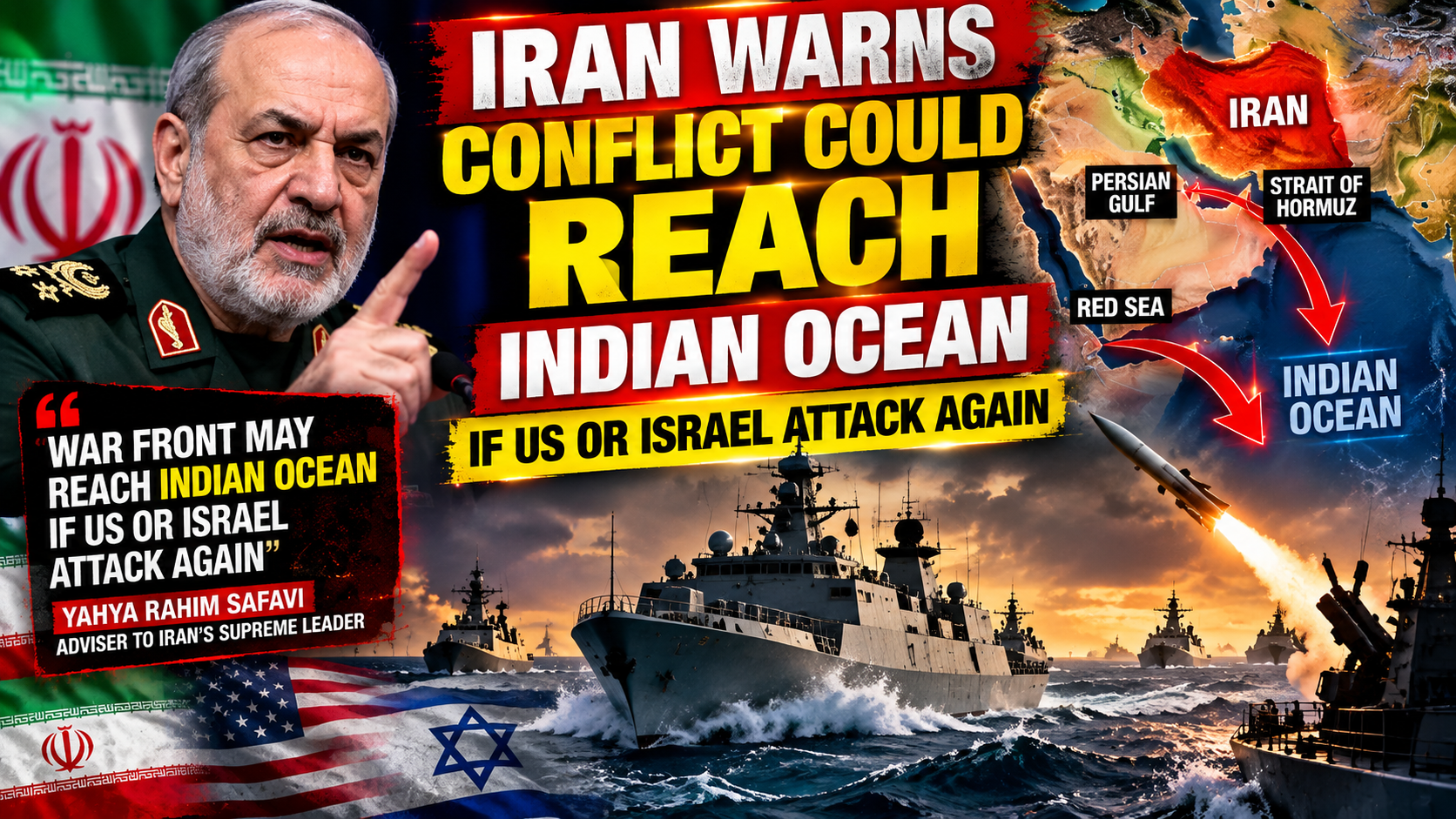
Supreme Leader’s adviser Yahya Rahim Safavi says the war could move beyond the Persian Gulf, Strait of Hormuz and Red Sea; warning raises concerns over maritime security and energy routes
Tehran, September 24, 2026:
Iran has warned that the ongoing conflict in West Asia could expand into the Indian Ocean if the United States or Israel launches further attacks, marking a significant escalation in Tehran’s rhetoric over the geographical scope of the confrontation.
Yahya Rahim Safavi, an adviser to Iran’s Supreme Leader Mojtaba Khamenei, made the warning in a video released by Iran’s Fars news agency. Safavi said that after the conflict had extended from the Persian Gulf and Strait of Hormuz to the Red Sea, a further expansion towards the Indian Ocean was possible if fighting resumed or intensified.
Tehran Signals Possible Expansion of Maritime Front
Safavi’s comments represent a warning rather than confirmation that Iran has decided to open a new military front in the Indian Ocean.
He said that if the United States or Israel attacked Iran again, the geographical scope of the conflict could expand further, potentially reaching the Indian Ocean and beyond.
The statement comes as the conflict has increasingly acquired a maritime dimension, with the Strait of Hormuz and Red Sea becoming important areas of confrontation.
The Strait of Hormuz is a critical global energy chokepoint, while the Red Sea and Bab el-Mandeb connect the Middle East with the Indian Ocean and provide an important route for commercial shipping between Asia and Europe.
Indian Ocean Raises Wider Maritime Concerns
The possibility of the conflict spreading into the Indian Ocean has particular significance for countries whose energy supplies and commercial trade depend on maritime routes linking the Gulf with Asian markets.
The New Indian Express reported that the Iranian warning has raised concerns for India because of its dependence on maritime routes for energy and trade with West Asia.
However, Safavi’s statement does not specify what form any potential Iranian expansion into the Indian Ocean would take, nor does it identify particular targets or locations.
The warning therefore indicates a potential geographic expansion of the conflict rather than establishing that hostilities are already taking place throughout the Indian Ocean.
Hormuz and Red Sea Already Under Pressure
The latest warning follows months of heightened maritime tensions.
The United States and Iran have exchanged attacks involving shipping and military assets around the Strait of Hormuz, with both sides seeking to influence control of the strategic waterway.
At the southern end of the Red Sea, the Bab el-Mandeb Strait has also become increasingly important to the wider conflict amid fighting involving Yemen’s Houthi movement.
AFP reported that the Houthis had recently taken control of sections of Yemen’s Red Sea coastline, increasing their influence around the strategic maritime corridor. Iran has long provided military support to the Houthis while denying direct involvement in the Yemen conflict.
This creates a chain of strategically important waterways extending from the Persian Gulf → Strait of Hormuz → Gulf of Aden → Bab el-Mandeb → Indian Ocean.
Implications for Shipping and Energy
Any further disruption across this maritime network could have consequences for international shipping and energy markets.
The Strait of Hormuz has already experienced severe disruption during the conflict. The Financial Times reported that container traffic through the strait had fallen sharply, while shipping costs, insurance expenses and transit times had increased.
The wider disruption has also affected alternative routes. Recent reporting indicates that Saudi Arabia has faced difficulties using Red Sea alternatives because of continuing security threats, increasing pressure on regional energy-export infrastructure.
A further expansion into the Indian Ocean would therefore introduce additional uncertainty for commercial vessels and energy shipments moving between West Asia and Asian markets.
Iran Keeps Diplomatic Track Open
Safavi’s warning comes alongside continuing diplomatic activity.
Iranian President Masoud Pezeshkian has continued to signal that Tehran remains engaged with diplomatic efforts, even while rejecting what Iranian officials describe as US military pressure.
Iran has previously communicated conditions for negotiations with Washington through intermediaries, including demands concerning the war and the status of the Strait of Hormuz.
This creates a dual-track situation in which Tehran is maintaining the possibility of negotiations while simultaneously warning that further military action could trigger escalation.
Claims About Iranian Military Capabilities
Iranian officials have repeatedly highlighted their missile and naval capabilities during the conflict.
Tehran has claimed progress in areas including long-range missiles, anti-ship systems and hypersonic weapons. Such claims about specific weapons capabilities should be distinguished from independently verified battlefield assessments.
The latest Safavi warning similarly does not provide operational details about how Iran might seek to extend the conflict into the Indian Ocean.
Why the Indian Ocean Matters
The Indian Ocean connects major energy-producing regions of the Middle East with some of the world’s largest consumer markets in Asia.
Its importance extends beyond commercial shipping. The region also hosts major naval deployments and strategically important maritime routes.
Any expansion of the conflict into this wider maritime space could therefore have implications not only for Iran, the US and Israel but also for India, Gulf states, shipping companies and other regional and international actors.
For now, however, Safavi’s statement should be viewed as an Iranian warning about a possible future escalation, rather than evidence that a new Indian Ocean military front has already opened.
Key Takeaways
- Iranian Supreme Leader’s adviser Yahya Rahim Safavi warned that the conflict could reach the Indian Ocean.
- He said the warning applies if the US or Israel launches further attacks against Iran.
- Safavi said the conflict had already expanded from the Persian Gulf and Strait of Hormuz to the Red Sea.
- His statement does not specify particular Indian Ocean targets or operations.
- The Strait of Hormuz and Bab el-Mandeb remain critical maritime chokepoints amid the conflict.
- Further disruption could affect shipping, insurance, trade and energy supplies.
- The warning comes while Iran continues to signal that diplomatic engagement remains possible.
- Iranian claims concerning advanced missile capabilities, including hypersonic systems, should be distinguished from independently verified capabilities.
- For India, any wider maritime disruption could affect energy and commercial shipping routes linking West Asia and Asian markets.
Safavi’s remarks underscore the widening geographical stakes of the US-Iran confrontation. Whether the warning translates into actual military activity in the Indian Ocean remains uncertain, but the possibility has added another layer to an already complex maritime security situation stretching from the Persian Gulf and Red Sea towards the wider Indian Ocean.