
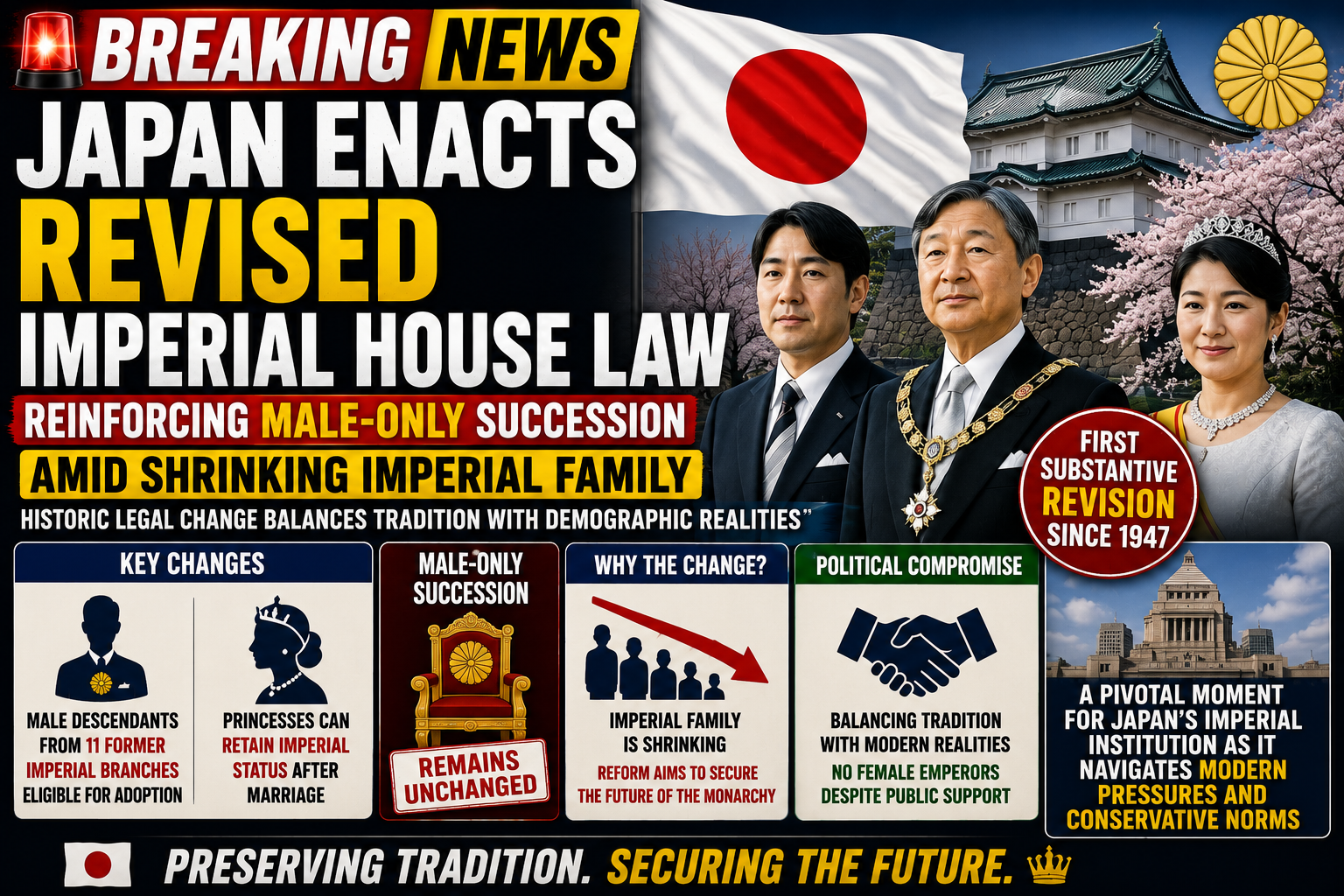
Tokyo, July 15: Japan has enacted a landmark revision to its Imperial House Law, introducing measures aimed at addressing the shrinking size of the Imperial Family while retaining the country’s long-standing male-only succession rule.
The amendment, approved by Japan’s National Diet, marks the first substantive revision of the Imperial House Law since 1947, reflecting growing concerns over the future sustainability of the world’s oldest hereditary monarchy.
Key Changes in the Revised Law
The new legislation introduces two major reforms:
- Male descendants from 11 former imperial branches will be eligible for adoption into the Imperial Family, expanding the pool of potential male-line successors.
- Princesses will be allowed to retain their imperial status after marriage, helping preserve the number of working members of the Imperial Household.
The measures are intended to strengthen the institution without altering the traditional rules governing succession.
Male-Only Succession Remains Unchanged
Despite the reforms, the revised law does not permit female emperors or succession through the maternal line.
Only males descended through the paternal imperial lineage will continue to be eligible to inherit the Chrysanthemum Throne.
The decision maintains a centuries-old tradition that has long governed Japan’s imperial succession.
Addressing a Shrinking Imperial Family
Japan’s Imperial Family has steadily declined in size over recent decades due to existing succession rules.
Under previous legislation, female members of the Imperial Family lost their royal status upon marrying commoners, reducing the number of royals available to perform official duties.
The revised law seeks to alleviate this challenge by allowing princesses to continue carrying out public responsibilities even after marriage.
Political Compromise
The legislation is widely viewed as a political compromise between conservative lawmakers seeking to preserve traditional succession rules and those advocating broader reforms to ensure the long-term survival of the monarchy.
While opinion polls have frequently indicated strong public support for allowing female emperors, the latest amendment stops short of introducing such a change.
A Significant Moment for Japan’s Monarchy
The reform represents one of the most significant developments affecting Japan’s Imperial institution in nearly eight decades.
Analysts say the amendment aims to balance historical tradition with modern demographic realities while preserving the continuity of the imperial household.
As Japan’s monarchy adapts to changing social and demographic pressures, the revised Imperial House Law is expected to play a key role in ensuring the stability and continuity of one of the world’s oldest royal institutions.