
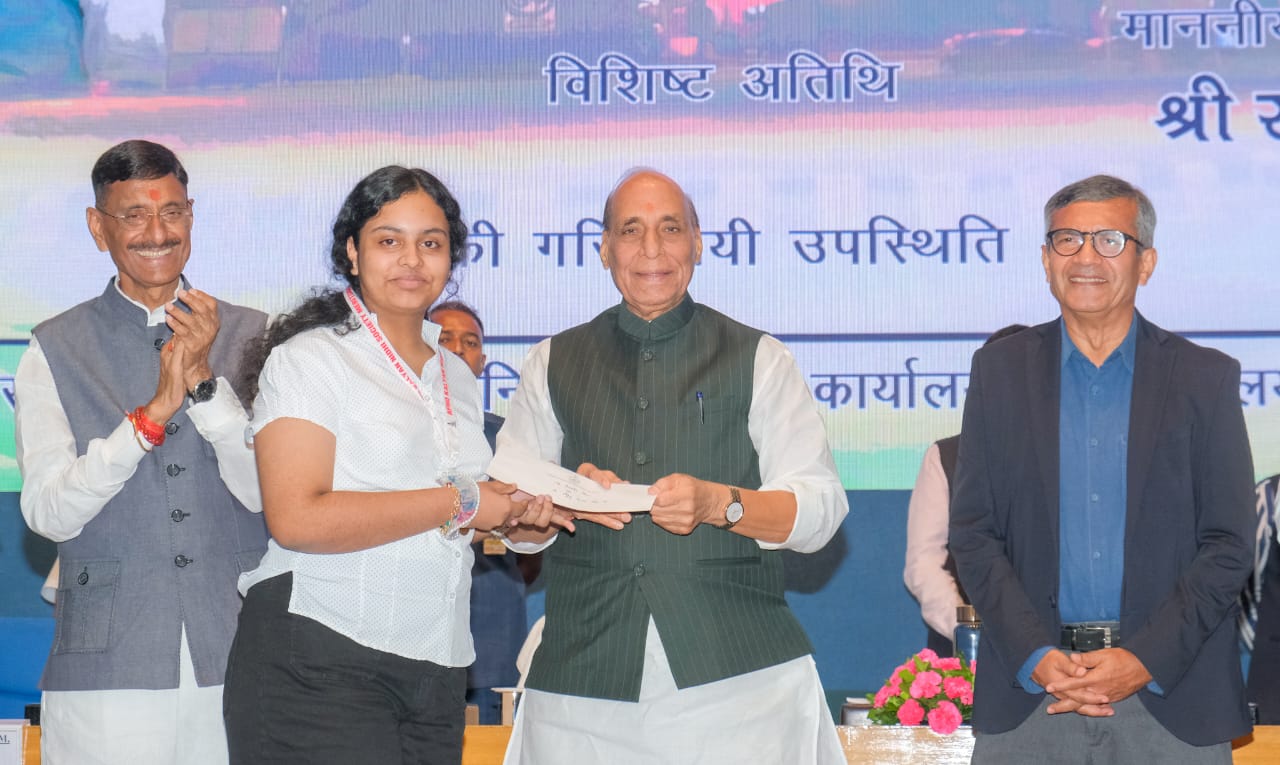
New Delhi, August 3: Defence Minister Rajnath Singh on Sunday stressed that deeper integration between the military and civilian wings of the Ministry of Defence is essential to build a stronger and future-ready defence ecosystem capable of addressing emerging security and technological challenges.
Addressing the 85th Armed Forces Headquarters (AFHQ) Civilian Services Day celebrations in New Delhi, the Defence Minister said the armed forces and civilian services are united by the common objective of “Nation First”, adding that when the goal is shared, every institution becomes a source of national strength.
Calls for Greater Military-Civil Synergy
Rajnath Singh said that as the Indian Armed Forces move towards greater jointness and integration, closer coordination between military personnel and civilian officers is equally important.
He noted that while military officers bring operational expertise and battlefield experience, civilian officers contribute institutional memory, policy continuity, administrative expertise and governance experience.
According to the Defence Minister, combining these strengths would result in more informed, balanced and effective decision-making.
Joint Training and Cross-Exposure
The Defence Minister advocated greater interaction between uniformed officers and civilian officials through:
- Joint training programmes
- Cross-posting and developmental assignments
- Knowledge-sharing initiatives
- Collaborative policy development
He said such measures would strengthen institutional capacity and improve coordination across the defence establishment.
AFHQ Civilian Services Should Become “Strategic Brain”
Rajnath Singh urged the AFHQ Civilian Services to evolve into the “strategic brain” of India’s defence management architecture.
He said the cadre should go beyond implementing administrative rules and actively contribute to:
- Strategic research
- Geo-political and geo-strategic analysis
- Defence policy formulation
- Innovation in defence management
- National security planning
He added that their permanent presence within the Ministry of Defence provides valuable institutional knowledge that can significantly strengthen India’s defence preparedness.
Focus on Emerging Technologies
Highlighting the changing nature of warfare, the Defence Minister pointed to cyber warfare as an area where civilian experts can make a major contribution.
He suggested developing defence-specific cyber tools and creating dedicated forums for studying Indian military history from a civilian perspective to generate fresh ideas and innovative solutions for future conflicts.
Digital Initiatives Launched
On the occasion, Rajnath Singh launched several digital initiatives aimed at improving administrative efficiency, including:
- Internet-Based Accommodation Management System (IBAMS)
- Integration of eHRMS with TULIP 2.0 for claims processing
- Integration of CAO systems with TULIP 2.0 for pay and allowances
- Onboarding onto the SPARROW online performance appraisal platform
He also released the 34th edition of the ‘Samvad’ magazine and presented awards to AFHQ personnel and students for excellence in sports and academics.
Senior Defence Leadership Present
The event was attended by several senior defence officials, including:
- Chief of Defence Staff General NS Raja Subramani
- Chief of the Army Staff General Dhiraj Seth
- Chief of the Naval Staff Admiral Krishna Swaminathan
- Raksha Rajya Mantri Sanjay Seth
- Defence Secretary Rajesh Kumar Singh
- Senior officials from the Ministry of Defence
The Defence Minister reiterated that a strong and integrated military-civilian partnership would play a crucial role in strengthening India’s national security and supporting the country’s journey towards becoming a technologically advanced and self-reliant defence power.