
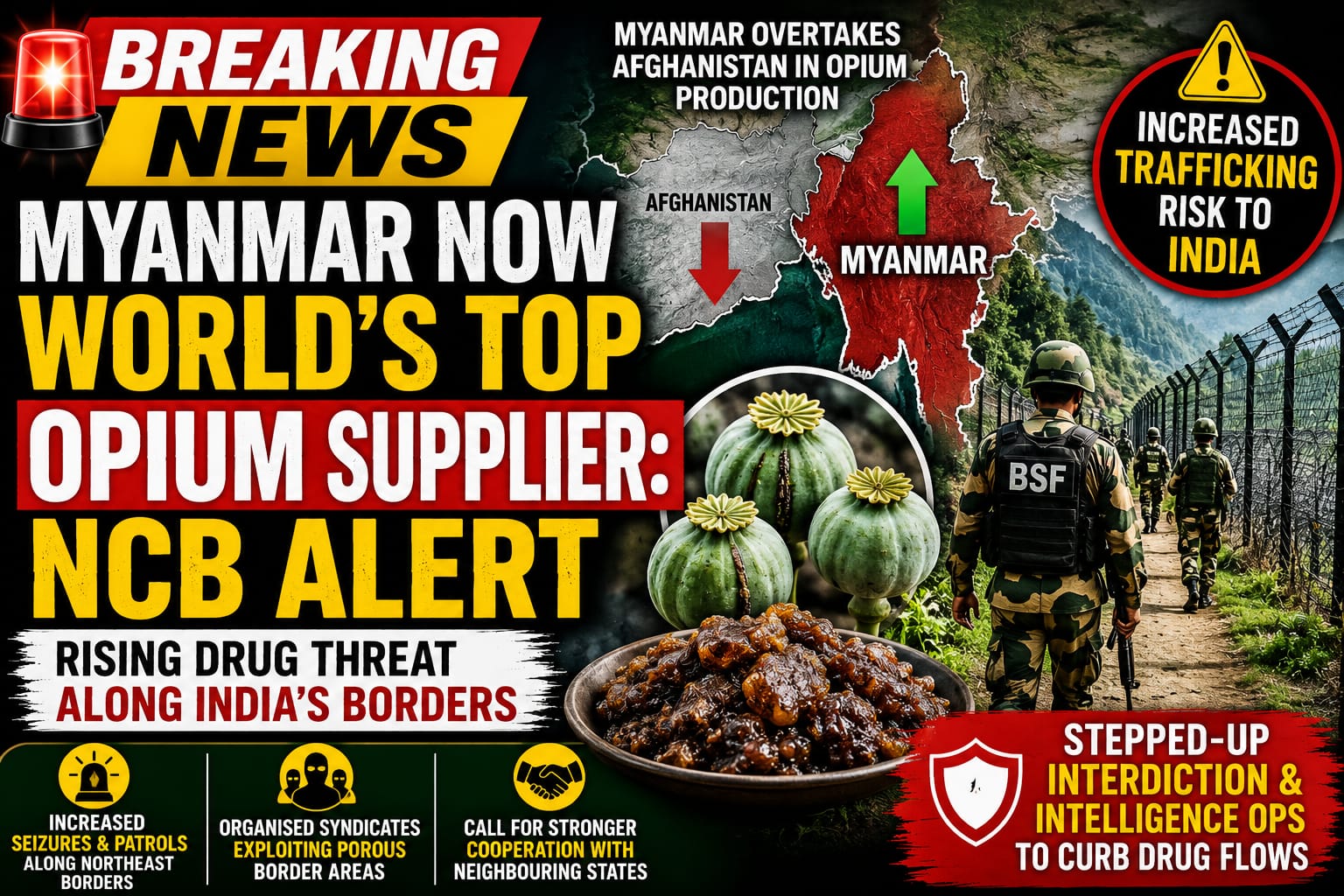
New Delhi, June 28: India’s anti-narcotics agencies have expressed growing concern over the changing dynamics of the global drug trade, with the Narcotics Control Bureau (NCB) indicating that Myanmar has overtaken Afghanistan as the world’s primary source of illicit opium. The development has significant security implications for India, particularly along its porous northeastern frontier, where authorities have reported a rise in cross-border drug trafficking, organised crime and smuggling activities. Officials say the shift in global opium production routes has prompted security agencies to intensify surveillance, intelligence gathering and interdiction operations along India’s border with Myanmar.
Shift in Global Opium Production
For decades, Afghanistan remained the world’s largest producer of illicit opium, supplying a substantial share of the global heroin market. However, following the Taliban government’s nationwide ban on poppy cultivation in 2022, opium production in Afghanistan witnessed a dramatic decline. The resulting supply vacuum has increasingly been filled by Myanmar, particularly in the country’s conflict-ridden Shan State, where armed ethnic groups and criminal syndicates continue to operate extensive narcotics networks.
According to officials, the resurgence of opium cultivation in Myanmar has reshaped regional trafficking routes, with Southeast Asia once again becoming a major source of heroin destined for international markets.
Growing Threat Along India’s Eastern Frontier
The changing narcotics landscape has heightened security concerns for India, especially along the 1,643-kilometre India-Myanmar border, much of which passes through difficult mountainous terrain and dense forests. Large sections of the border remain unfenced, making them vulnerable to infiltration, smuggling and organised criminal activities.
Security agencies have reported increased attempts to smuggle heroin, opium, methamphetamine tablets (Yaba), crystal meth and precursor chemicals into India through Manipur, Mizoram, Nagaland and Arunachal Pradesh. Officials believe several transnational drug syndicates are exploiting the challenging terrain and ethnic linkages across the border to facilitate trafficking operations.
NCB Intensifies Anti-Drug Operations
In response to the evolving threat, the Narcotics Control Bureau, in coordination with state police forces, the Assam Rifles, Border Security Force (BSF), Customs and other central agencies, has significantly stepped up intelligence-led operations across the northeastern region.
Authorities have reported a steady increase in seizures of heroin, opium, synthetic drugs, precursor chemicals and illegally manufactured narcotics over the past year. Intelligence-sharing mechanisms between central and state agencies have also been strengthened to identify trafficking routes, financial networks and organised criminal syndicates involved in the illicit drug trade.
Organised Crime and National Security Concerns
Security experts warn that drug trafficking is no longer merely a law enforcement issue but has emerged as a significant national security challenge. Revenue generated through narcotics smuggling is often used to finance organised crime, insurgent groups, illegal arms trafficking and cross-border criminal networks operating across South and Southeast Asia.
Analysts note that instability in Myanmar following the military takeover has further weakened governance in several border regions, allowing armed groups and trafficking syndicates greater operational freedom. This has increased concerns that narcotics trafficking could become further intertwined with regional insurgency and transnational organised crime.
Strengthening Border Management
Indian authorities have responded by increasing border patrols, deploying advanced surveillance equipment, expanding intelligence networks and strengthening coordination among security forces operating along the frontier. Enhanced vehicle checks, improved monitoring of vulnerable crossing points and greater use of technology are expected to play a key role in disrupting trafficking routes.
Officials have also emphasised the importance of cooperation with neighbouring countries and international law enforcement agencies to dismantle cross-border drug syndicates and improve information sharing.
Multi-Agency Strategy Against Drug Networks
The government has reiterated its commitment to a zero-tolerance policy against narcotics, combining strict enforcement with financial investigations targeting the assets and funding networks of traffickers. Alongside enforcement measures, authorities continue to promote public awareness campaigns, rehabilitation programmes and community participation to address drug abuse, particularly among young people in vulnerable regions.
Challenge Ahead
With Myanmar now emerging as the principal source of illicit opium production, Indian security agencies are preparing for a more complex anti-narcotics environment. Officials believe that sustained intelligence operations, stronger border management, enhanced regional cooperation and coordinated action against organised crime will be essential to preventing the growing flow of narcotics into India and safeguarding national security.
The evolving situation also underscores the increasingly close link between narcotics trafficking, transnational crime and border security, making the fight against drugs a critical component of India’s broader internal security strategy.