
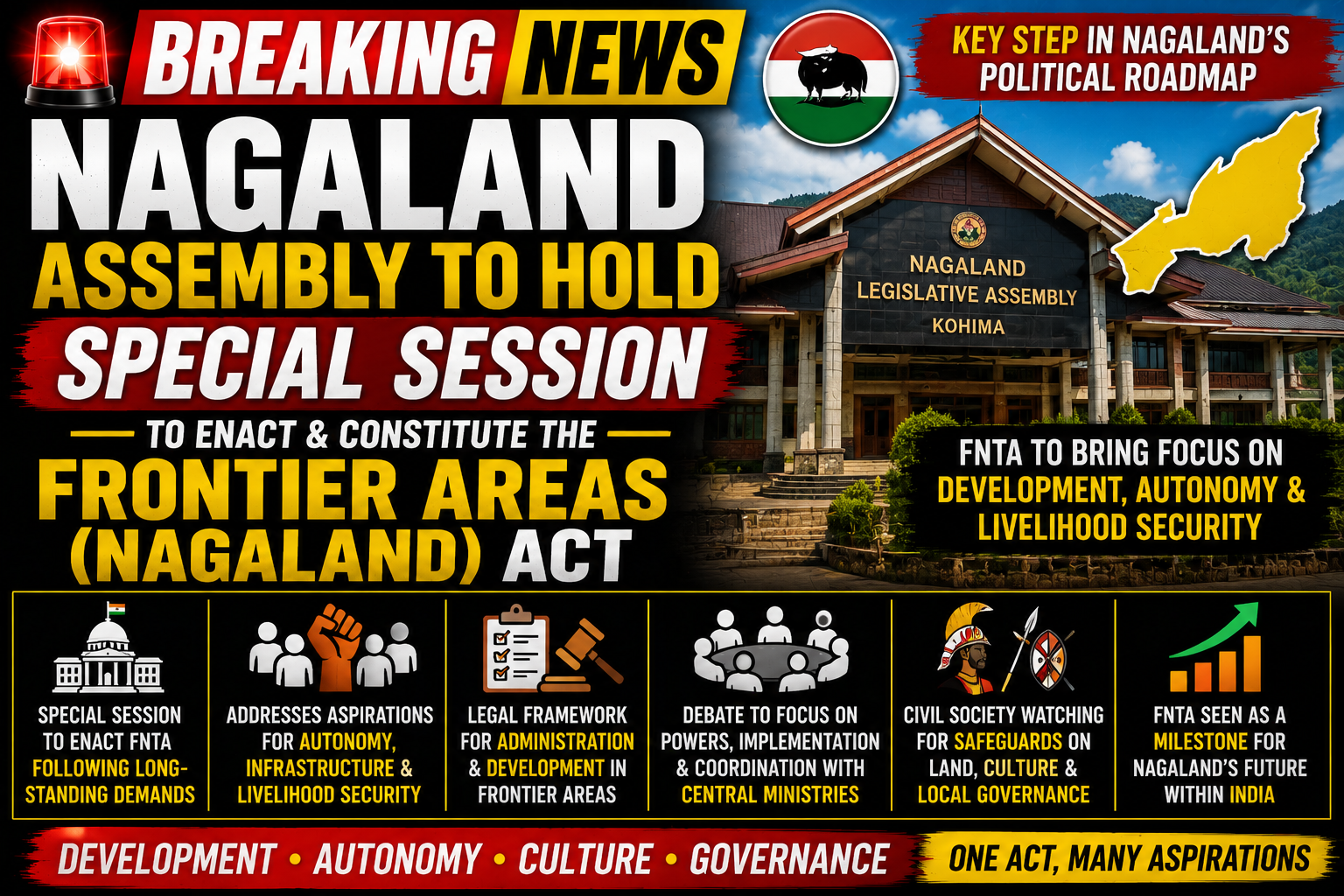
Kohima, July 7: The Nagaland Legislative Assembly is set to convene a special session to enact and operationalise the Frontier Areas (Nagaland) Act (FNTA), marking a significant milestone in addressing the long-standing demands of the state’s eastern frontier districts for greater administrative attention and accelerated development.
The proposed legislation is expected to provide a legal framework for the functioning of the Frontier Nagaland Territorial Authority (FNTA), a body aimed at ensuring focused governance and development in the region.
Long-Standing Demand
The move follows years of negotiations between the Government of Nagaland, the Centre, and the Eastern Nagaland People’s Organisation (ENPO), which has consistently demanded greater autonomy and equitable development for the eastern districts of the state.
The demand stems from concerns over perceived neglect in infrastructure, employment opportunities, healthcare, education, and overall socio-economic development.
What the FNTA Will Do
The Frontier Areas (Nagaland) Act is expected to lay down the legal framework for establishing the Frontier Nagaland Territorial Authority, which will oversee planning, development, and administration in the eastern region.
Officials say the authority is intended to improve governance while remaining within the constitutional framework of the State of Nagaland.
Assembly to Debate Key Provisions
During the special session, legislators are expected to deliberate on several crucial aspects of the proposed law, including:
- Administrative powers of the Frontier Nagaland Territorial Authority.
- Financial and developmental responsibilities.
- Coordination with the Nagaland Government and Central ministries.
- Implementation mechanisms and institutional structure.
- Safeguards for traditional institutions and local governance.
Focus on Development and Autonomy
State leaders have described the proposed authority as a mechanism to accelerate development without altering Nagaland’s constitutional status.
The initiative aims to improve infrastructure, road connectivity, education, healthcare, livelihood opportunities, and public service delivery in the eastern districts.
Civil Society Monitoring the Process
Civil society organisations and tribal bodies are closely watching the legislative process, particularly regarding provisions related to:
- Protection of customary land ownership.
- Preservation of indigenous culture and traditions.
- Representation of local communities.
- Safeguards for existing tribal institutions and village governance.
Important Political Milestone
The proposed enactment of the Frontier Areas (Nagaland) Act is being viewed as one of the most significant political developments in Nagaland in recent years.
If passed, the legislation is expected to pave the way for the formal constitution of the Frontier Nagaland Territorial Authority, addressing decades-old regional aspirations while strengthening governance and development in the state’s frontier districts.