
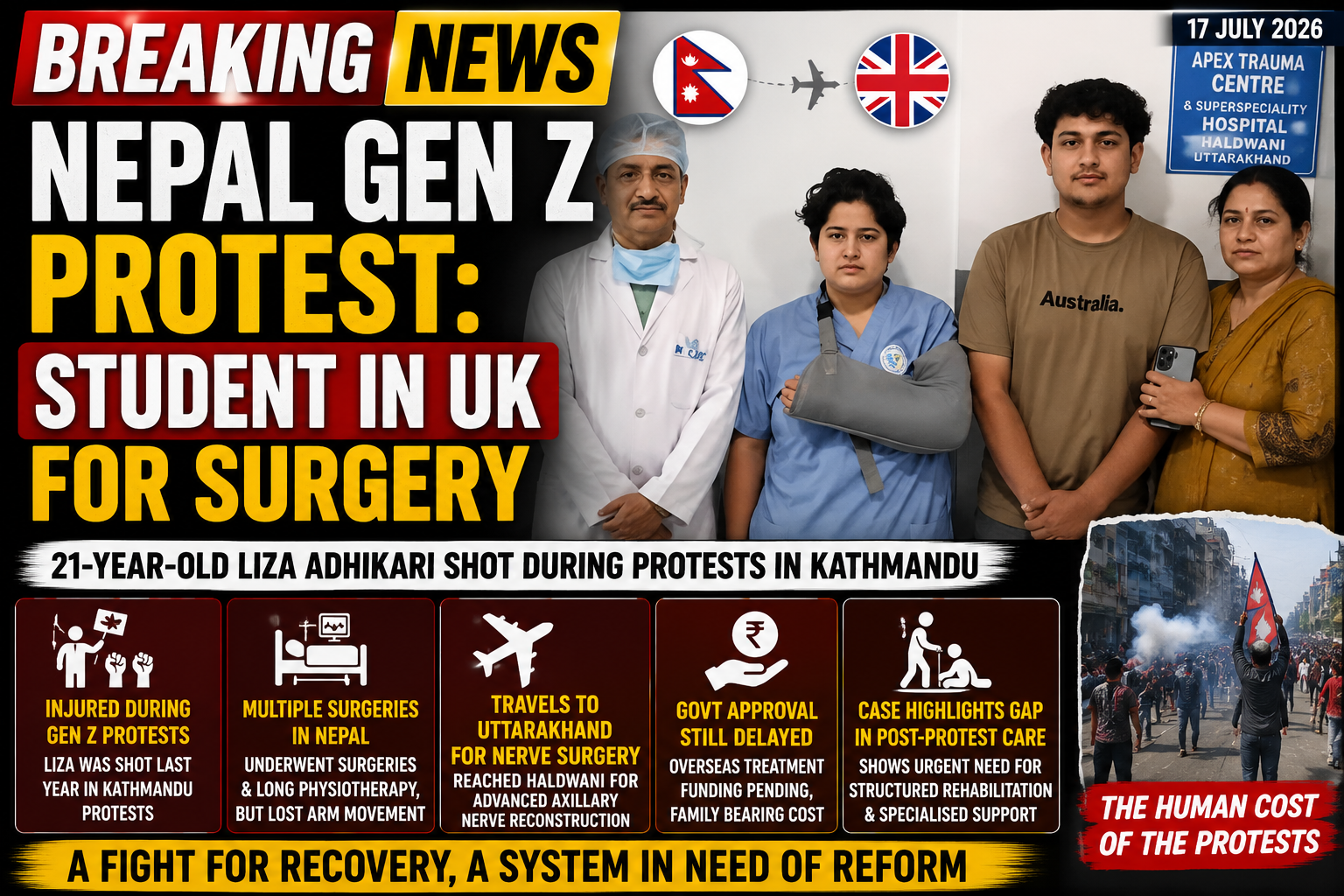
Kathmandu/Haldwani, July 15: A 21-year-old Nepali student, who sustained serious injuries during last year’s Gen Z protests in Kathmandu, has travelled to Haldwani, Uttarakhand, for advanced reconstructive surgery after prolonged treatment in Nepal failed to restore movement in her arm.
The case has drawn attention to the long-term medical challenges faced by injured protesters and the growing reliance on cross-border healthcare for specialised treatment.
Journey to India for Specialist Care
The student, Liza Adhikari, reportedly suffered a gunshot injury during the protests in Kathmandu. Despite undergoing multiple surgeries and months of physiotherapy in Nepal, she was left with significant damage to her axillary nerve, resulting in the loss of movement in one of her arms.
Following consultations with specialists, her family decided to seek advanced reconstructive nerve surgery in Haldwani, Uttarakhand, where she is expected to undergo a specialised procedure aimed at restoring function to the affected limb.
Delays in Government Assistance
According to reports, Liza’s family had sought financial assistance from the Nepal government for treatment abroad. However, approval for overseas medical funding has reportedly been delayed.
As a result, the family is bearing the cost of the surgery independently while hoping for reimbursement or government support at a later stage.
Long Road to Recovery
Doctors say recovery from complex nerve reconstruction often requires:
- Specialised microsurgical procedures.
- Long-term physiotherapy.
- Rehabilitation over several months.
- Continuous neurological assessment.
Medical experts note that early intervention is often critical in improving the chances of restoring nerve function.
Human Cost of the Protests
Liza Adhikari’s case has become a symbol of the lasting impact of the protests, highlighting the difficulties many injured demonstrators continue to face long after public attention has shifted elsewhere.
Rights advocates have called for comprehensive rehabilitation programmes, including long-term medical care, psychological support and financial assistance for those seriously injured during the unrest.
Cross-Border Healthcare
The case also underscores the role of India’s healthcare system in providing specialised treatment to patients from neighbouring countries, particularly for complex procedures that may not be readily available locally.
Medical centres in northern India have increasingly become destinations for patients from Nepal seeking advanced neurological, orthopaedic and reconstructive surgeries.
Calls for Better Rehabilitation Support
The incident has renewed calls for governments to establish structured rehabilitation mechanisms for civilians injured during periods of unrest, ensuring timely access to specialised treatment and financial assistance.
As Liza undergoes surgery in India, her case continues to highlight both the human cost of political violence and the importance of accessible, long-term medical rehabilitation for survivors.