
Islamabad Eyes Wider Maritime Presence as China Deepens Its Strategic Footprint
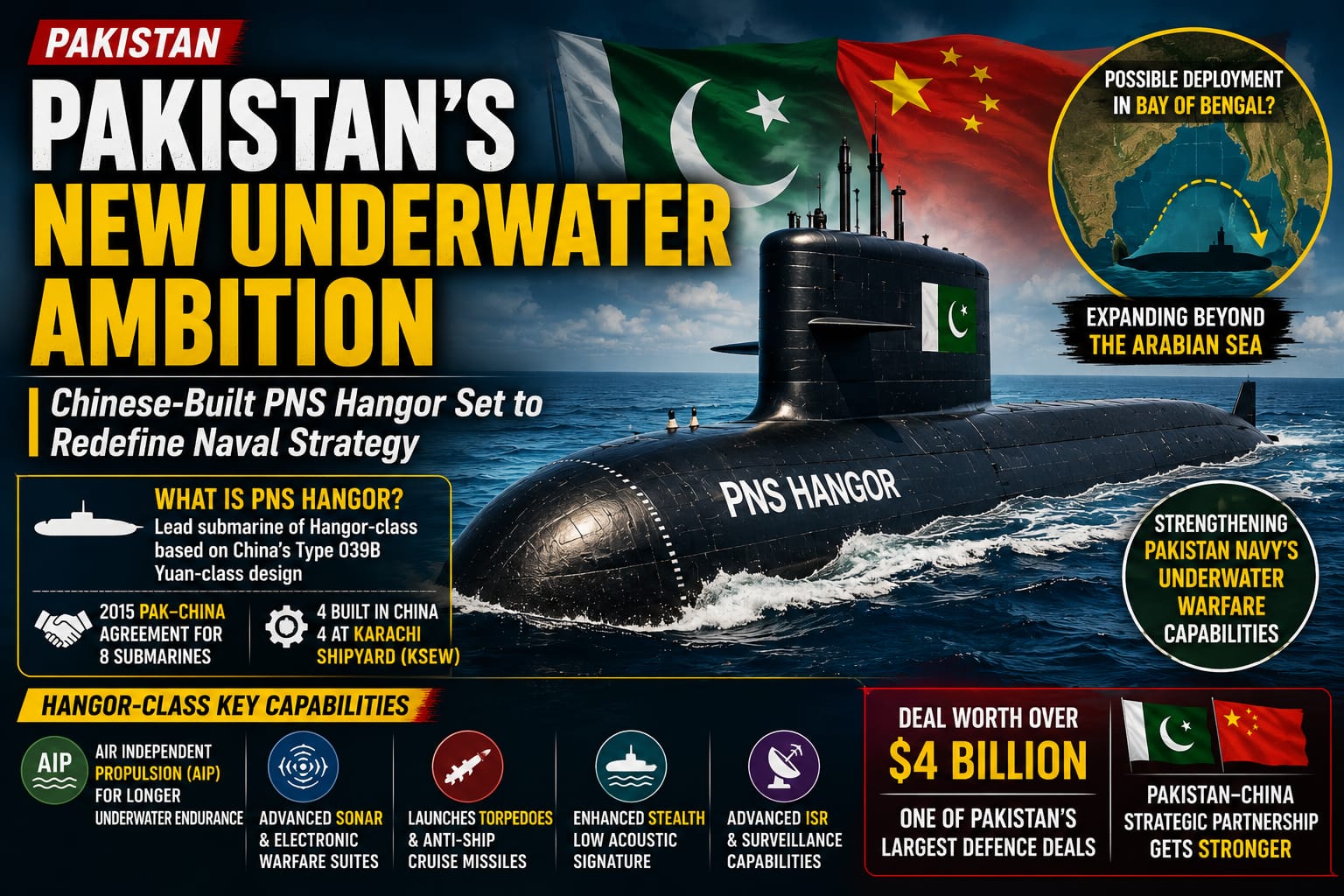
Islamabad, June 18: Pakistan is preparing to significantly expand its maritime reach after inducting PNS Hangor, the first of the eight advanced Hangor-class submarines being built in collaboration with China. The development marks a major milestone in Islamabad’s naval modernisation programme and is being viewed as a strategic shift that could alter the security dynamics of the Indian Ocean Region.
Reports indicate that Pakistan is exploring the possibility of deploying the submarine in the Bay of Bengal—a region where the Pakistan Navy has maintained only a limited presence since the 1971 India-Pakistan war. If the plan materialises, it would signal Islamabad’s intent to operate beyond its traditional areas of influence in the Arabian Sea.
What is PNS Hangor?
PNS Hangor is the lead submarine of Pakistan’s new Hangor-class, based on China’s Type 039B Yuan-class diesel-electric attack submarine design. The project forms part of a landmark agreement signed between Islamabad and Beijing in 2015 for the acquisition of eight submarines.
Under the arrangement, four submarines are being constructed in China, while the remaining four are being built at Pakistan’s Karachi Shipyard and Engineering Works (KSEW) with Chinese technical assistance.
The induction of PNS Hangor is considered one of the most significant upgrades to Pakistan Navy’s underwater warfare capabilities in decades.
Capabilities of the Hangor-Class
The Hangor-class submarines are equipped with advanced stealth features and are designed for both anti-ship and anti-submarine warfare missions.
Key features include:
- Air Independent Propulsion (AIP) system allowing longer underwater endurance.
- Advanced sonar and electronic warfare suites.
- Capability to launch torpedoes and anti-ship cruise missiles.
- Improved stealth characteristics, reducing acoustic signatures.
- Enhanced intelligence, surveillance and reconnaissance (ISR) capabilities.
The AIP technology enables the submarine to remain submerged for extended periods without surfacing, making detection by enemy forces significantly more difficult.
Why the Bay of Bengal Matters
The reported consideration of deploying PNS Hangor in the Bay of Bengal has attracted considerable attention among defence analysts.
The Bay of Bengal is a strategically important maritime zone connecting South Asia with Southeast Asia and hosting major sea lanes of communication. The region is also witnessing increasing naval activity by India, China and other regional powers.
For Pakistan, operating in the Bay of Bengal would represent a major expansion of its operational geography. Analysts say such a move would be aimed at demonstrating long-range deployment capabilities and increasing strategic flexibility.
However, there has been no official confirmation from Pakistan regarding any imminent deployment in the Bay of Bengal.
China’s Growing Role in Pakistan Navy
The Hangor programme is another example of the deepening military partnership between China and Pakistan.
Over the past decade, China has emerged as Pakistan’s principal defence supplier, providing fighter aircraft, naval frigates, drones, air defence systems and now advanced submarines.
The submarine deal is reportedly valued at over $4 billion, making it one of the largest defence contracts in Pakistan’s history.
Experts believe the programme not only strengthens Pakistan’s underwater warfare capabilities but also reflects Beijing’s growing influence in shaping the naval balance in the Indian Ocean.
Regional Implications
The induction of PNS Hangor comes at a time when the Indian Ocean Region is witnessing increased strategic competition.
India has been expanding its own submarine fleet and maritime surveillance capabilities, while China continues to enhance its naval presence through ports, infrastructure projects and regular deployments across the region.
Against this backdrop, Pakistan’s acquisition of advanced Chinese submarines is likely to be closely watched by regional militaries and defence planners.
While the full operational impact of the Hangor-class will unfold over the coming years, one thing is clear: Pakistan’s underwater ambitions are growing, and China is playing a central role in powering them.