
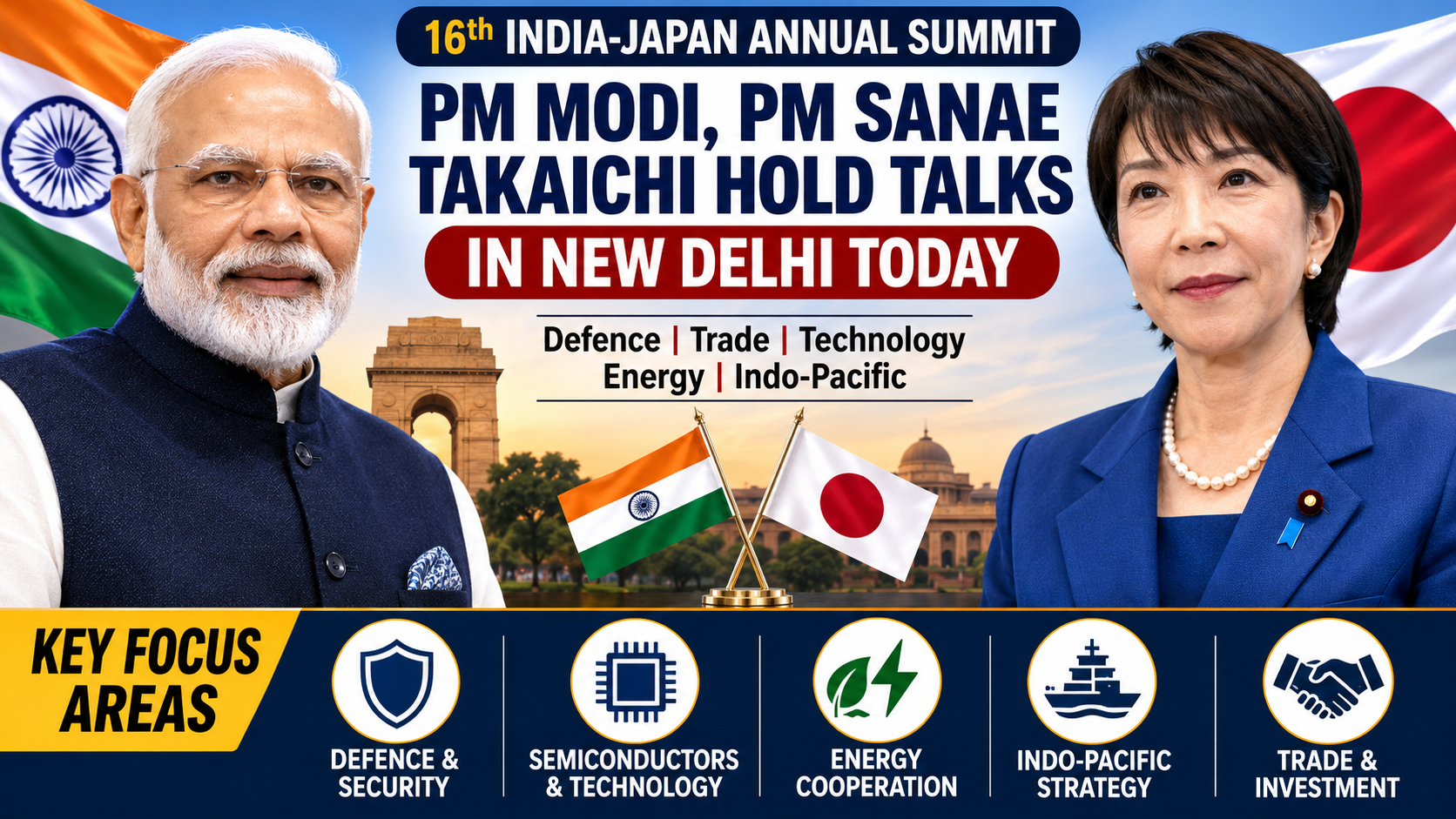
New Delhi, July 2: Prime Minister Narendra Modi is set to hold wide-ranging talks with Japanese Prime Minister Sanae Takaichi during the 16th India-Japan Annual Summit in New Delhi on Thursday, as the two strategic partners seek to further deepen cooperation in defence, economic security, advanced technologies, energy, supply chains and the Indo-Pacific. The summit, the highest institutional mechanism between the two countries, comes at a time of growing geopolitical uncertainty in the Indo-Pacific and increasing efforts by both nations to strengthen resilient economic and strategic partnerships.
Prime Minister Takaichi, who arrived in New Delhi on a three-day official visit from July 1 to 3, is making her first official visit to India since assuming office. She was welcomed at the airport by Union Minister Dr. Jitendra Singh. The visit follows Prime Minister Modi’s trip to Tokyo for the 15th India-Japan Annual Summit last year and reflects the growing momentum in the India-Japan Special Strategic and Global Partnership.
Full Spectrum of Bilateral Relations Under Review
The summit is expected to review progress across the entire spectrum of bilateral cooperation, including:
- Defence and security cooperation
- Maritime security and Indo-Pacific strategy
- Trade and investment
- Semiconductor manufacturing
- Critical minerals
- Artificial Intelligence (AI)
- Digital technologies
- Clean energy and green hydrogen
- Infrastructure development
- Supply chain resilience
- People-to-people exchanges
Following the bilateral talks, both leaders are expected to oversee the signing of several Memorandums of Understanding (MoUs) and issue a joint statement outlining the future roadmap for bilateral cooperation.
Defence and Indo-Pacific Cooperation
Defence cooperation is expected to remain one of the central pillars of the discussions. India and Japan have significantly expanded military engagement over the past decade through:
- Joint military exercises
- Naval cooperation
- Maritime domain awareness
- Defence technology collaboration
- High-level strategic dialogues
- Intelligence sharing
Both countries are members of the Quad alongside the United States and Australia, and continue to advocate a Free, Open and Inclusive Indo-Pacific based on international law and freedom of navigation.
The leaders are also expected to exchange views on the evolving security environment in the Indo-Pacific, including developments in the East China Sea, South China Sea and broader regional architecture.
Semiconductors and Critical Minerals Take Centre Stage
One of the biggest focus areas of the summit is expected to be cooperation in semiconductors and critical minerals, both of which have become strategically important amid global supply chain disruptions.
India is seeking Japanese investment and technological collaboration to strengthen its semiconductor manufacturing ecosystem, while Japan views India as a reliable partner for building resilient supply chains outside traditional manufacturing hubs.
Officials are also expected to discuss cooperation in battery technologies, rare earth processing and advanced electronics manufacturing.
LNG Pact and Energy Security
According to reports, India and Japan are likely to sign a Liquefied Natural Gas (LNG) Security Agreement during the summit.
The proposed pact aims to enhance energy security by ensuring stable LNG supplies during global disruptions. The two countries are also expected to discuss cooperation in:
- Green hydrogen
- Renewable energy
- Nuclear energy
- Carbon-neutral technologies
- Sustainable industrial development
Energy security has become a major pillar of India-Japan cooperation following recent geopolitical disruptions affecting global energy markets.
Expanding Economic Partnership
Japan remains one of India’s largest foreign investors, with nearly 1,400 Japanese companies operating across sectors including automobiles, electronics, infrastructure and manufacturing.
Bilateral trade reached approximately USD 27.5 billion during FY 2025–26, while Japanese investments continue to expand into infrastructure, manufacturing, financial services and emerging technologies.
Major projects such as the Mumbai-Ahmedabad High-Speed Rail Corridor, industrial townships and logistics corridors are also expected to be reviewed during the summit.
Business Forum and Industry Engagement
Apart from official talks, Prime Minister Modi and Prime Minister Takaichi are expected to participate in the India-Japan Business Forum, where leading industrialists from both countries will discuss investment opportunities in manufacturing, digital technologies, infrastructure, clean energy and innovation.
Business leaders are expected to explore new avenues of cooperation under India’s Make in India and Aatmanirbhar Bharat initiatives.
Strategic Partnership Enters New Phase
India and Japan elevated their relationship to a Special Strategic and Global Partnership in 2014, and bilateral cooperation has steadily expanded since then. The annual summit mechanism has become the principal platform for reviewing progress and setting priorities across defence, economy, technology and regional security.
Officials from both countries expect the 16th India-Japan Annual Summit to further strengthen one of Asia’s most important strategic partnerships, reinforcing cooperation in defence, economic resilience, emerging technologies and the shared vision of a free, open, prosperous and rules-based Indo-Pacific.