
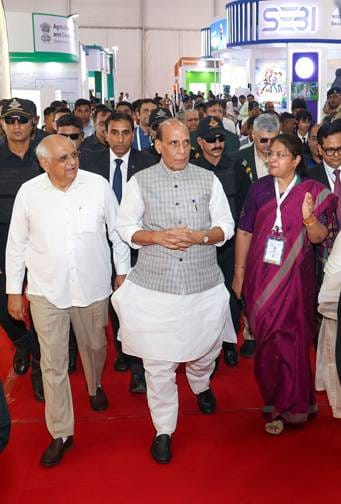
Vadodara, June 30: Defence Minister Rajnath Singh on Monday urged regional industries to become active partners in India’s journey towards Viksit Bharat 2047, asserting that the country’s economic strength, technological capability and national security must grow together to secure India’s place as a leading global power. Addressing the Vibrant Gujarat Regional Conference in Vadodara, the Defence Minister called upon industrialists, entrepreneurs, start-ups and academic institutions to transform regional strengths into national capabilities, local innovations into global competitiveness and industrial growth into strategic strength. He emphasised that self-reliance is not about isolation but about enabling India to engage with the world as an equal and confident partner.
The conference was attended by Gujarat Chief Minister Bhupendra Patel, Union Minister Rajiv Ranjan Singh, Gujarat Minister Dr Manisha Vakil, senior government officials, defence industry representatives, MSMEs, start-ups and academicians.
Economic Strength, Technology and Security Must Go Together
Rajnath Singh stressed that history has shown great nations are built on three fundamental pillars—economic prosperity, technological excellence and national security. He said a strong economy and advanced technology reinforce national security, while a secure nation creates the environment necessary for innovation, industrial growth and investment.
He noted that the rapidly evolving geopolitical environment demands that India strengthen its indigenous capabilities to safeguard its strategic interests while emerging as a global manufacturing and technology hub.
Defence Sector Driving India’s Industrial Growth
Highlighting the transformation of India’s defence sector over the past decade, the Defence Minister said defence manufacturing is no longer limited to producing weapons but has evolved into a catalyst for infrastructure development, logistics, employment generation and technological innovation.
He pointed out that defence corridors and indigenous manufacturing projects are creating opportunities for industries across multiple sectors while boosting research, development and advanced engineering capabilities.
According to Rajnath Singh, sustained investments in defence production are helping build an integrated industrial ecosystem that supports both national security and economic growth.
Defence Production and Exports Reach Record Highs
The Defence Minister highlighted the remarkable growth achieved under the Government’s Aatmanirbhar Bharat initiative.
He stated that India’s annual defence production has increased from around ₹46,000 crore in 2014 to a record ₹1.78 lakh crore, while defence exports have risen from less than ₹1,000 crore to an all-time high of ₹38,424 crore.
He credited this growth to indigenous platforms, increased participation of private industry, policy reforms, defence start-ups and continuous innovation within the domestic defence ecosystem.
Government Reforms Boost Indigenous Manufacturing
Rajnath Singh said several policy initiatives have significantly improved the ease of doing business in the defence sector.
He cited reforms such as Make in India, revisions to the Defence Acquisition Procedure (DAP), the Technology Development Fund (TDF), iDEX, the Srijan Portal, Green Channel Certification, self-certification mechanisms and liberalised Foreign Direct Investment (FDI) norms as major enablers of indigenous manufacturing.
He added that these initiatives have encouraged greater participation by MSMEs, start-ups and private companies while strengthening collaboration between government, industry and academia.
Gujarat Emerging as a Defence Manufacturing Hub
The Defence Minister said Gujarat is well-positioned to become one of India’s leading defence manufacturing centres because of its strong industrial base, skilled workforce and entrepreneurial ecosystem.
He highlighted the Tata-Airbus C-295 aircraft manufacturing facility in Vadodara as a landmark project in India’s aerospace sector and noted that the K-9 Vajra self-propelled artillery system, one of the world’s most advanced artillery platforms, is also being manufactured in Gujarat.
According to him, the state’s expertise in chemicals, petrochemicals, electronics, shipbuilding, ports, renewable energy and green hydrogen provides a strong foundation for future defence manufacturing.
Semiconductor Ecosystem to Power Future Warfare
Rajnath Singh also underscored the strategic importance of semiconductor manufacturing, describing computer chips as the foundation of both future warfare and economic competitiveness.
He expressed confidence that the semiconductor ecosystem being developed in Sanand and Dholera would strengthen India’s capabilities in artificial intelligence, quantum computing, cybersecurity, electronics, aerospace and space technologies, helping achieve long-term technological sovereignty.
Aatmanirbhar Bharat Does Not Mean Isolation
Clarifying the government’s vision of self-reliance, Rajnath Singh said Aatmanirbhar Bharat is not about closing India’s doors to the world but about building strong domestic capabilities while collaborating globally.
He said India continues to encourage partnerships with foreign Original Equipment Manufacturers (OEMs), technology transfers and joint ventures that create manufacturing capacity, employment and technological expertise within the country.
Industry-Academia Collaboration Emphasised
During the event, the Defence Minister interacted with representatives from the private sector, MSMEs, start-ups and academic institutions during a seminar on defence and aerospace manufacturing.
He reaffirmed the government’s commitment to creating a supportive policy environment that encourages innovation, strengthens indigenous defence capabilities and positions India among the world’s leading defence manufacturing nations.
Rajnath Singh also visited an exhibition showcasing products from defence industries, MSMEs, start-ups, automobile manufacturers, women entrepreneurs, tribal artisans, mobility innovators and exporters, highlighting the broad industrial ecosystem contributing to India’s vision of Viksit Bharat 2047.