
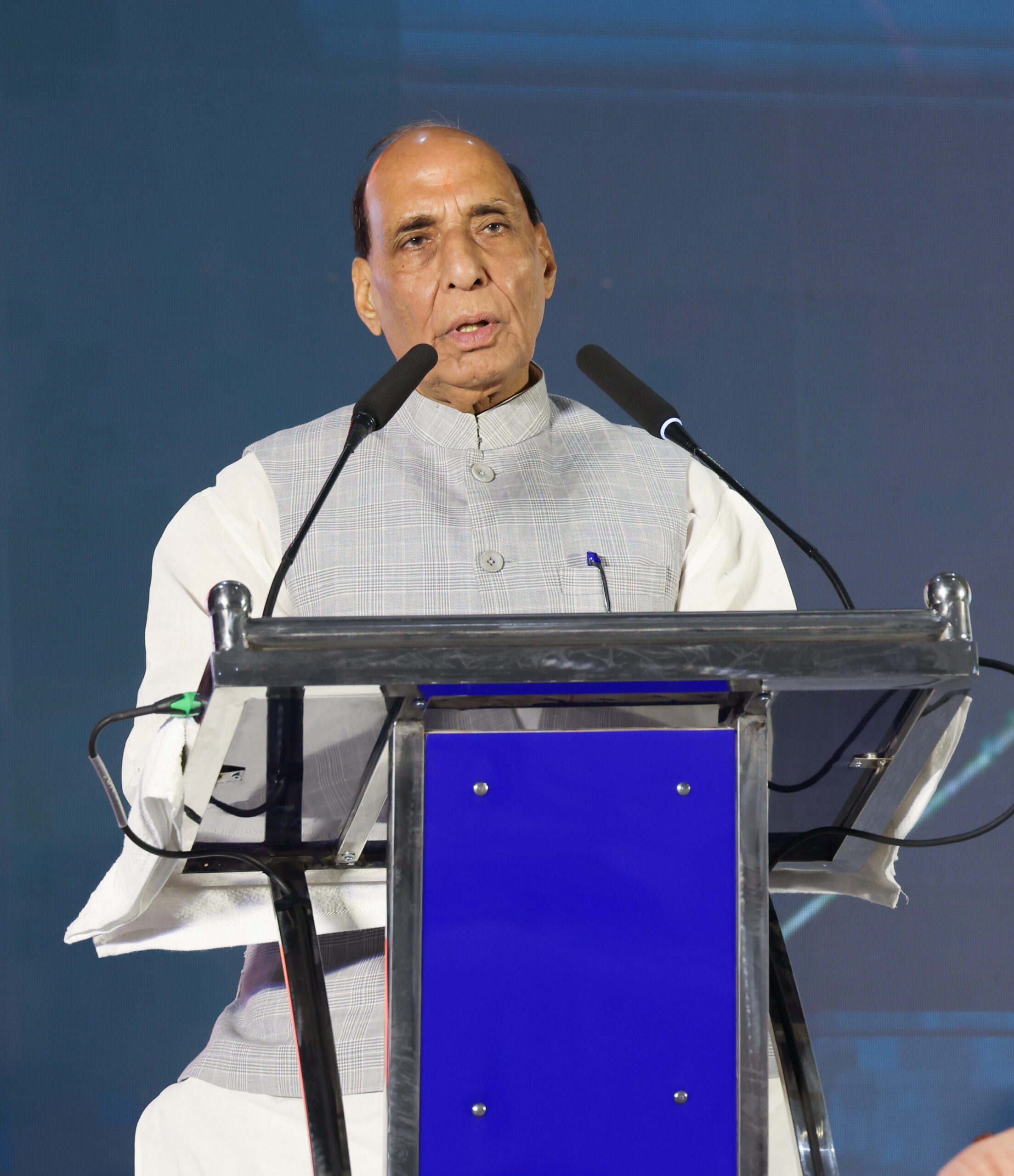
Defence Minister says India is moving towards self-reliance, stronger national capabilities and inclusive prosperity; highlights defence production, exports, youth innovation and welfare initiatives
Kochi, September 18: Defence Minister Rajnath Singh on Friday said India is progressing towards the vision of Viksit Bharat@2047 by focusing on resilience, innovation, national strength, inclusive development, compassion and a stronger sense of national identity.
Addressing an event in Kochi, Kerala, Singh said India’s development journey was being shaped by its ability to confront challenges and convert them into opportunities. He attributed the government’s approach to what he described as India’s long-standing values of courage, service, determination, compassion and national capability.
The remarks were part of a wider address covering India’s development, defence self-reliance, welfare programmes, technological innovation, climate action, cultural heritage and the role of the media.
Focus on Resilience and Self-Reliance
Singh said India had faced major challenges over the past decade, including the global COVID-19 pandemic and the economic impact of wars and geopolitical instability.
According to the Defence Minister, despite these international disruptions, India has continued to pursue the objective of becoming a self-reliant and developed nation.
He also referred to challenges that he said India faced before 2014, including corruption and governance-related problems, arguing that the country’s subsequent progress has been accompanied by greater confidence in dealing with adversity.
These are political and government assessments expressed by Singh in his speech rather than independently established measures of governance performance.
Operation Sindoor and National Security
The Defence Minister also referred to Operation Sindoor, presenting it as an example of India’s willingness to respond to threats against its sovereignty and territorial integrity.
Singh said the operation demonstrated India’s willingness to act against those who threaten the country.
He also stated that Naxalism has been brought to an end, a government position that has been expressed in the context of India’s long-running counter-Naxal operations.
Defence Production and Exports
A significant portion of Singh’s address focused on India’s growing defence-industrial capabilities.
He stated that indigenous defence production, which he put at approximately ₹40,000 crore in 2014, has now reached nearly ₹1.80 lakh crore.
He also said India’s defence exports have increased from around ₹600 crore to approximately ₹40,000 crore, with Indian defence equipment now reaching around 100 countries.
The figures cited by Singh reflect the government’s assessment of India’s defence-production and export growth. Earlier official data have also recorded substantial increases in defence production and exports, although the precise figures depend on the financial year and methodology used. For example, the Ministry of Defence reported defence production of ₹1.51 lakh crore and exports of ₹23,622 crore for FY 2024-25.
Youth and Technology as Drivers of Development
Singh described India’s youth as a major national strength, pointing to their involvement in start-ups, unicorn companies, drones, hydrogen technology, rockets and satellites.
He said young Indians are contributing to India’s economic and technological transformation and urged them to continue participating in the country’s development journey.
The Defence Minister’s emphasis on technology comes amid the government’s broader push for indigenous innovation in sectors ranging from defence and aerospace to digital technology and clean energy.
Inclusive Development and Welfare
Singh also highlighted the government’s welfare and development programmes, saying that more than 250 million people have been lifted out of poverty over the past 10–12 years.
He cited initiatives including:
- Ayushman Bharat
- PM SHRI
- Lakhpati Didi
- Pradhan Mantri Awas Yojana
- Jal Jeevan Mission
- Ujjwala Yojana
He also referred to UPI, describing it as the world’s largest real-time payment system and noting that it has been adopted by more than 11 countries.
These references were presented by Singh as examples of India’s efforts towards more inclusive development.
Climate Action and India’s Global Role
The Defence Minister also highlighted India’s environmental and international initiatives.
He said India has achieved several climate-related targets ahead of schedule and referred to India’s COVID-19 vaccine efforts, including the supply of vaccines to other countries.
Singh also pointed to the International Yoga Day, the International Solar Alliance and the Global Biofuels Alliance as examples of India’s international initiatives.
He described these developments as evidence of India’s growing role in global efforts concerning health, climate, renewable energy and sustainable development.
Development Alongside Cultural Heritage
Singh said India’s development should not be viewed only through the lens of economic growth.
He argued that national development also involves strengthening national confidence and cultural awareness, while moving beyond what he described as a colonial mindset.
The Defence Minister emphasised the importance of India’s history, culture and civilisational heritage and said modernisation should proceed alongside appreciation of cultural traditions.
He also referred to ‘Sarva Dharma Samabhava’, or equal respect for all faiths, as part of India’s civilisational ethos.
His comments on secularism and the interpretation of Indian traditions were part of his broader political and cultural argument about India’s identity.
Call to Engage the Younger Generation
Singh called for greater awareness among young people about India’s history, culture and heritage, saying that this could contribute to stronger national consciousness.
At the same time, he urged the youth to participate actively in India’s economic, social and technological transformation.
He said a confident, capable and socially inclusive India could play a greater role in shaping the future global order.
Media as the Fourth Pillar
Towards the conclusion of his address, Singh spoke about the role of the media in a democracy.
He described journalism as the “fourth pillar of democracy” and emphasised the importance of an independent and impartial press in ensuring accountability.
He said the media’s responsibility extends beyond simply reporting events to asking difficult questions, presenting facts to the public and holding those in power accountable.
The remarks underline the importance of journalism’s watchdog function in a democratic system.
Viksit Bharat@2047 Vision
The central theme of Singh’s address was India’s long-term objective of becoming a developed nation by 2047, the centenary year of independence.
He framed the vision around several interconnected priorities:
Resilience. Innovation. National security. Self-reliance. Inclusive prosperity. Compassion. Technological capability.
The Defence Minister’s remarks linked these objectives to both domestic development and India’s position in the international system.
Key Takeaways
- Rajnath Singh addressed an event in Kochi on September 18, 2026.
- He highlighted resilience, innovation, compassion, national strength and inclusive development as elements of the Viksit Bharat@2047 vision.
- He cited growth in India’s indigenous defence production and defence exports.
- Youth innovation in start-ups, drones, space and emerging technologies was highlighted.
- Singh cited government welfare programmes as examples of inclusive development.
- He referred to UPI, International Yoga Day, International Solar Alliance and Global Biofuels Alliance.
- He emphasised India’s cultural and civilisational heritage alongside modernisation.
- The Defence Minister called for greater awareness among young people of India’s history and culture.
- He described the media as the fourth pillar of democracy and stressed independent and impartial journalism.
- The overall address focused on India’s stated objective of becoming a developed, self-reliant and strategically secure nation by 2047.
**Singh’s Kochi address brought together the government’s stated priorities across defence, technology, welfare, culture and national security, presenting them as interconnected components of the Viksit Bharat@2047 vision.**