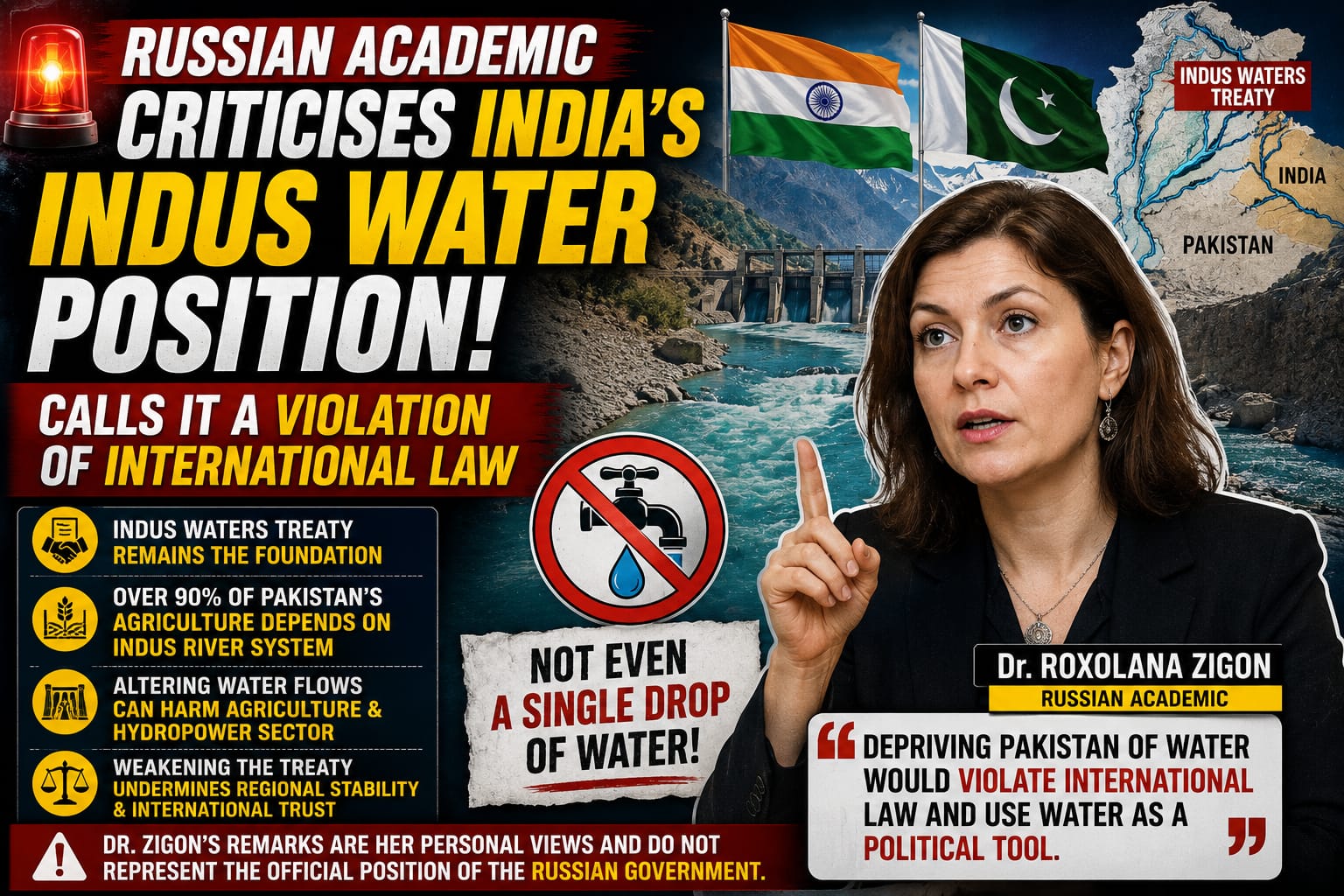
Moscow/New Delhi, July 1: Russian academic Dr. Roxolana Zigon has criticised recent statements made in India regarding the Indus Waters Treaty (IWT), arguing that withholding water from Pakistan would be inconsistent with international law and could undermine regional stability. Her remarks come amid renewed debate over the future of the 1960 treaty following heightened India-Pakistan tensions.
Dr. Zigon stressed that her comments reflect an academic assessment and do not represent the official position of the Russian government
Indus Waters Treaty Remains the Basis of Water
SharingAccording to Dr. Zigon, the Indus Waters Treaty, brokered by the World Bank and signed in 1960, continues to serve as the principal legal framework governing water sharing between India and Pakistan.She argued that the treaty has survived multiple wars and periods of heightened hostility between the two neighbours, demonstrating its significance as one of the world’s most enduring transboundary water agreements.
Concerns Over Pakistan’s Water Security
The Russian academic stated that more than 90% of Pakistan’s agriculture depends on the Indus River system, making uninterrupted river flows crucial for food production, irrigation and rural livelihoods.She warned that any significant alteration in water flows could adversely affect Pakistan’s agricultural output, hydropower generation and overall water security.
Warning on Regional Stability
Dr. Zigon argued that weakening or abandoning the treaty could damage confidence in international agreements governing shared natural resources.
According to her, the use of water as a geopolitical instrument could increase regional tensions and reduce trust between neighbouring countries, making future cooperation more difficult.
She also described public remarks suggesting that Pakistan would not receive “even a single drop of water” as being inconsistent with international legal principles governing transboundary rivers.
Debate Intensifies After Terror Attack
The Indus Waters Treaty has come under renewed scrutiny following the Pahalgam terror attack, after which India announced a series of diplomatic and strategic measures against Pakistan, including placing the treaty in abeyance until Pakistan takes credible and irreversible action against cross-border terrorism.
The Indian government has maintained that continued cooperation under the treaty cannot be separated from concerns over cross-border terrorism and national security.
India’s Position
New Delhi has repeatedly stated that Pakistan’s continued support for cross-border terrorism has fundamentally affected bilateral relations.Indian officials have argued that while India has historically honoured the treaty even during periods of conflict, future cooperation must be viewed in the broader context of security and terrorism.
Academic Opinion, Not Official Russian Position
Observers note that Dr. Roxolana Zigon’s remarks represent her personal academic opinion and should not be interpreted as reflecting the policy of the Russian Federation.
Moscow has not issued any official statement endorsing her views, and Russia continues to maintain close strategic relations with both India and Pakistan while publicly encouraging dialogue and regional stability.