
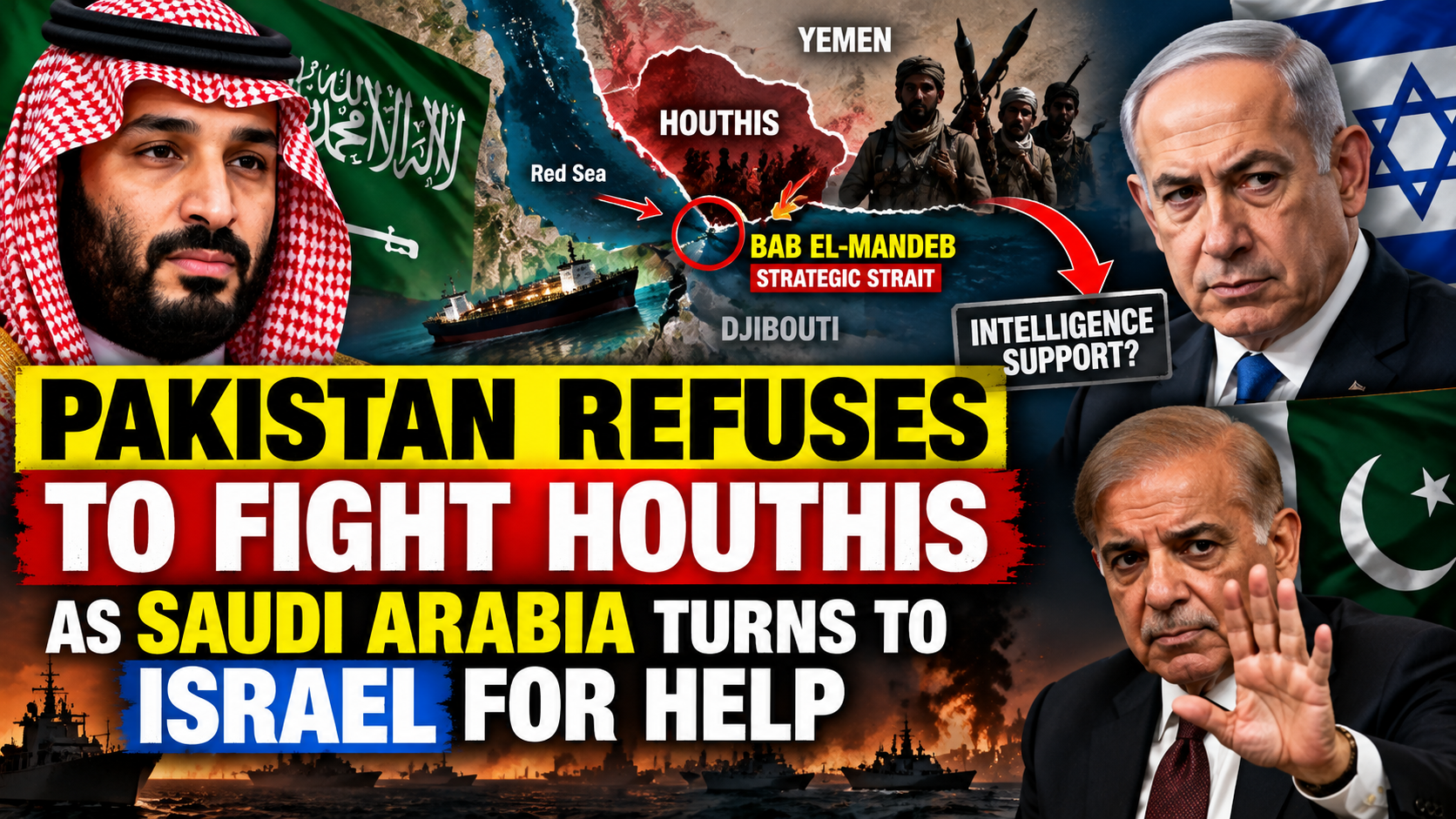
Riyadh seeks additional support against advancing Houthis near Bab el-Mandeb; reported back-channel highlights shifting regional security dynamics
Riyadh, September 15: Saudi Arabia has reportedly sought Israeli intelligence assistance through the US Central Command (CENTCOM) as the kingdom confronts an escalating threat from Yemen’s Houthi movement around the strategically vital Bab el-Mandeb Strait, according to recent reports.
The reported outreach comes as Riyadh faces growing pressure from Houthi advances along Yemen’s Red Sea coast and repeated attacks against Saudi territory and infrastructure. At the same time, Pakistan appears reluctant to undertake direct combat operations inside Yemen, despite its expanding defence relationship with Saudi Arabia.
If confirmed, the reported Saudi-Israeli intelligence channel would represent a striking development in the Middle East, given that Saudi Arabia and Israel do not have formal diplomatic relations.
Saudi Arabia Seeks Help Against Houthi Threat
According to a report by Israel Hayom, Saudi Crown Prince Mohammed bin Salman approached Israel indirectly through US Central Command, seeking intelligence assistance to counter the Houthi threat around the Bab el-Mandeb.
The reported request comes amid a rapidly deteriorating security situation along Yemen’s western coastline.
The Houthis have expanded their control towards strategically important areas around the Red Sea and the Bab el-Mandeb, creating a direct concern for Saudi Arabia’s maritime trade and alternative oil-export routes.
Reuters reported on September 15 that Houthi forces had launched another series of missile and drone attacks against Saudi Arabia, including an attack targeting a military base in Khamis Mushait, in which 13 civilians were reportedly wounded.
The escalation has also increased pressure on Saudi energy infrastructure and shipping.
Why Bab el-Mandeb Matters
The Bab el-Mandeb Strait is one of the world’s most strategically important maritime chokepoints, connecting the Red Sea with the Gulf of Aden and the wider Indian Ocean.
For Saudi Arabia, the waterway has particular significance because it provides access to the kingdom’s Red Sea ports and oil-export infrastructure.
The growing Houthi presence along Yemen’s Red Sea coast therefore presents Riyadh with a potentially serious strategic problem.
Recent reports say Houthi forces have captured or consolidated positions around Mokha, Dhubab and Perim Island, strengthening their ability to threaten maritime traffic approaching the strait. The Wall Street Journal reported that the capture of Perim and Dhubab gave the Houthis effective control over the strategic chokepoint.
The situation is particularly sensitive because Saudi Arabia has been relying on alternative routes to mitigate disruptions elsewhere in the region.
US Support — But No Direct Strike Commitment
Saudi Arabia has also reportedly sought direct US military assistance.
Reuters reported that Mohammed bin Salman asked the US administration for military support against the Houthis. Washington reportedly declined to authorize direct US strikes but agreed to provide intelligence and targeting support.
A separate report said US military personnel were providing intelligence assistance to Saudi forces.
This creates an unusual situation for Riyadh: the kingdom is receiving intelligence and advisory assistance from Washington while reportedly seeking additional intelligence capabilities from Israel through the US military command structure.
Pakistan’s Difficult Position
Pakistan’s position is particularly important because of its close and recently expanded defence relationship with Saudi Arabia.
The two countries are parties to a mutual defence agreement, which was subsequently expanded into the wider Mecca Joint Defence Agreement involving Turkey.
However, Pakistan’s possible role in the Yemen conflict remains constrained.
An analysis published by Al Jazeera said that while Pakistan’s Defence Minister Khawaja Asif had stated that aggression against Saudi Arabia or spillover from Yemen could activate the defence agreement, direct Pakistani military operations inside Yemen remained unlikely. The analysis pointed to Pakistan’s concerns over domestic security, its western border and the consequences of becoming directly involved in another regional war.
Therefore, describing Islamabad as having formally “refused” to fight the Houthis would go beyond what is publicly established. The clearer picture is that Pakistan has expressed strong support for Saudi Arabia while appearing reluctant to commit combat forces to offensive operations inside Yemen.
Islamabad Publicly Supports Riyadh
Pakistan has nevertheless strongly condemned Houthi attacks against Saudi Arabia.
On September 8, Pakistan’s Foreign Ministry condemned attacks on Abha, Khamis Mushait, Jazan and Najran, calling them violations of Saudi sovereignty and territorial integrity. Islamabad reiterated its support for Saudi Arabia’s right to defend its territory and national assets.
Pakistan had also previously condemned Houthi threats against Saudi Arabia and commercial shipping in the Red Sea, stressing the importance of freedom of navigation and international maritime security.
This distinction is crucial: political and defence support for Riyadh does not necessarily mean Pakistani forces will conduct offensive operations against the Houthis inside Yemen.
Why Israel Becomes Relevant
Israel has extensive intelligence capabilities focused on Iran and Iranian-aligned armed groups across the Middle East.
The Houthis are closely aligned with Iran and have developed increasingly sophisticated missile, drone and maritime capabilities.
This makes Israeli intelligence potentially valuable to Saudi Arabia for areas such as:
- Tracking Houthi missile and drone deployments
- Monitoring movements along the Red Sea coast
- Identifying launch sites and military infrastructure
- Assessing maritime threats
- Tracking Iranian logistical support
- Improving early-warning capabilities
The reported Saudi outreach is therefore driven less by diplomatic rapprochement and more by a common security threat.
A Remarkable Back-Channel
The reported channel is particularly notable because Riyadh and Jerusalem have no formal diplomatic relationship.
Saudi Arabia had been engaged in discussions concerning possible normalization with Israel before the regional conflicts disrupted that trajectory.
The current situation, if the reports are accurate, demonstrates how rapidly strategic calculations can change when a common threat emerges.
However, the reported intelligence cooperation should not be interpreted as formal Saudi-Israeli diplomatic normalization.
An intelligence exchange conducted indirectly through CENTCOM would represent a very different development from establishing official diplomatic relations.
The Houthi Threat Is Becoming a Saudi Security Problem
The conflict is also changing geographically.
The Houthis are no longer merely a Yemeni internal-security challenge. Their control of sections of the Red Sea coast and attacks against Saudi territory have transformed the situation into a wider regional security problem.
The Indian Ocean, Red Sea and Gulf of Aden are interconnected maritime spaces. Any sustained disruption around Bab el-Mandeb could affect global shipping, energy supplies and insurance costs.
Recent reporting has already linked the Houthi advance with increased pressure on Saudi oil exports and wider disruptions to regional energy infrastructure.
A New Regional Security Equation
The emerging picture is therefore complex.
Saudi Arabia is seeking additional intelligence and military support. The United States is providing intelligence and targeting assistance while avoiding deeper direct involvement. Pakistan strongly supports Riyadh but appears reluctant to enter a direct ground war in Yemen. And Israel may now be contributing intelligence through an indirect channel.
If confirmed, this would represent an unusual convergence of interests among countries that do not share formal diplomatic relationships or identical strategic objectives.
The immediate driver is the Houthi threat to Saudi territory, maritime traffic and the Bab el-Mandeb chokepoint.
Key Takeaways
- Saudi Arabia has reportedly sought Israeli intelligence assistance through CENTCOM against the Houthi threat.
- Riyadh is facing increasing Houthi attacks and territorial advances along Yemen’s Red Sea coast.
- The Houthis have reportedly strengthened their position around Bab el-Mandeb.
- Washington has reportedly provided intelligence and targeting support, while declining direct US strikes requested by Riyadh.
- Pakistan has strongly condemned attacks on Saudi Arabia and reaffirmed support for the kingdom.
- Direct Pakistani combat operations inside Yemen appear unlikely for now, according to regional analysis—notwithstanding Pakistan’s defence commitments to Saudi Arabia.
- Saudi-Israeli intelligence cooperation, if confirmed, would be significant because the two countries lack formal diplomatic relations.
**The reported Saudi outreach to Israel illustrates how the rapidly expanding Houthi threat is reshaping traditional regional alliances. For Riyadh, securing the Red Sea and Bab el-Mandeb is becoming an increasingly urgent strategic priority—and the kingdom appears willing to explore even unconventional channels to obtain the intelligence it needs.**