Multinational exercise begins in Jodhpur with eight foreign air forces flying alongside the Indian Air Force; 32 more nations attend as observers
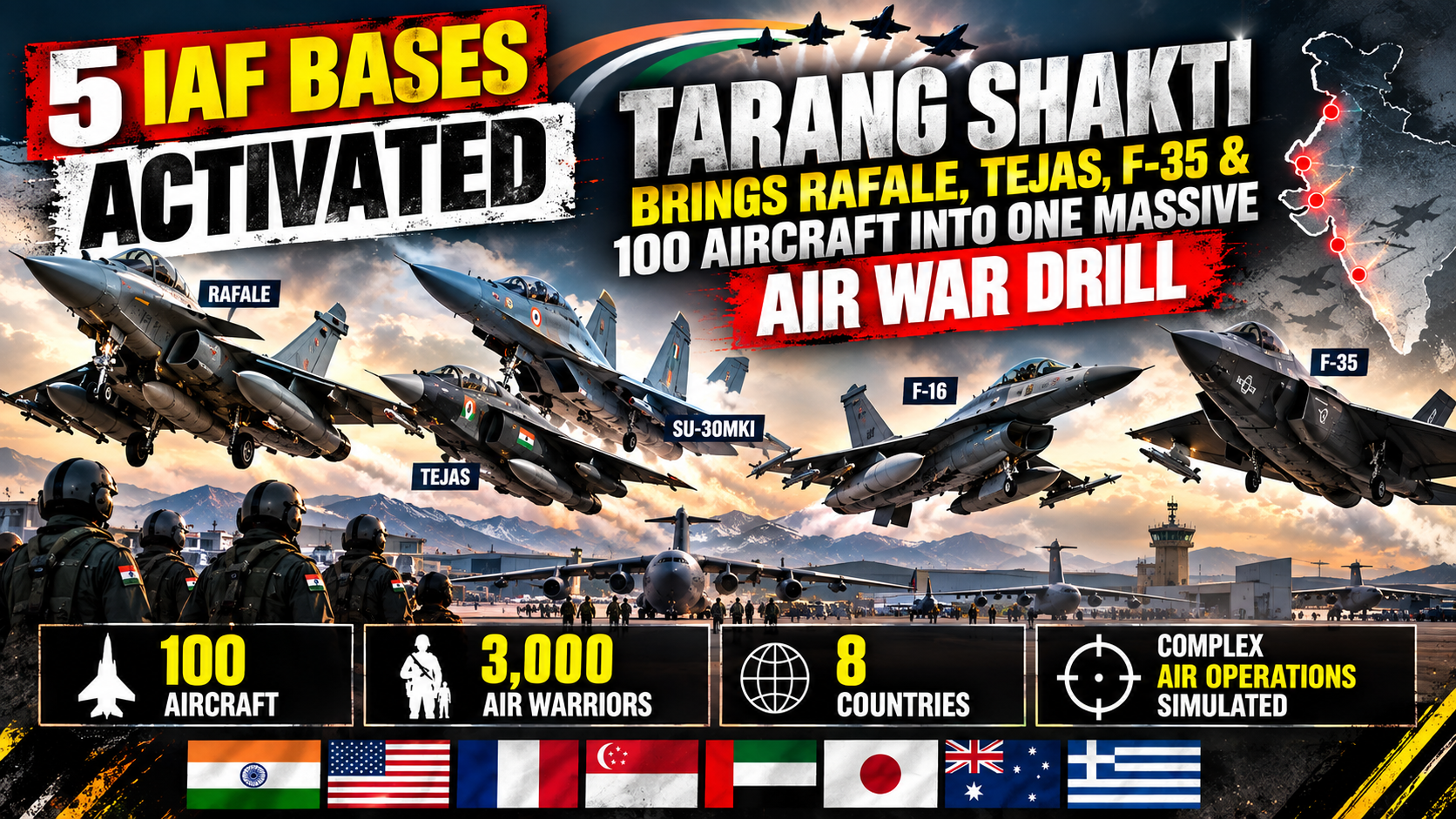
JODHPUR, September 26: The Indian Air Force has activated five air bases along India’s western frontier as the second edition of the multinational Exercise Tarang Shakti 2026 gets underway, bringing together nearly 100 aircraft and around 3,000 air warriors in one of the country’s largest multinational air exercises.
The exercise, centred on Air Force Station Jodhpur and adjoining bases, is designed to replicate a realistic contemporary air-war environment in which participating forces operate from separate locations and undertake complex missions. The exercise runs from September 26 to October 12, 2026.
The drill has attracted aircraft and personnel from multiple partner air forces, including some of the world’s most advanced combat platforms. The US is participating with the F-35A fifth-generation stealth fighter, France with Rafale fighters, the UAE with F-16s, while the IAF is fielding platforms including the Rafale, Su-30MKI, Tejas, Mirage 2000, Jaguar and MiG-29.
Five IAF Bases Activated for Realistic Combat Scenario
Unlike a conventional exercise centred on a single airfield, Tarang Shakti 2026 will use five IAF bases along the western frontier to create a more realistic operational environment.
According to The Tribune, the participating forces will be divided into separate groups operating from different bases, with the arrangement designed to replicate the dynamics of a real conflict. This allows air forces to practise planning, launching and coordinating missions across multiple locations rather than simply conducting flying displays from one airfield.
The exercise comes shortly after Exercise Veer Guardian 2026, the India-Japan air exercise that concluded at Jodhpur on September 22. During that drill, Indian Rafales, Su-30MKIs and Tejas fighters operated with Japanese F-2A aircraft.
F-35 to Fly Combat Missions With IAF Aircraft
One of the major highlights of Tarang Shakti 2026 is the participation of the American F-35A Lightning II.
The IAF Vice Chief, Air Marshal Ashutosh Dixit, has confirmed that this will be the first time F-35 aircraft undertake tactical missions with Indian fighters from Indian soil. The aircraft had previously appeared in India during Aero India, but Tarang Shakti marks a different level of operational interaction.
The exercise will therefore bring together aircraft representing different generations and operational philosophies — including the F-35, Rafale, Su-30MKI, Tejas and F-16.
For the IAF, the value lies not simply in having these aircraft present but in testing how different air forces can plan and execute missions together in a common battlespace.
Eight Countries Bringing Air Assets
The IAF has said that eight friendly foreign countries are participating with air assets, while 32 additional nations are attending as observers.
The participating foreign countries include Australia, Bangladesh, France, Germany, Greece, Sri Lanka, the United Arab Emirates and the United States.
The foreign contingents are expected to bring a mix of fighter, transport, surveillance and support capabilities.
Among the most prominent aircraft are:
- US: F-35A stealth fighters and support aircraft
- France: Rafale fighters and other support platforms
- UAE: F-16 fighters
- Germany: A400M transport aircraft
- Australia: C-130 transport aircraft
- Bangladesh: C-130J transport aircraft
- Sri Lanka: King Air 350
- India: Rafale, Su-30MKI, Tejas, Mirage 2000, Jaguar and MiG-29, among other assets.
The wider participation means that Tarang Shakti is not limited to the aircraft actually flying missions. Observer countries will also get exposure to the planning and operational aspects of a major multinational air exercise.
From Air Defence to Air-to-Air Refuelling
Tarang Shakti is designed around a broad spectrum of air operations rather than a single combat scenario.
According to the IAF, the exercise will cover missions including:
- Counter-air operations
- Air defence
- Combat operations
- Reconnaissance
- Strategic and tactical airlift
- Air-to-air refuelling
- Complex composite missions
- Multi-aircraft coordinated operations
These scenarios are intended to test how different air forces communicate, share information and coordinate their aircraft during demanding missions.
The inclusion of aerial refuelling and transport aircraft is particularly important because modern air operations depend on much more than fighter aircraft alone. Tankers, transport platforms, surveillance assets, command-and-control systems and fighters have to operate as part of a connected network.
Lessons From Operation Sindoor to Shape Training
The exercise also comes against the backdrop of operational lessons drawn by India from Operation Sindoor, the 2025 military operation against Pakistan.
Air Marshal Ashutosh Dixit has said lessons from the operation will be incorporated into Tarang Shakti’s scenarios. The objective is to bring together India’s operational experience with the experiences and tactics of partner air forces.
The IAF has highlighted areas such as precision weapons, integrated air defence, information dominance, space-enabled capabilities, electronic warfare and unmanned systems as increasingly important elements of future air warfare.
This makes Tarang Shakti more than an aircraft-to-aircraft exercise. It provides an opportunity to examine how air power is employed within a wider multi-domain battlespace.
Why Multinational Interoperability Matters
One of the central objectives of Tarang Shakti is interoperability — the ability of different air forces using different aircraft, communications systems, procedures and operating methods to work together effectively.
The IAF has described the exercise as an opportunity to learn from one another, operate together and prepare for the air-warfare challenges of the future.
Mission planning conferences, operational briefings and post-mission debriefs allow participating forces to compare tactics and identify differences in procedures.
The first edition of Tarang Shakti, held in 2024, brought multiple foreign air forces together in a format that the IAF described as an expansion beyond its traditionally bilateral exercise model. The 2026 edition further expands that multinational approach.
Jodhpur Becomes a Major Multinational Airpower Hub
The choice of Jodhpur and adjoining air bases provides a large operating environment for the exercise while placing the drill close to India’s western frontier.
Jodhpur has already hosted the India-Japan Veer Guardian 2026 exercise, which involved advanced air combat missions between Indian and Japanese aircraft. With Tarang Shakti now following immediately, the region has become a major hub for multinational air operations.
The exercise also gives participating foreign air forces an opportunity to operate in India’s geographical and climatic conditions while allowing Indian personnel to work with different foreign aircraft, procedures and mission-planning philosophies.
Key Takeaways
- Tarang Shakti 2026 began on September 26 at Jodhpur.
- The exercise will continue until October 12.
- Five IAF bases are being activated for the realistic multi-base scenario.
- Nearly 100 aircraft and around 3,000 air warriors are involved.
- Eight foreign countries are participating with air assets.
- Another 32 nations are attending as observers.
- The US F-35A is participating in tactical missions from Indian soil for the first time.
- French Rafales, UAE F-16s, Indian Rafales, Tejas and Su-30MKIs are among the prominent combat aircraft involved.
- Missions cover air defence, counter-air, reconnaissance, airlift, aerial refuelling and complex composite operations.
- The exercise incorporates operational lessons and focuses on improving multinational interoperability.
Conclusion
Tarang Shakti 2026 represents a major expansion of India’s multinational air-exercise framework. With five IAF bases being used to create a realistic combat environment, nearly 100 aircraft operating across different mission sets, and the F-35 flying tactical missions alongside Indian fighters for the first time from Indian soil, the exercise provides a significant training opportunity for all participating air forces.
More importantly, the exercise is focused on the practical challenges of planning, coordinating and executing complex air operations involving multiple nations, with interoperability and adaptation to evolving air-warfare technologies at its core.