
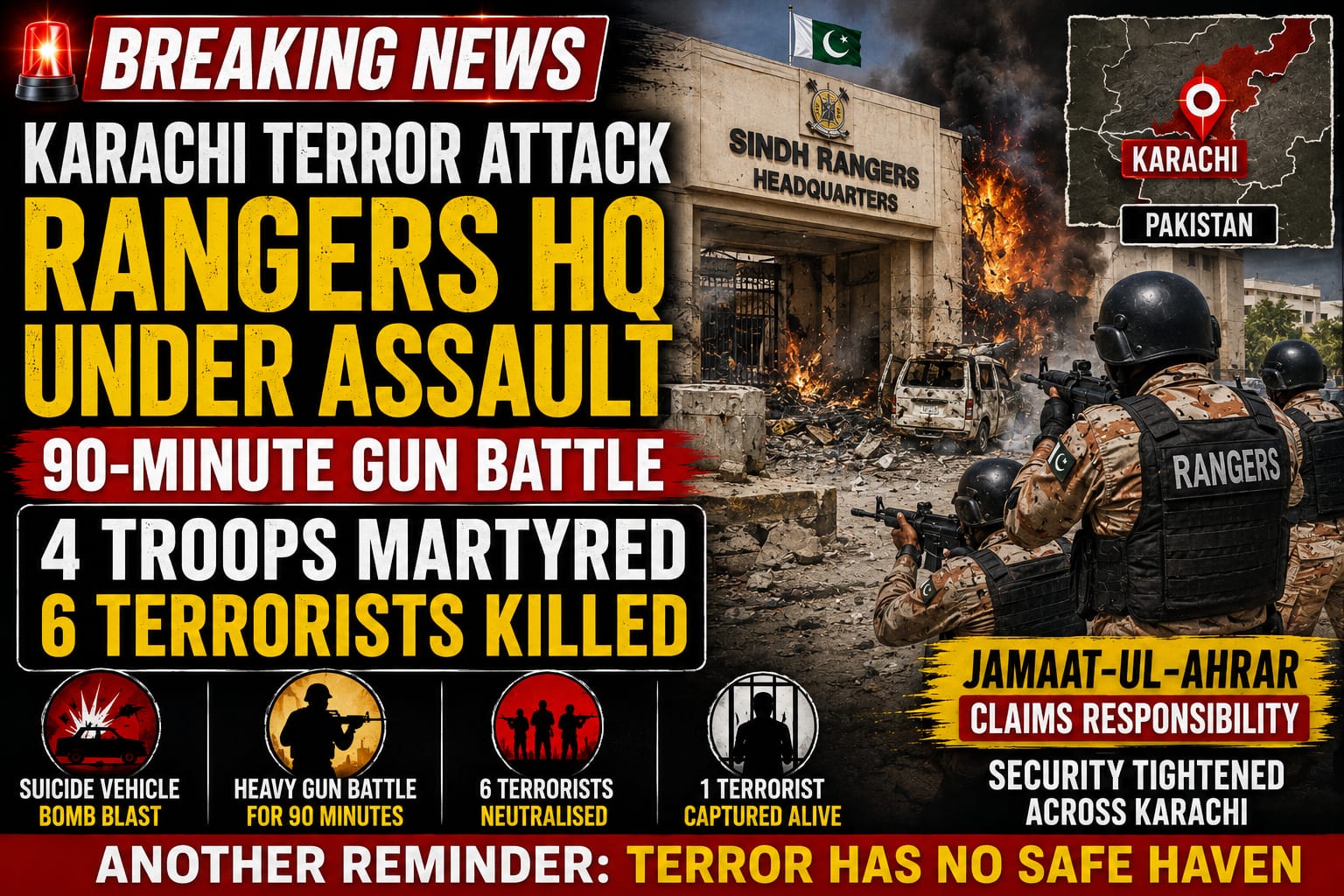
Karachi, June 28: In one of the deadliest terrorist attacks in Karachi in recent years, heavily armed militants stormed the Sindh Rangers Headquarters in the city’s Gulistan-e-Jauhar area, triggering an intense 90-minute gun battle that left four Rangers personnel dead and six terrorists killed. One militant was captured alive during the operation, providing investigators with a potential lead into the planning and execution of the assault. The attack once again highlights Pakistan’s continuing struggle against terrorism despite years of counter-insurgency operations and renewed military offensives against militant groups.
Suicide Assault Followed by Coordinated Attack
According to Pakistani media reports, the attackers launched a well-planned assault by first ramming an explosives-laden vehicle into the main entrance of the Rangers’ Bhittai Wing headquarters. The powerful blast breached the security perimeter, allowing several heavily armed militants carrying assault rifles, grenades and suicide vests to enter the compound.
Security personnel responded immediately, engaging the attackers in a fierce firefight. The exchange of gunfire continued for nearly an hour and a half before reinforcements from the Special Security Unit (SSU), Anti-Terrorist Force (ATF) and local police arrived at the scene. After a prolonged operation, security forces neutralised six militants while one injured attacker was arrested alive for interrogation.
Heavy Casualties Among Security Forces
The attack claimed the lives of four Sindh Rangers personnel, while several others sustained injuries during the operation. Ambulances and emergency response teams rushed to the scene as security forces sealed off the surrounding area, evacuated civilians and carried out a comprehensive clearance operation to ensure no additional militants were hiding inside the complex.
Authorities later declared the headquarters secure after completing room-to-room searches and bomb disposal checks.
Jamaat-ul-Ahrar Claims Responsibility
According to reports, the attack was claimed by Jamaat-ul-Ahrar, a militant faction affiliated with the banned Tehreek-e-Taliban Pakistan (TTP). The group has previously carried out several high-profile attacks targeting Pakistan’s military, police and government installations.
Security officials believe the assault was intended to inflict maximum casualties while sending a message that militant organisations retain the capability to strike even heavily guarded security establishments in Pakistan’s largest city.
Karachi’s Security Under Fresh Spotlight
Karachi, Pakistan’s financial hub, has witnessed a significant improvement in law and order over the past decade following extensive counter-terrorism operations. However, the latest attack has renewed concerns over the ability of extremist groups to infiltrate major urban centres despite heightened security measures.
Witnesses described hearing multiple explosions followed by sustained automatic gunfire, while roads leading to the Rangers headquarters were immediately cordoned off. Security helicopters monitored the area as emergency services transported the wounded to nearby hospitals.
Pakistan Faces Renewed Wave of Militancy
The attack comes amid a broader resurgence of militant violence across Pakistan, particularly in Khyber Pakhtunkhwa and Balochistan, where security forces have increasingly come under attack from terrorist organisations.
Since the collapse of the previous Afghan government in 2021, Pakistan has reported a sharp rise in attacks attributed to the Tehreek-e-Taliban Pakistan (TTP) and allied militant groups. Islamabad has repeatedly accused militants of operating from safe havens across the Afghan border—an allegation denied by the Taliban administration in Kabul.
In response, Pakistan has intensified intelligence-based operations, strengthened border security and expanded counter-terrorism measures nationwide. However, defence analysts warn that attacks on high-value military and paramilitary installations indicate that militant groups continue to possess the capability to execute complex, coordinated operations despite sustained security crackdowns.
Investigation Underway
Security agencies have launched a detailed investigation to determine how the attackers planned and executed the assault, identify their support network and trace possible facilitators. Forensic teams have collected evidence from the site, while intelligence agencies are analysing information obtained from the captured militant.
The Karachi attack is expected to trigger a review of security protocols at military and paramilitary installations across Pakistan, as authorities seek to prevent similar attacks on critical defence infrastructure in the future.