
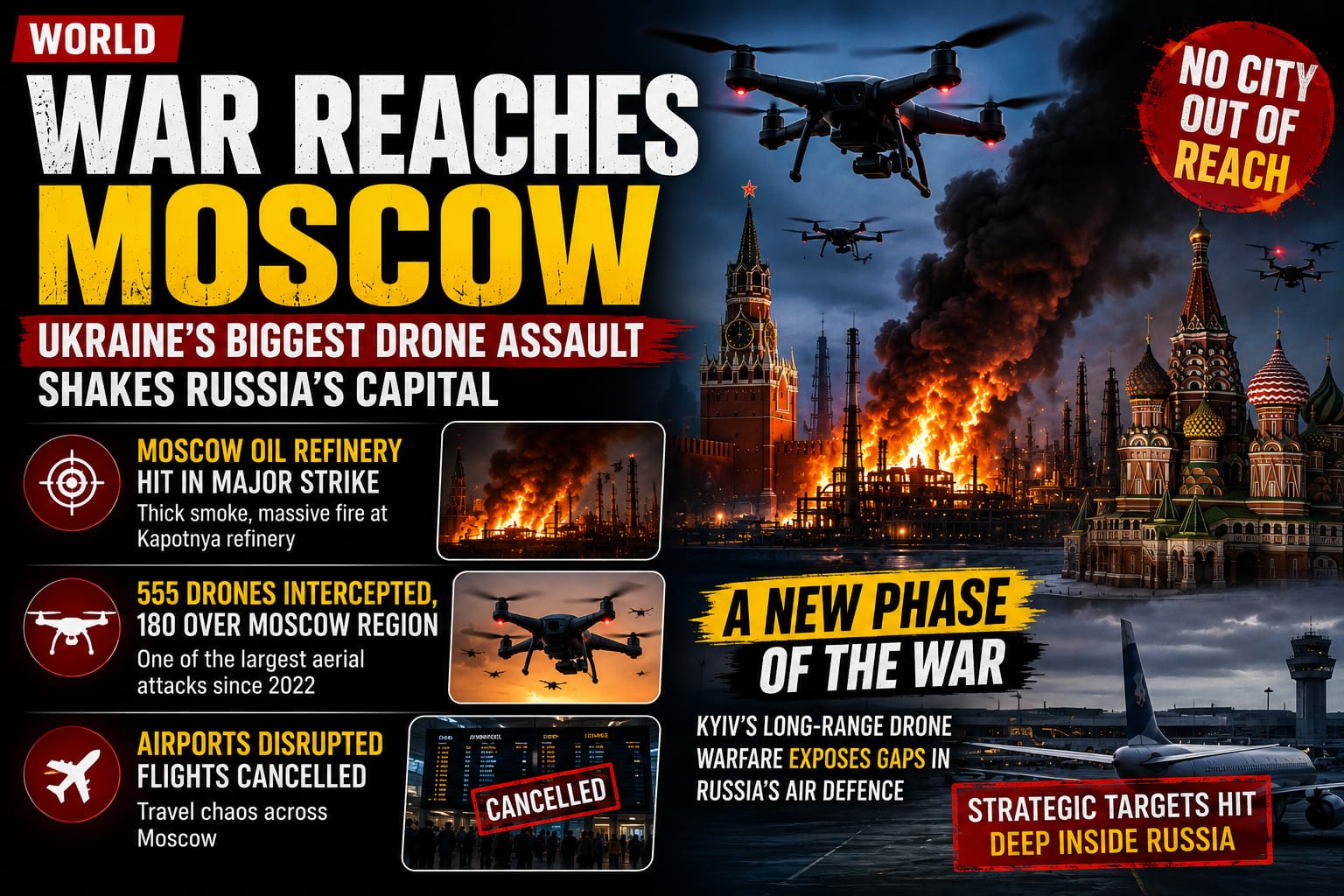
Hundreds of drones target Russian territory as Kyiv demonstrates growing long-range strike capability
Moscow/Kyiv, June 18: In one of the most audacious attacks since the beginning of the Russia-Ukraine war, Ukraine launched a massive overnight drone assault deep inside Russian territory, targeting strategic infrastructure in and around Moscow and exposing vulnerabilities in Russia’s air defence network.
Russian authorities claimed their air defence systems intercepted hundreds of Ukrainian drones, including around 180 over the Moscow region. However, several drones reportedly breached the defences and struck key targets, including the Moscow Oil Refinery in the Kapotnya district—one of the capital’s most important fuel processing facilities.
Moscow Oil Refinery Targeted
Videos circulating on social media showed thick plumes of black smoke rising over the refinery as emergency teams rushed to contain the blaze. The attack also disrupted operations at several Moscow airports, forcing temporary closures and flight delays.
The Moscow Oil Refinery is a critical energy asset that supplies a significant portion of the fuel consumed in the Russian capital. The facility had reportedly been targeted earlier this week as well, raising fresh concerns about the security of Russia’s energy infrastructure.
Russia Claims to Have Shot Down 555 Drones
According to Russian officials, a total of 555 Ukrainian drones were intercepted across various regions overnight, making it one of the largest aerial attacks on Russian territory since the war began in 2022.
Despite these claims, the successful strikes on strategic targets have renewed questions over the effectiveness of Russia’s layered air defence systems and their ability to counter large-scale drone swarms.
Ukraine’s Expanding Drone Warfare Strategy
Ukrainian President Volodymyr Zelenskyy described the operation as a response to recent Russian missile strikes on Ukrainian cities and cultural landmarks.
Over the past two years, Kyiv has increasingly relied on long-range drones to target military installations, airbases, ammunition depots and energy infrastructure deep inside Russia. The strategy is aimed at disrupting logistics, stretching Russian air defences and increasing the economic cost of the war.
Military analysts believe the latest attack marks a significant evolution in drone warfare. Unlike the early phases of the conflict, Ukraine is now capable of launching coordinated long-range strikes that can overwhelm sophisticated air defence networks and hit targets hundreds of kilometres away from the battlefield.
Diplomacy Takes a Back Seat
The attack comes at a crucial diplomatic moment as world leaders continue to discuss possible pathways to end the conflict during international forums, including the G7 summit.
However, the latest escalation highlights the deep divide between Moscow and Kyiv. Even as calls for peace grow louder, both sides continue to intensify military operations, signalling that a resolution to the war remains elusive.
A New Phase of the War
More than four years after the conflict began, the war is no longer confined to the frontlines.
With Ukrainian drones reaching the heart of Russia’s capital and strategic installations coming under repeated attack, the conflict appears to have entered a new phase—one in which geography offers diminishing protection and no city seems entirely out of reach.