
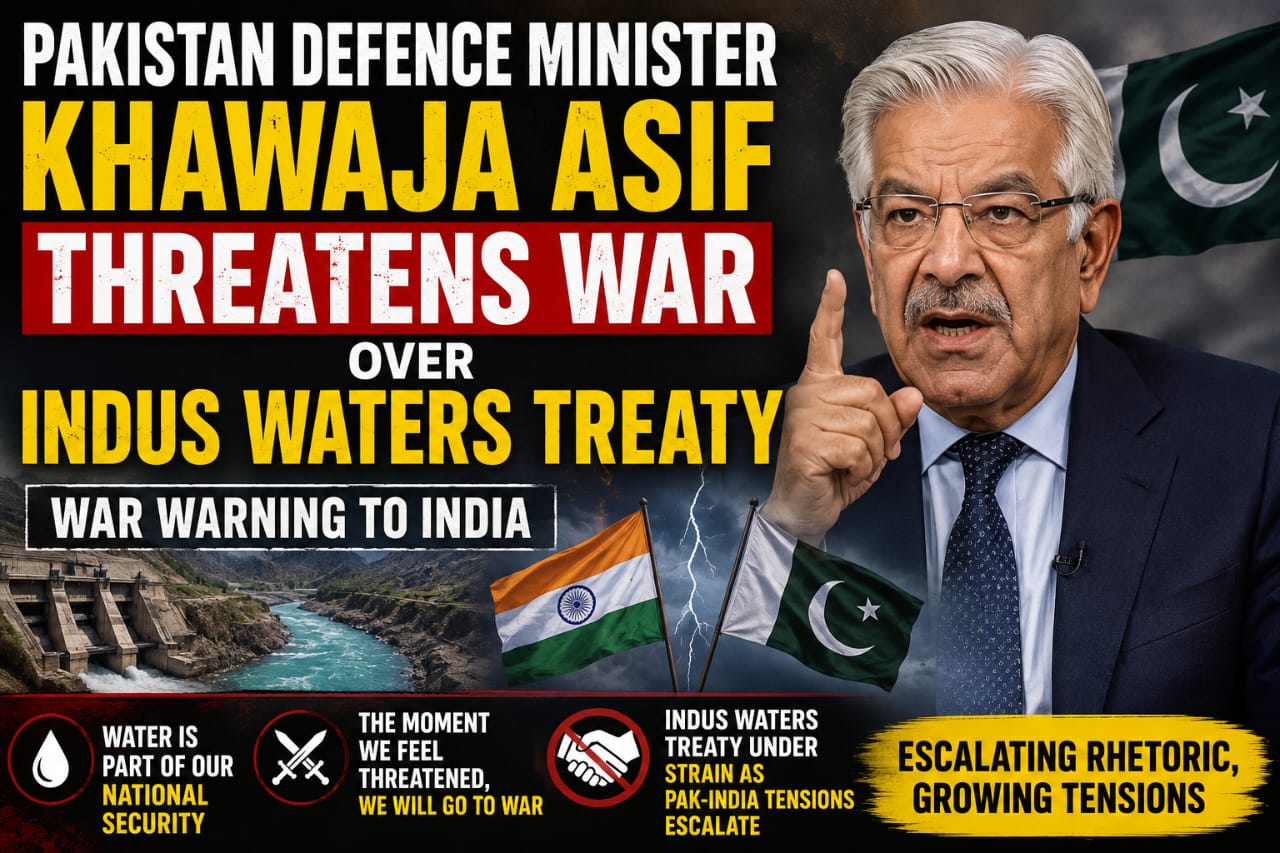
Islamabad/New Delhi, June 22: Pakistan Defence Minister Khawaja Asif has issued a fresh warning to India, saying Islamabad could resort to military action if it perceives any threat to its water security under the Indus Waters Treaty (IWT), significantly escalating tensions between the two nuclear-armed neighbours.
Water Security Linked to National Security
Speaking during an interview with Pakistan’s ARY News, Asif described water as an integral component of Pakistan’s national security and warned that the country would not hesitate to go to war if it believed India’s actions endangered its access to waters from the Indus river system.
“The moment we feel that our national security — and water is part of our national security — is being threatened, we will go to war against India. Definitely,” Asif said, according to media reports.
He further alleged that India was attempting to use water as a strategic tool and accused New Delhi of taking steps that could adversely affect Pakistan’s share of river waters governed under the treaty.
Tensions Over Indus Waters Treaty Continue
The latest remarks come amid an ongoing dispute over the Indus Waters Treaty, a water-sharing agreement signed in 1960 between India and Pakistan with the mediation of the World Bank. Under the treaty, Pakistan was given control over the western rivers — Indus, Jhelum and Chenab — while India retained rights over the eastern rivers — Ravi, Beas and Sutlej.
Relations between the two countries have remained strained since India decided to place the treaty in abeyance in April 2025 following the terror attack in Pahalgam, citing national security concerns. The move triggered sharp reactions from Pakistan, which has repeatedly expressed concerns over its water security and accused India of “weaponising water”.
Not the First Warning From Khawaja Asif
This is not the first time Khawaja Asif has issued strong statements regarding India. In recent months, the Pakistani Defence Minister has repeatedly warned of an “all-out war” if tensions continue to escalate. He had earlier threatened to target any structure built by India on the Indus river system, describing such actions as a form of aggression.
Asif has also been at the centre of several controversial statements in the past, including remarks on the suspension of the Simla Agreement and claims linking Pakistan to cyberattacks on Indian infrastructure, many of which have drawn criticism and scrutiny.
Strategic Importance of the Treaty
The Indus Waters Treaty is considered one of the most enduring agreements between India and Pakistan, having survived multiple wars and periods of intense hostility. However, recent developments have placed the treaty under increasing strain, with both countries adopting hardened positions on issues related to water sharing and regional security. Analysts believe that while the rhetoric has intensified, any long-term resolution will require diplomatic engagement and sustained dialogue between the two sides.