
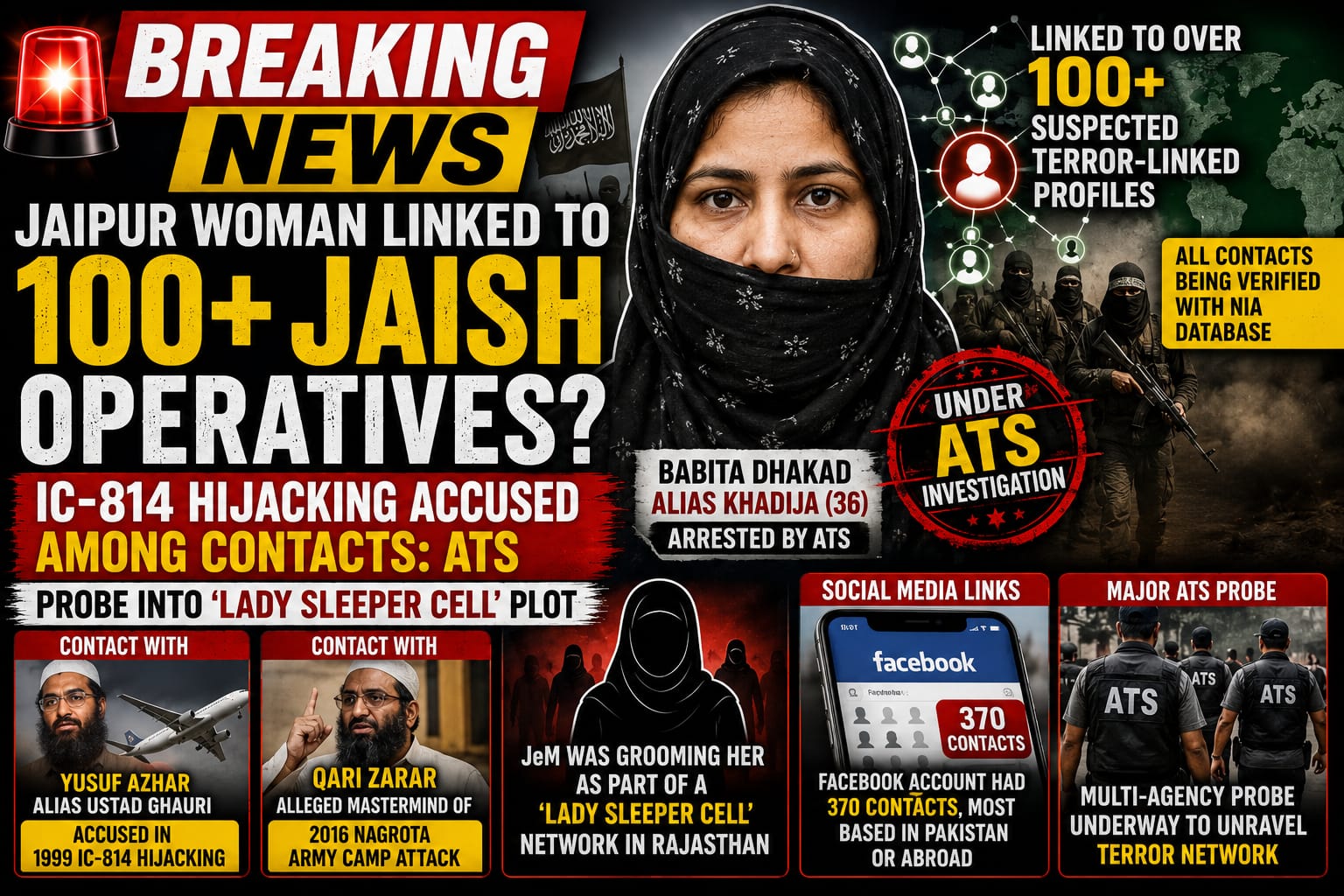
Jaipur, June 29: The arrest of a 36-year-old Jaipur woman, identified as Babita Dhakad alias Khadija, has led to a major counter-terrorism investigation by the Rajasthan Anti-Terrorism Squad (ATS). Investigators allege that the accused was in contact with numerous Pakistan-based operatives linked to the banned terrorist organisation Jaish-e-Mohammed (JeM) and was allegedly being groomed as part of a proposed “lady sleeper cell” network in Rajasthan. The investigation remains ongoing, and the allegations are currently being examined by security agencies.
According to ATS officials, digital evidence recovered during the investigation has revealed extensive online interactions with multiple foreign-based accounts suspected of having links to terrorist organisations. Authorities are now conducting forensic analysis of seized electronic devices while coordinating with national security agencies to verify the identities of the individuals involved.
More Than 100 Suspected Terror-Linked Contacts Under Verification
Officials said preliminary analysis suggests that the accused was allegedly connected to more than 100 social media profiles suspected of having links with extremist organisations. The Rajasthan ATS has reportedly shared the details with the National Investigation Agency (NIA) and other central intelligence agencies for verification against existing terror databases.
Investigators are examining whether these online contacts were limited to communication or whether they involved operational planning, recruitment efforts or the dissemination of extremist propaganda.
Alleged Contact with IC-814 Hijacking Accused
Among the names being investigated are Yusuf Azhar alias Ustad Ghauri, an accused in the 1999 IC-814 Indian Airlines hijacking, and Qari Zarar, who Indian investigators have previously linked to the 2016 Nagrota Army camp attack.
According to the ATS, digital communication records allegedly indicate contact with accounts believed to be associated with these individuals. Officials are working to establish the authenticity of these communications, the duration of contact and whether they had any operational significance.
Probe into Alleged Radicalisation Network
Investigators allege that Jaish-e-Mohammed operatives may have been attempting to recruit and radicalise the accused as part of a broader effort to establish a female sleeper network in Rajasthan. Officials suspect that online platforms and encrypted communication applications may have been used to facilitate ideological indoctrination and maintain contact with foreign-based handlers.
Security agencies are now examining whether the alleged network extended beyond Rajasthan and whether additional individuals may have been targeted through similar methods.
Social Media Activity Under Investigation
The ATS has reportedly found that the accused’s Facebook account contained around 370 contacts, a large number of whom are alleged to be based in Pakistan or other foreign countries. Investigators are scrutinising these connections to determine whether they represent genuine social interactions or organised efforts by extremist networks to expand their digital reach.
Cyber forensic experts are analysing chat records, digital devices, financial transactions and online activity to reconstruct the communication pattern and identify any potential facilitators.
Multi-Agency Investigation Underway
The investigation is now being carried out in coordination with multiple intelligence and security agencies. Officials are examining electronic evidence, financial records, travel history and communication metadata to determine whether any national security threat existed or whether the alleged contacts progressed beyond the online domain.
Authorities have not indicated that any terrorist act was carried out in connection with the investigation, and the inquiry remains focused on establishing the nature and extent of the alleged links.
Growing Concern Over Online Radicalisation
Security experts say the case highlights the increasing use of social media, encrypted messaging platforms and online networks by terrorist organisations to identify, contact and radicalise vulnerable individuals across international borders.
Indian security agencies have repeatedly warned that extremist organisations are increasingly relying on digital platforms for recruitment, propaganda dissemination and communication, making cyber surveillance and digital intelligence critical components of counter-terrorism operations.
The Rajasthan ATS has stated that the investigation is continuing and that further action will depend on the evidence gathered during the course of the probe.