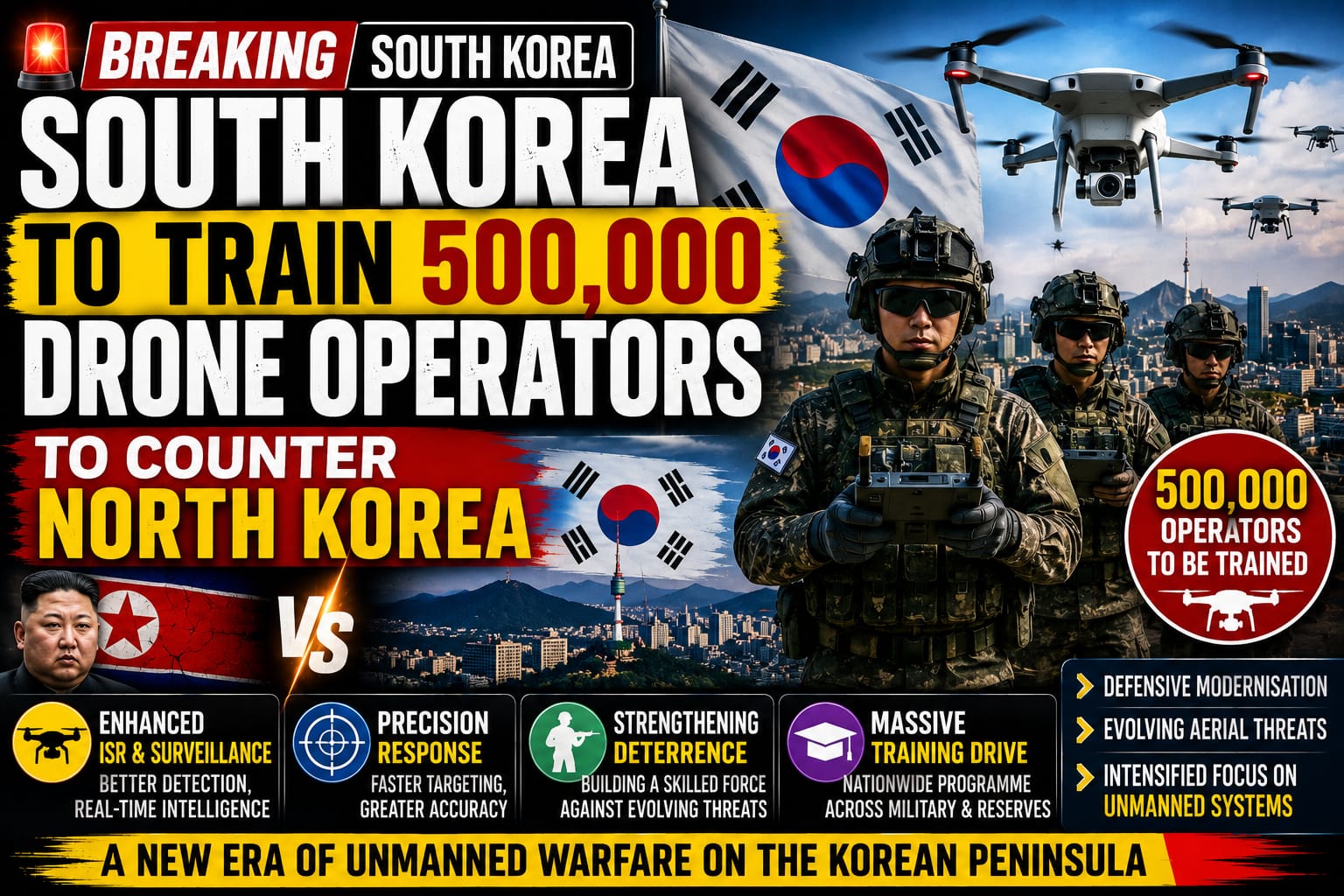
Seoul, June 27: In one of the most ambitious military modernisation initiatives in its history, South Korea has announced plans to train 500,000 drone operators as part of a nationwide effort to transform its unmanned warfare capabilities and strengthen deterrence against North Korea. The large-scale programme reflects Seoul’s growing recognition that future conflicts will increasingly be shaped by autonomous systems, artificial intelligence, and network-centric warfare rather than conventional military platforms alone. Officials said the initiative is aimed at creating a highly skilled reserve of drone operators capable of supporting intelligence, surveillance and reconnaissance (ISR), border security, precision targeting, electronic warfare, disaster response and homeland defence. The announcement comes amid rapidly evolving security dynamics on the Korean Peninsula, where North Korea has accelerated the development of drones, ballistic missiles, cruise missiles and other strategic weapons while expanding cooperation with countries such as Russia.
Shift Towards Drone-Centric Warfare
South Korean defence planners view unmanned systems as one of the defining technologies of modern warfare. Lessons drawn from recent conflicts—including the Russia-Ukraine war, the Israel-Hamas conflict and evolving military doctrines in the Indo-Pacific—have demonstrated how relatively inexpensive drones can perform missions that once required costly fighter aircraft or helicopters. From intelligence gathering and battlefield surveillance to precision strikes and logistics support, drones have fundamentally altered military planning across the world.
Military officials said the training programme will prepare personnel to operate a wide spectrum of unmanned aerial systems, ranging from small tactical quadcopters used for frontline reconnaissance to sophisticated long-endurance drones capable of conducting surveillance deep inside hostile territory. The programme is expected to integrate artificial intelligence, autonomous navigation, electronic warfare resilience and real-time data sharing into drone operations, significantly enhancing South Korea’s ability to detect, monitor and respond to emerging threats.
Response to Growing North Korean Drone Threat
The decision is largely driven by North Korea’s expanding drone capabilities. Over the past several years, Pyongyang has invested heavily in unmanned aerial vehicles for reconnaissance, surveillance and potential strike missions. Tensions escalated after multiple North Korean drones crossed into South Korean airspace in late 2022, exposing weaknesses in Seoul’s air defence network. The incident prompted widespread criticism after South Korean fighter aircraft and helicopters struggled to intercept the small drones, leading the government to accelerate investments in counter-drone technologies and unmanned warfare.
Since then, North Korea has unveiled several new reconnaissance and combat drone designs during military parades and defence exhibitions. The regime has also claimed advances in long-range surveillance drones and loitering munitions, while continuing to test increasingly sophisticated missile systems capable of delivering both conventional and nuclear payloads. South Korean military planners believe the proliferation of such systems requires a fundamental transformation in force structure and operational doctrine.
Building a New Generation of Drone Operators
Under the proposed programme, approximately 500,000 military personnel, reservists and selected civilian participants are expected to undergo specialised drone training over the coming years. The curriculum is likely to include drone piloting, mission planning, battlefield surveillance, target acquisition, electronic warfare awareness, cyber security, autonomous systems management and counter-drone operations.
Officials indicated that training will be conducted through military academies, reserve training centres and specialised institutions equipped with advanced simulators and live-flight facilities. The initiative is expected to produce a large pool of trained operators who can be mobilised rapidly during national emergencies, thereby strengthening South Korea’s overall defence readiness without significantly increasing active troop numbers.
Enhancing Intelligence and Precision Response
South Korea expects the expanded drone force to significantly improve its intelligence, surveillance and reconnaissance capabilities. Persistent aerial surveillance using unmanned systems would allow the military to monitor troop movements, missile launch sites, infiltration routes and strategic infrastructure across the Demilitarised Zone (DMZ) with greater accuracy and lower operational risk.
Military planners also anticipate enhanced precision-response capabilities through the integration of drones with artillery, missile units and command-and-control networks. Real-time battlefield information collected by unmanned platforms could enable faster targeting decisions, improve strike accuracy and reduce collateral damage during military operations.
The programme is also expected to strengthen maritime surveillance, border security and disaster response capabilities, allowing drones to assist in search-and-rescue operations, wildfire monitoring, flood assessments and humanitarian assistance during natural disasters.
Investment in Indigenous Defence Technology
The initiative aligns with South Korea’s broader efforts to become a global leader in defence technology and military innovation. Seoul has significantly increased investment in artificial intelligence, robotics, autonomous weapons, quantum technologies and next-generation command systems under its Defence Innovation 4.0 strategy.
South Korea already possesses one of the world’s most advanced defence industrial bases, producing indigenous fighter aircraft, tanks, submarines, warships, missile systems and armoured vehicles. Expanding drone capabilities is expected to further strengthen the country’s defence manufacturing sector while creating opportunities for domestic aerospace companies, artificial intelligence developers and start-ups specialising in autonomous technologies.
Budgetary and Ethical Considerations
While government officials have pledged sufficient financial support for the programme, lawmakers are continuing discussions regarding budget allocations, procurement priorities and regulatory oversight. Defence analysts estimate that implementing a nationwide drone training initiative of this scale will require significant investment in infrastructure, simulation systems, instructor development and maintenance facilities.
The programme has also sparked discussions regarding ethical considerations surrounding autonomous weapons, artificial intelligence in military decision-making and the legal framework governing drone operations. Experts have emphasised the importance of establishing clear operational doctrines, robust command-and-control mechanisms and strict rules of engagement to ensure responsible use of unmanned systems.
Regional Security Implications
Analysts believe South Korea’s announcement reflects a broader shift in military strategy across the Indo-Pacific, where countries including Japan, China, Taiwan, Australia and India are rapidly expanding investments in unmanned systems. As drones become increasingly central to military operations, competition in autonomous warfare is expected to intensify across the region.
Although Seoul has described the initiative as a purely defensive measure aimed at protecting national security, experts caution that the rapid expansion of drone capabilities on both sides of the Korean Peninsula could contribute to an accelerated regional arms race. They argue that confidence-building measures, military communication channels and clear operational doctrines will remain essential to reducing the risk of miscalculation.
Preparing for the Future Battlefield
The plan to train half a million drone operators signals South Korea’s determination to adapt its armed forces to the changing character of warfare. Rather than relying solely on traditional military platforms, Seoul is investing in technologies that combine artificial intelligence, autonomous systems and network-centric operations to build a more agile and technologically advanced force.
As unmanned systems continue to reshape military doctrine worldwide, South Korea’s latest initiative underscores its intent to remain at the forefront of defence innovation while maintaining credible deterrence against one of the world’s most heavily militarised adversaries. If successfully implemented, the programme could become one of the largest national drone training initiatives undertaken by any country, setting a new benchmark for military preparedness in the era of autonomous warfare.